AI phone receptionist for beauty salons
Quick summary
- Saturday morning both hands are in the foils; the person who would pick up is mixing or walking someone to the dryer.
- Ask cut, colour or nails first — those go to different people and take different times.
- How long colour takes depends on the hair, not the printed list — long virgin hair is not a root touch-up.
- A walk-in who gets voicemail hangs up and goes two doors down.
- It checks your calendar before it offers a time, writes the booking in, and texts the confirmation.
- Four hours is the cancel window most salons already say out loud — a cancelled Saturday colour can still go to the next caller.
TL;DR
Saturday morning the phone rings and nobody can pick up. The stylists have both hands in the foils. The caller wants a cut, a colour or nails — different people, different times — and how long colour takes depends on the hair, not the card in the window. They will not wait on voicemail; the salon two doors down is taking walk-ins. An assistant answers every line at once, asks what they want done, then how long the hair is, checks the real calendar, books the chair, texts the confirmation, and says your four-hour cancel window out loud. It will not quote a colour price before anyone has seen the hair, and it will not give skin advice.
Key takeaways
- Put the assistant on the existing salon number with a forward-on-no-answer rule, so whoever is free at the desk still takes the call.
- Give it three service families first: cut and blow-dry, colour work, nails — and who does which.
- Tell it that colour time depends on hair length, and that it must ask length before offering a colour time.
- Mark the Saturday walk-in window if you take walk-ins; do not let the assistant book those hours as colour.
- Use a four-hour cancel window, and offer the freed chair to the next caller.
- Tell it not to give skin, mole or rash advice — it books beauty work, it does not examine skin.
What an AI phone receptionist does in a salon
An AI phone receptionist answers the salon number, talks the way a person at the desk would, and then does something with what it heard. It books a chair, sends the confirmation, or writes down what the caller asked for and puts that note in front of whoever is free.
The first thing it has to get right is the work. A cut, a colour and a set of nails go to different people, take different times, and are done at different stations. An assistant that opens with “what time would you like?” will put a balayage on the nail desk and leave the colourist with an empty chair. It asks what they want done. For anything with dye, it then asks how long the hair is. After that it checks the calendar you already use, offers only a time that is free, books it, texts the confirmation, and says the cancel window you actually use.
A caller who rang in English gets the confirmation in English. A caller who rang in Greek gets it in Greek. The assistant works in 70+ languages. The SMS follows the language of the call.
Saturday, foils, and the phone nobody can reach
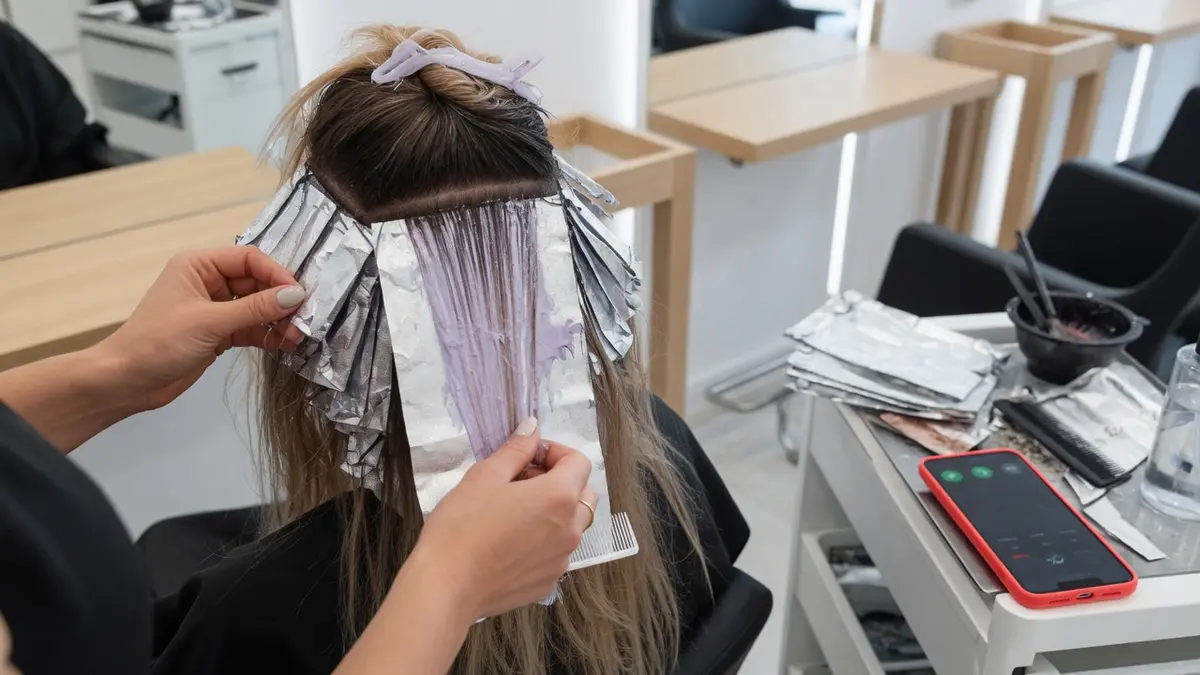
Saturday, late morning. The stylists have both hands in the foils. The colour on the next client is still on. One person is mixing. Another is walking someone to the dryer. The phone rings.
Nobody can pick up. Both hands are wet, or gloved, or holding a bowl, and the client in the chair cannot be left.
It is not forty calls spaced through the week. It is a burst between late morning and early afternoon, on the one day you cannot spare a pair of hands. A second person hired for Tuesday does not touch Saturday. A second line with the same two hands still leaves the third caller listening to a busy tone.
The caller who wanted a colour is often already on the street. They have your name and the salon two doors down in the same glance. They are not going to wait on voicemail. They hang up and push a door.
How long the work takes is not on the card in the window. A printed “full colour” is wrong the moment the hair is past the shoulders, or has never been dyed, or is still fighting last year’s box dye. A person at the desk asks length because they have booked the wrong stretch of afternoon before. An assistant that skips the question puts a two-and-a-half-hour piece of work into a gap that was meant for a blow-dry, and everyone after that runs late.
Walk-ins and booked colour share the same Saturday. If the assistant treats every Saturday hour as bookable colour, the walk-in window you have always protected disappears. If it treats every Saturday hour as walk-in, the colourists wait and callers are told to come down. You already know the difference. The assistant has to be told, in the setup, or Saturday will have a walk-in queue and a booked balayage at the same basin.
Cut, colour or nails — then the length of the hair
Cut and blow-dry. Shorter times, often more flexible, sometimes still taken as a walk-in. The assistant can offer these more freely once it knows who cuts and who only colours.
Colour work. Root touch-up, full colour, foils, balayage, toner, correction. These are not one family in the book even if they share a sink. A root touch-up on short hair and a colour correction on long hair are two different appointments. The assistant asks which of those the caller means, then asks length — above the shoulder, past the shoulder, mid-back — and only then looks at times that actually fit.
Nails. A different station, often a different person, sometimes a different cancel habit. A gel fill does not belong on the colourist’s Saturday. If you run nails in the same room, mark that desk as its own resource. If you do not offer nails, say so in the notes you give the assistant, so it stops taking those bookings and offers what you do.
Hair length is the question that has to be written down. One sentence is enough: “Is it above the shoulders, past the shoulders, or longer?” The answer decides how long to hold in the book. An assistant that skips it books two colours into a gap that fits one.
Who can take the work
Many small salons have no one sitting at a desk all day. You are cutting, or you are in foils, or you are at the basin. The person who would have picked up is the person whose hands are busy.
The assistant has to know who does what. Anna takes colour. Someone else takes cuts. If only one person does balayage, a Saturday balayage can only go on that person’s hours. If the junior does blow-dries and not foil work, the assistant must not offer the junior for highlights.
Write it down the way you would for a new Saturday hire: who is in, who does colour, who does nails, who is off. The assistant will honour a list it can see. If the list is empty, it will offer times that nobody can actually take.
A mixed booking needs the same care. Cut and colour on the same visit is not a cut with a colour squeezed after it. It is the longer of the two, in the right order, on a person who does both — or on two people whose hours actually meet. The assistant should not guess the order. You write the order once.
Walk-ins and the hours you keep off the book
Plenty of salons still take walk-ins. The ones that do it well protect a window — often Saturday late morning — and keep the rest of the colour book closed. The assistant has to know that window exists.
A caller who asks “are you taking walk-ins this morning?” is not asking for a booking. They are asking whether it is worth crossing the street. The honest answers are short: yes until a time you set; no, the book is closed, here is the next colour time; or yes for a cut, no for colour. An assistant that answers that question with Thursday at 16:00 has not heard it.
A caller who wants to book a Saturday colour into the walk-in hours has to be moved, so a queue of short work and a booked balayage do not arrive at the same basin. Mark those hours in the calendar the way you mark a stylist’s lunch. The assistant will honour a mark it can see.
Four hours’ notice
A client who rings at ten to cancel a two o’clock colour is still inside the window most salons already say out loud, and that chair can still be offered to the next person who calls — or to the person who called twenty minutes ago and was told Saturday was full.
Set the window you actually enforce. Four hours is the figure most of you already use. The assistant should say it at the end of a booking, and treat a cancel inside that window as a chair that is free again, not as a note for Monday. A cancel after the window is still a cancel. You would rather hear it than find an empty basin. It is not a refill you can count on.
Saturday clients decide in the morning whether they are coming. If the cancel rule is written for the next day, a cancelled two o’clock stays empty.
A price nobody can give from a description
When someone describes their hair on the phone — dark, they want it softer, there is old box dye — the tempting answer is a number. The assistant does not give one. Hair length, previous colour, and whether this is a correction all change the work. A number quoted before anyone has seen the hair is a number the desk then has to take back.
It can repeat a published menu item you gave it. A blow-dry can have a list price. A gel fill can have a list price. Unseen colour work cannot, not honestly. The assistant takes the request and books a consultation or a colour time, depending on what you allow. Leave the number to someone who can see the hair.
Do not put a colour tariff in the notes and hope the assistant will “use judgement”. It will read the number out. If a figure must not be said until someone has seen the hair, do not give the assistant that figure.
Patch tests, corrections, and questions about skin
A caller asks if they need a patch test. A caller wants to go from box dye to a soft brown. A caller asks about a mark on the scalp, a rash, a cream.
The assistant does not decide the chemistry and it does not examine skin. Beauty work is not a skin examination. It can book the facial or wax you actually offer. It cannot say what a mark is, what cream to use, or whether something needs a doctor. Those calls are a note or a polite redirect. They are never advice.
For a correction or old box dye, book a consultation if that is your rule. For a first colour, follow the patch-test rule you wrote down. Some of you book the test visit first. Some of you book the colour and remind the client to come in for the test at the time you use. The assistant follows your rule. It does not invent one.
A complaint about last week’s colour is the same kind of call: take the name, take what they said, put it in front of you. Do not offer a free redo from the phone. You look at the hair.
How CITT handles it
- Your number stays on the window. A forwarding rule at the provider sends what you do not answer. Calls the desk picks up never leave the salon.
- Every line is answered at once. A Saturday burst is a set of conversations, not a stack of busy tones.
- It knows the salon you described. Which services you offer, who does colour, whether Saturday morning is walk-in, where to park, how the four-hour cancel works.
- It asks what they want done, then hair length, then looks at the book. A time is offered only after those two facts exist.
- It checks the real calendar before it offers a time, and writes the booking into the same book the team already uses.
- It confirms by SMS, in the language of the call — 70+ languages — and can remind before the appointment.
- It escalates what cannot be finished on the call — a colour correction that needs eyes, a skin question, a complaint — as a tagged note, not as a guess.
- You get the transcript, the summary, and the service the caller named.
What it will not do
It will not look at the hair. A caller who wants to go from box dye to a soft brown gets a consultation or a callback, not a number.
It will not give skin advice. A mole, a rash, or a request for a cream is a note, not advice.
It will not invent how long the work takes. If the caller does not know whether they want foils or a toner, the assistant asks. If they still cannot say, it does not pick the short time to be helpful.
It will not treat walk-in hours and booked colour as the same book. Mark the difference, or the assistant will book colour into the walk-in hours.
It will not decide a patch test, a correction, or a redo. It takes the request. A human decides.
What these calls sound like
The order is the work, then the length, then the offer, then the cancel window said out loud. There is no colour price. There is no “I’m sure we can squeeze you in at twelve” over a walk-in window. There is no advice about hair the assistant cannot see.
If the assistant is friendly and still books the wrong length of time, Saturday runs late. Put the person who rang about a long-hair colour at 11:10 on the book, not on the street outside the salon two doors down.
What you set up first
Put the assistant on the number on the window with a forward-on-no-answer rule, so a free pair of hands at the desk still takes the call. Then the three service families and who does which, the length question, the walk-in hours, and the four-hour cancel you already say out loud.
Give the assistant the published prices it may repeat — the blow-dry, the gel fill, the listed cut — and do not give it a colour figure it would read out. Write one line that forbids skin, mole and rash advice. Add opening hours, who is in on Saturday, where to park, how to find the door.
Rates live on the pricing section of the home page. They are not repeated here.
AI receptionist, in-house staff, or a call centre
| CITT | In-house | Call centre | |
|---|---|---|---|
| Saturday morning burst | Every line answered at once | One call, if a stylist can put the bowl down | Depends who was rostered |
| Asks cut, colour or nails first | Yes — before it looks at the book | Yes | Often jumps to what time |
| Duration from hair length | Asks, then matches the right stretch of time | Yes — they can see the hair | Uses a flat menu time |
| Walk-in hours vs booked colour | Honours the window you set | Yes, if they remember | Treats every hour as a booking |
| Four-hour cancel, same-day refill | Releases the chair and offers it | If someone is free to rebook | Takes a message |
| Speaks the client's language | 70+ languages | One or two | Whoever is on that shift |
| What it will not do | Quote unseen colour work or give skin advice | Can look at the hair | Reads a price list aloud |
What one unanswered Saturday morning costs a four-chair salon
Worked from these assumptions — change any of them and the answer changes:
- Four chairs, a normal Saturday, roughly 40 inbound calls.
- About a third arrive between ten and twelve, when every stylist is already in foils.
- Of the calls nobody reaches, 5 are new colour or cut-and-colour bookings.
- A colour appointment is worth about €85 to the salon — YOUR figure will differ, and this is the number to change first.
- Three of those five callers walk into the salon two doors down instead of leaving a message.
- 5 new colour enquiries reach voicemail on a normal Saturday morning.
- 3 of them do not call back and sit down somewhere else.
- 3 × €85 = €255 of that Saturday's colour book, gone before lunch.
- Saturdays alone, over a 48-week year — 48 × €255.
About €12,240 a year, from one recurring two-hour Saturday window.
What it costs
CITT is pay as you go: no packages, no minimum, no contract. The current rates — the monthly fee per number and the per-minute rate — are on the pricing section of the home page, which is the only place they are published.
Frequently asked questions
Do I have to give up the salon number?
No. You keep the number on the window, the Instagram bio and the booking cards. You add one forwarding rule with your telephony provider — every call, or only the ones still ringing after the seconds you choose. If someone at the desk picks up, the call never leaves the salon and is never charged.
Can it tell a caller what a colour will cost?
It can repeat a published menu item you gave it — a blow-dry, a gel fill, a listed cut. It must not invent a colour price from a phone description. Hair length, previous colour, and whether this is a correction all change the work. A number quoted before anyone has seen the hair is a number the desk then has to take back. It takes the request and books a consultation or a colour time, depending on what you allow.
Will it put a three-hour balayage into a forty-five-minute cut?
Not if you configured the service families and the length question. It asks cut, colour or nails first, then hair length for colour work, and it only offers a stretch of time that matches. If the calendar cannot confirm that longer stretch, it takes a callback rather than squeezing the work into the next short gap.
We take walk-ins on Saturday. Can it still book?
Yes, once you mark the walk-in hours. Those hours stay off the colour book. The assistant can tell a caller you are taking walk-ins until a time you set, or offer the next bookable colour chair outside that window. Mixing the two without a mark is how a walk-in queue and a booked balayage meet at the same basin at noon.
What if someone wants advice about a rash or a mole?
The assistant does not give it. Beauty work is not a skin examination. It can book the facial or wax you actually offer; it cannot say what a mark is, what cream to use, or whether something needs a doctor. Those calls are taken as a note or a polite redirect, never as advice.
What do we see after a call?
A transcript, a short summary, the service the caller asked for, hair length if it was colour, and whatever was booked or left for the desk. Confirmations go out by SMS in the language of the call. You read the Saturday list the way you already read the paper book — except the ones nobody could pick up are on it too.