AI phone receptionist for car rental desks
Quick summary
- The ferry has just tied up. Both of you are at the counter with keys when the published number rings.
- The first question is pickup, return, or a change — those are three different jobs.
- On a pickup it takes the booking name or the plate. It never says the deposit is waived.
- A caller still at the arrivals hall will not wait on voicemail. They ring the next desk.
- It checks the board before it offers a time, writes the pickup in, and texts the confirmation.
- After a delayed flight, or when two ferries land together, several people ring at once. It answers every line at once.
TL;DR
The ferry has just tied up. Both of you are at the counter with a set of keys and a deposit card. The phone rings. The person still in the arrivals hall will not leave a message. Neither will the one whose flight was delayed until 23:40. They ring the next desk on the same hall. An assistant answers in the caller's language, asks whether this is a pickup, a return, or a change, takes the booking name or the plate, books a time only if that slot is free, and never says the deposit is waived or that they are covered. It does not invent a class of car. It does not invent insurance.
Key takeaways
- Put the assistant on the published number with a forward-on-no-answer rule, so a free pair of hands at the desk still takes the call.
- Teach it the first question: pickup, return, or a change — and do not let it jump to a time before that split.
- On a pickup it takes the booking name or the plate. Give it the sentence: it cannot waive the deposit or invent cover.
- Let it book pickups and returns against the board you actually use. Keep insurance, excess and a waived deposit as a callback.
- After a delayed flight, shorten the ring-time before forwarding so overflow is caught before the third ring-out.
- Give it the line verbatim: the desk will look at the booking. It does not invent a class of car from a description of a family.
What an AI phone receptionist does at a car rental desk
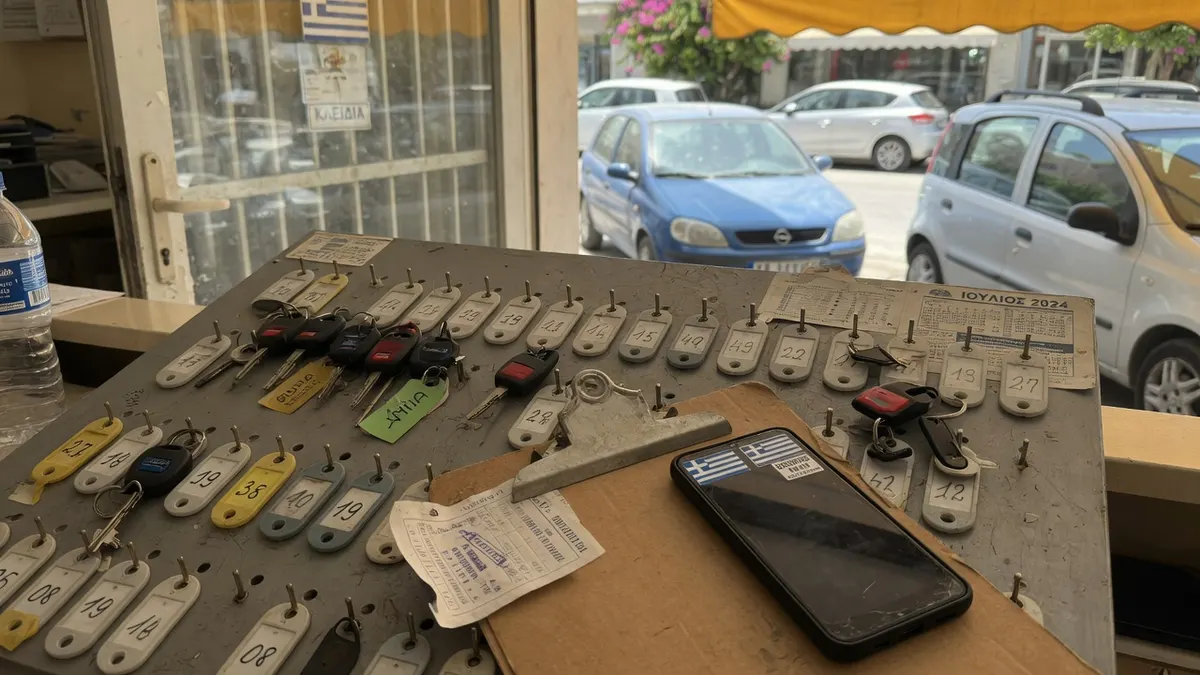
You are at a Greek island counter. The ferry has just tied up. A family is standing with a voucher and a card. You have a set of keys in one hand and a deposit slip in the other. The published number rings. The colleague is already walking a couple to the lot. There is no third pair of hands.
You put the assistant on the number already on the booth, the voucher and the Google listing. It answers when you cannot. Then it does one of two things. It books a pickup against the board you already use. Or it takes a note — a delayed flight, a second driver, a return at a different desk — and puts that in front of you.
The first question is whether this is a pickup, a return, or a change to a booking they already have. A delayed flight is not a new hire. A new hire is not a waived deposit. An assistant that opens with “what time would you like?” will put a 23:40 airport collection into a town slot and leave the person in the arrivals hall without a car.
This is not a dealership. Nobody is asking whether the Peugeot is still on the lot to buy it. Nobody wants a test drive or a service bay. They want keys, a time, and a clear sentence about the deposit. The assistant has to know that, or Saturday will sound like a showroom.
A caller who rang in English gets the confirmation in English. A caller who rang in German gets it in German. The assistant works in 70+ languages. The SMS follows the language of the call.
The ferry, the delayed flight, and both of you at the keys
One of you is walking a family to a compact on the dusty lot. The other is taking a card imprint at the booth. The published number still rings.
It is a burst. July, two ferries in twenty minutes. A late Athens flight that was due at 21:10 and is now 23:40. The morning after a storm cancelled the fast boat. A second line with the same two hands still leaves the third caller on a busy tone.
The person standing at the arrivals hall will not wait on voicemail. They have your booth and the next hire desk in the same glance. They hang up and walk. The person whose flight was delayed until after you close will not leave a message either. They will try the desk that still answers.
Existing bookings will often wait. A person who cannot collect tonight, and a person who has no booking yet and needs a car for tomorrow’s ferry, will not. If those two wait behind the family at the counter, the walk-in is gone, and the delayed passenger arrives angry at midnight — or the next desk has already given them keys.
Whoever takes the first pickup often takes the extra days. That is why a missed pickup call is not only a missed set of keys.
Pickup, return, or a change — then the name on the booking
Pickup. They have a voucher, or they want one. The assistant asks for the name on the booking, then the time they land or the ferry they are on, then whether they are coming to the airport booth, the port, or the town desk. It checks the board. It offers a slot that is actually free. It does not invent a class of car. It does not say a compact is waiting if the board does not show one. If you are sold out of automatics that day, it says so from the line you typed in.
Return. They want to bring the car back early, late, or at a different desk. The assistant takes the plate or the booking name, then where they want to leave it, then when. It does not waive a late fee. It does not invent that the airport desk is open on Sunday. It writes the request. You decide the one-way and the hour.
Change. A second driver, extra days, a baby seat, a switch from the town desk to the airport. The assistant takes the booking name and what they want changed. It does not add a twenty-four-year-old as a driver. It does not extend the hire from the phone. It books a short time at the counter if they are already here, or it flags you to look at the file.
People remember the name they booked under. They do not remember the six-digit voucher. Ask for the name first. If they offer the number, take that too. One identifier is enough to put the note on the right file. None is still a note, not a guess at a class of car.
A sentence the assistant is not allowed to say
“Can you waive the deposit?” is the question on this phone. It comes from a British couple with their own annual policy, from a German family who bought cover on a comparison site, and from a driver who does not want a hold on the card.
The assistant does not answer it. Not with yes. Not with “we can usually skip it if you have your own”. Not with “the excess is normally small”. A sentence that sounds like a waived deposit, said on the recorded line, is a sentence the desk now owns, and the assistant cannot see the contract, the card, the age of the driver, or what the franchise will do.
The line you give it is short: the desk will look at the booking. Cover and the deposit are decided at the keys. This call books the pickup.
“Are we fully covered?”, “is the excess zero?”, “can I drive to Albania?”, “is a twenty-four-year-old allowed?” are still contract questions. The assistant names the topic so the callback is useful, and refuses the decision.
Do not put a CDW table in the notes. It will read the table out.
After hours at the airport
A delayed flight is not a daytime pickup. The arrivals hall at 23:40 is a different desk from the town booth at 10:00. If you run a night collection — a person with keys, a locked lot, a text with a pin — write that rule down the way you would text a guest. The assistant repeats it. It does not invent a night driver to sound helpful.
If you close at 22:00, it says so. It takes the name, the flight number if they have it, and a morning slot if the board has one. It does not promise that someone will wait in the hall. It does not invent a key box you do not use.
August needs its own hours. Some of you run until midnight in July and close at eight in October. Mark the season. A caller who heard “we are open” in May should not be told a 23:40 pickup is fine in November.
A ferry that lands at 21:50 and a flight that lands at 23:40 are not the same collection. The port booth and the airport booth are two places. If the assistant books an airport pickup against the town diary, a family is standing in the wrong car park.
Second driver, extra days, one-way
Second driver. They want the partner on the contract. The assistant takes the name on the booking and the name they want to add. It does not say a twenty-four-year-old can drive. It does not say an extra driver is free. Age, licence years and the extra line on the contract are yours at the desk.
Extra days. They like the island. They want Friday as well. The assistant checks whether that class is free on the extra day. If the board cannot say, it takes a callback. It does not extend a hire from a description of a beach.
One-way. Pickup in Heraklion, return in Chania. Pickup at the port, return at the airport. The assistant takes both desks and the dates. It does not invent that you allow it. If you only return at the desk they started from, it says so from the line you typed in.
A baby seat, a GPS, an automatic instead of a manual: take the request. Do not confirm the extra is on the car until the board says it is. A family of five who were promised a compact will not fit, and that is a row at the keys, not a booking.
How CITT handles it
- Your number stays on the booth and the voucher. A forwarding rule sends what you do not answer. Calls the desk picks up never leave, and are never charged.
- Every line is answered at once. A ferry hour is several conversations, not a stack of busy tones.
- It knows the desk you described. Airport, port, town. Whether you run nights. Whether you are sold out of automatics today. How a pickup should look.
- It asks pickup, return, or change first, then the booking name or the plate, and only then looks at the board.
- It books a pickup only if that slot is free, and never as a waived deposit or a cover sentence.
- It checks the real board before it offers a time, and writes the collection into the same diary the desk already uses.
- It confirms by SMS, in the language of the call — 70+ languages — and can remind them what to bring: licence, voucher, the card for the deposit.
- It escalates cover, a waived deposit, a young driver, and a night pickup you have not marked as a tagged note or a transfer.
- You get the transcript, the summary, the booking name, and what the caller asked for.
What it will not do
It will not waive the deposit. It will not say they are covered, or that the excess is zero. It will not invent a class of car. It will not add a second driver. It will not extend a hire from the phone. It will not invent a night collection, a key box, or a driver waiting in the hall. It will not treat a 23:40 airport pickup and a town collection at 10:00 as the same slot. It will not sound like a dealership. There is no test drive. There is no “is the Peugeot still on the lot”.
What these calls sound like
The order is the split, then the name on the booking, then the time on the board, then the refusal said out loud. There is no “we can skip the deposit”. There is no “you are fully covered”. There is no compact promised from a description of a family of five.
If the assistant is friendly and still waives the deposit, you own that sentence. Put the person who rang from the arrivals hall at 16:10 on a pickup slot that is actually free, not on the next desk’s pad.
What you set up first
Put the assistant on the number on the booth with a forward-on-no-answer rule, so a free pair of hands at the counter still takes the call. Then the three-way split, the booking-name question, and the two sentences that forbid a waived deposit and a cover decision.
Write down the desks you actually run — airport, port, town — and the hours, including the night rule if you have one. Mark sold-out classes for the day. Give it the pickup fields you want on every note: name, flight or ferry, which desk, how many drivers, whether they asked about cover. Mark two kinds of slot: a collection that needs you at the keys, and a short change at the counter.
Give it the same-day list: delayed flight, night pickup, sold out of automatics, a driver under twenty-five. Do not give it a CDW table it would read out. Write one line that forbids cover, excess and waived-deposit sentences. Add where to stand at the airport, where the port booth is, and the August hours.
Rates live on the pricing section of the home page. They are not repeated here.
AI receptionist, in-house staff, or a call centre
| CITT | In-house | Call centre | |
|---|---|---|---|
| Answers while you are handing keys at the counter | Always | Only between customers | Yes |
| Several callers after a delayed flight | Every line at once | One | Depends on the plan |
| Asks pickup, return or change first | Yes — before it looks at the board | Yes | Often jumps to what time |
| Waives the deposit | Never — takes the note | Not on the first call either | Must not; sometimes does |
| Invents that they are covered | Never | Reads the contract at the desk | Often reads a range |
| Speaks the caller's language | 70+ languages | One or two | Whoever is on that shift |
| What it will not do | Invent cover, waive a deposit, or promise a class | Opens the booking, still does not invent | Reads a script |
What one unanswered ferry hour costs a two-person island desk
Worked from these assumptions — change any of them and the answer changes:
- Two people, a July afternoon after a ferry, roughly 28 inbound calls before early evening.
- About a third arrive while both of you are at the counter with keys and a deposit card.
- Of the calls nobody reaches, 5 are people who want a pickup today or tomorrow.
- A hire that stays is worth about €65 of margin on those days — put your own figure in, this is the number to change first.
- This example assumes 3 of the 5 never leave a message and ring the next desk in the same hall.
- 5 pickup requests reach nobody in one ferry hour.
- 3 of them do not call back.
- 3 × €65 = €195 of margin, that afternoon.
- Ferry hours, over a 16-week island season — 16 × €195.
About €3,120 a season, from the same ferry window repeating.
What it costs
CITT is pay as you go: no packages, no minimum, no contract. The current rates — the monthly fee per number and the per-minute rate — are on the pricing section of the home page, which is the only place they are published.
Frequently asked questions
Do I have to give up the desk number?
No. You keep the number on the booth, the voucher, and the Google listing. You set one forwarding rule — every call, or only the ones still ringing after the seconds you choose. If someone at the counter picks up, the call never leaves the desk and is never charged.
Can it waive the deposit if they have their own insurance?
It must not. It takes the booking name, asks what they want changed, collects a callback number, and puts the note in front of you. Whether a deposit is taken, reduced, or held on a card is a decision at the counter after the contract is open. The assistant does not say “we can skip the deposit” to sound helpful.
Can it tell them they are fully covered?
No. A sentence that sounds like cover, said on the recorded line, is a sentence the desk now owns. It does not read a CDW table. It does not say the excess is zero. It books the pickup and writes that they asked about cover. You go through the contract at the keys.
What if I am already handing keys to a family from the ferry?
That is the usual afternoon. The assistant answers the overflow. A pickup becomes a time on the board, or a callback. A delayed flight becomes a later slot if that slot is free. After two ferries land together, shorten the ring-time so the third caller is not listening to a busy tone.
Someone is still at the airport at 23:40. Can it invent a night pickup?
Only if you marked that you run a night collection, and only if the board shows a free slot and a car. It does not invent a driver, a key box, or a car that is still out. If you close at 22:00, it says so from the hours you typed in, and takes a request for the morning.
What do we actually see afterwards?
A transcript, a short summary, whether this was a pickup, a return or a change, the booking name or the plate if they gave one, and whatever was booked or left for you. Confirmations go out by SMS in the language of the call.