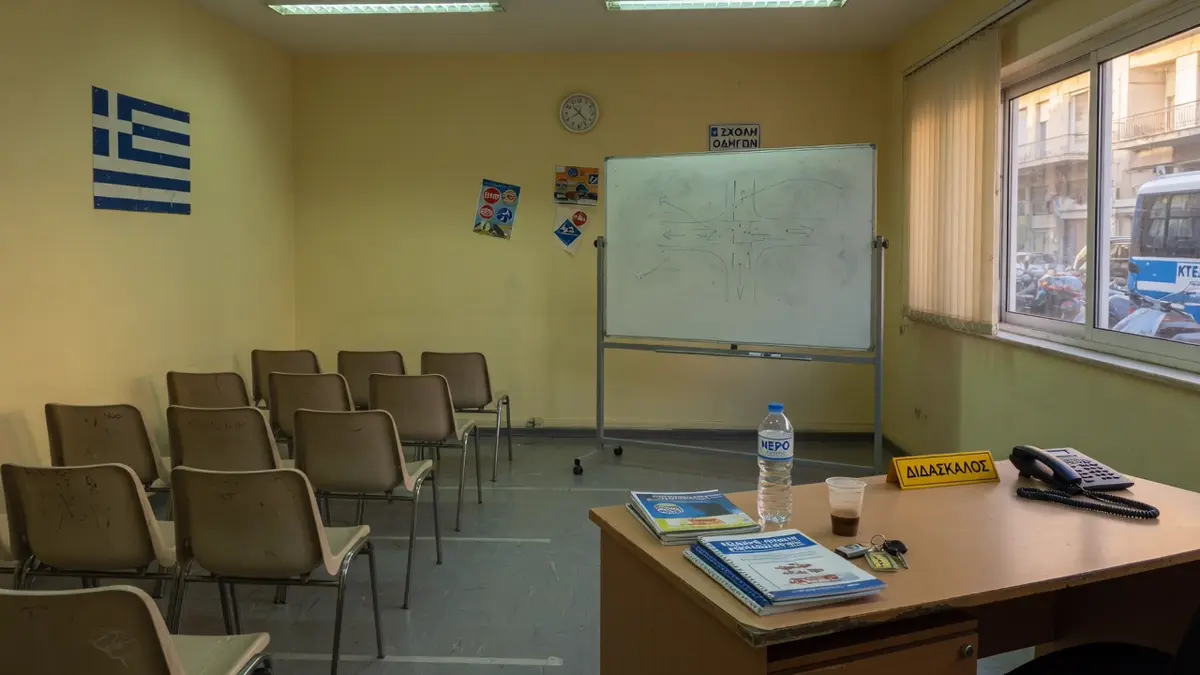
AI phone receptionist for driving schools
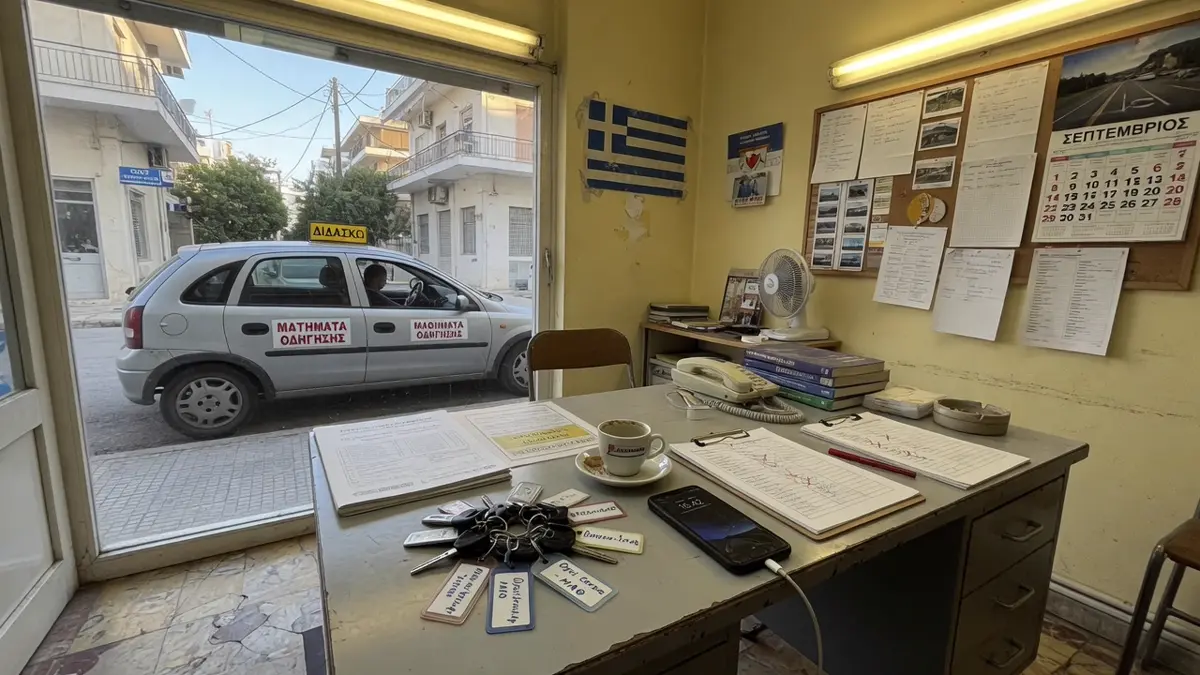
Quick summary
- Late afternoon both instructors are in a car; the person who would pick up is in the passenger seat with a foot over the second brake.
- Ask driving lesson, theory class or test date first — those sit on different lists and belong to different people.
- A lesson hour is free only if that instructor and that car are actually free. The assistant must not invent one.
- A caller who gets voicemail hangs up and rings the next school.
- It checks your calendar before it offers a time, writes the lesson in, and texts the confirmation.
- A test date is not a lesson. Repeat only a date the transport office has already given you.
TL;DR
The instructor is already in the car when the phone rings. A student wants a driving lesson, a theory class, or a test date — three different lists. They will not wait on voicemail; they ring the next school. An assistant answers every line at once, asks which of the three they mean, checks the calendar you already use, offers only a time that is free, books it, and texts the confirmation. It will not invent a free lesson hour, and it will not confirm a test date the transport office has not given you.
Key takeaways
- Put the assistant on the existing school number with a forward-on-no-answer rule, so whoever is back at the desk still takes the call.
- Give it three request types first: driving lesson, theory class, test date — and which list each one uses.
- Tell it a lesson hour is only free if that instructor and that car are free. It must not invent a spare hour to be helpful.
- Mark who teaches which category, and whether you pick students up or they meet at the school.
- Give it only the test dates the transport office has actually given you. If you have none, it takes a note.
- Tell it not to give driving advice, and not to say a student is ready for the test.
What an AI phone receptionist does in a driving school
An AI phone receptionist answers the school number, talks the way a person at the desk would, and then does something with what it heard. It books a driving lesson, writes a student onto a theory class, or takes a question about a test date and puts that note in front of you.
The first thing it has to get right is which of those three the caller means. A driving lesson needs an instructor and a dual-control car for a stretch of time that is actually free. A theory class needs the room and the evening you already run it. A test date is not yours to invent — it comes from the transport office. An assistant that opens with “what time would you like?” will put a theory student into Kostas’s five o’clock car and leave a real lesson hour empty.
It asks which of the three they mean. For a driving lesson it then asks who they usually go with, and whether you collect them or they come to the school. After that it checks the calendar you already use, offers only a time that is free, writes the lesson in, and texts the confirmation.
A caller who rang in English gets the confirmation in English. A caller who rang in Greek gets it in Greek. The assistant works in 70+ languages. The SMS follows the language of the call.
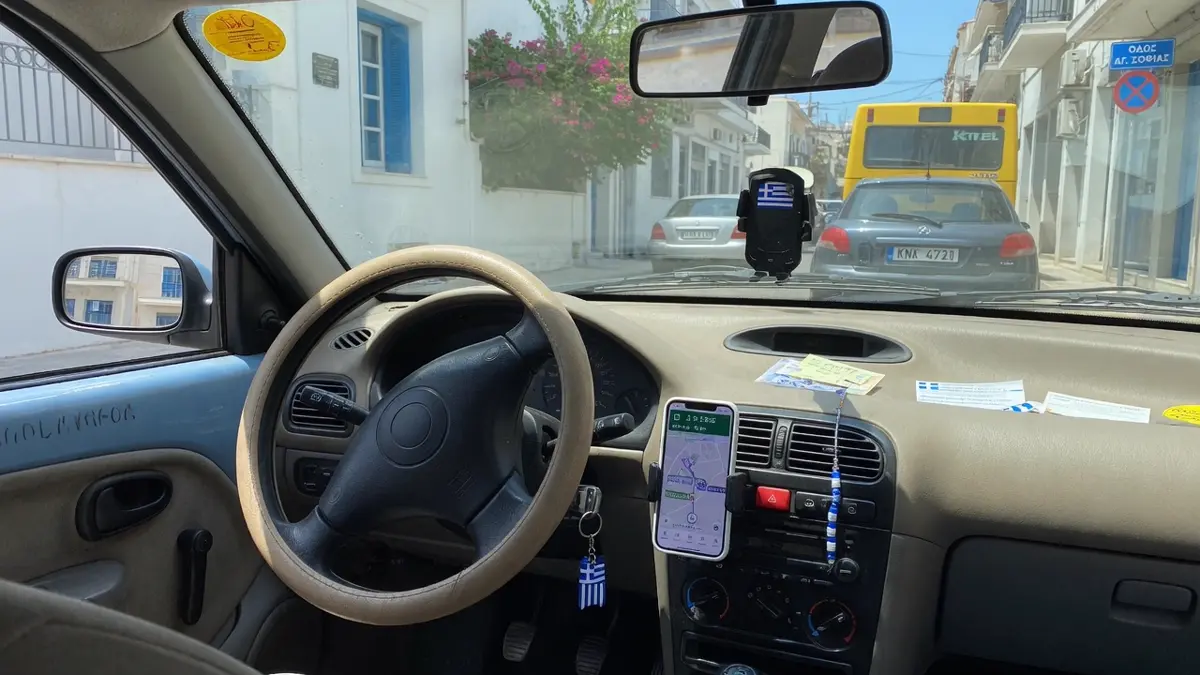
The instructor is in the car
Kostas is in the passenger seat. The student is approaching a junction you have used a hundred times. His right foot is over the second brake. The phone in the door pocket lights up.
He cannot pick it up. The student cannot be left. If you have a second instructor, she is in the other car, on the ring road, with the same problem. The shopfront, if you still have one, is empty until someone comes back to swap a student.
The burst is late afternoon into the early evening, when people leave work and want tomorrow at five. That is exactly when both of you are on the road. A person hired to sit at the desk on Tuesday morning does not touch Thursday at 17:30. A second line in the same empty shopfront still leaves the caller listening to a ring.
The caller who wanted to start this week is often standing with two school numbers from the same search. They will not wait on voicemail. They hang up and dial the next one.
A parent calls for an eighteen-year-old who turns in March. A student calls to cancel because the shift overran. Someone asks if Thursday’s theory is still on. Someone asks when the test is. All of that lands on a phone that is face-down in a moving car.
Kostas at 17:00 is a person and a car that are either already out or not. An assistant that skips the check puts two students on the same hour, and one of them is standing on a pavement in Agia Paraskevi while the car is still in Piraeus.
Driving lesson, theory class, or test date
Driving lesson. An instructor, a dual-control car, a stretch of time that is actually free. Often after work. Sometimes a pickup from a metro or a square. If the assistant skips “who do you usually go with?”, it offers Maria when the student has only ever sat with Kostas, and Maria is already in Nea Smyrni. If it skips the car, it offers an hour when that car is already on a test morning.
Theory class. A room, a group, the evenings you already run. Not a one-to-one in a car. A caller who says “lesson” and means the classroom has to be asked. If you only run theory on Tuesday and Thursday, those are the times it may offer. It must not invent a private theory hour on Saturday morning because that hour is empty on the car calendar. The car calendar is the wrong list.
Test date. The transport office gives you a date, or it does not. The assistant may repeat a date you have already written down for that student. It may take a name and a request if you do not have one yet. It must not pick a Tuesday and say they are in. A test morning also takes the instructor and the car. That morning is not a lesson morning. Mark it the way you mark a day off, or the assistant will fill it.
The order on the call is the type of request, then the person, then the time. An assistant that starts with the time will fill whatever gap it can see, and you will spend the evening untangling a theory student, a test question and a real lesson that all landed on 17:30.
A free hour that does not exist
The kind answer on a tight day is to find “something.” The assistant must not. If Kostas is out from 16:00 to 19:00, 17:00 is not free. If the car is on a test in the morning, 10:00 is not free. If Maria is the only motorcycle instructor and she is already out, a motorcycle hour does not appear because the category B calendar has a gap.
A free hour is an instructor plus a car plus a stretch of time that is not already taken. All three. The assistant checks the calendar you already use, then offers. If nothing fits, it takes a callback. It does not invent a spare hour to sound helpful. That invented hour is how two students arrive for the same car.
You do not owe a free extra hour because someone cancelled yesterday. If that is not a rule you already say out loud, do not write it into the notes you give the assistant. It will read the sentence out. A cancelled lesson is a cancelled lesson. If you sometimes make one up, you decide that when you see the name, not from the phone.
Who is in which car
Many small schools have no one sitting at a desk all day. The person who would have picked up is the person in the passenger seat.
The assistant has to know who teaches what. Kostas takes category B. Maria takes motorcycles. If only one person does automatic, an automatic lesson can only go on that person’s hours. If someone sits in on theory and does not take the car, the assistant must not offer them for a driving lesson.
Write it down the way you would for a new hire: who is in, who takes B, who takes A, who is off, which car they have. The assistant will honour a list it can see. If the list is empty, it will offer times nobody can actually take.
Pickup is the same kind of fact. Some of you collect from a metro, a square, a house. Some of you meet at the school. A lesson booked at 17:00 with no meeting point written on it is how Kostas waits in Glyfada while the student waits in Marousi. Ask, then write it on the lesson. If you do not pick up, say so in the notes so the assistant stops promising a collection it cannot keep.
Test dates you do not own
In Greece the date comes from the transport office. You accompany, you prepare, you block the morning. You do not print a date because a caller asked nicely.
Give the assistant only the dates you already have, against the student they belong to. If you have none, it says you do not have a date yet and takes a callback. It does not guess from “they usually send us Tuesdays.” It does not offer the next empty morning on your lesson list as if that were a test.
A caller who asks “am I ready?” is asking you, not the phone. The assistant does not decide that. It has not sat through the last junction. It books another driving lesson if that is what you allow, or it takes a note. The same rule covers a parent who wants a date before the student has finished theory. Theory first, then the car, then the test — in that order, and only the steps you actually run.
Remaining hours, packages, and a cancel at twenty to five
“How many hours do I have left?” Only answer if you have given the assistant that list. If you have not, it takes the name and says you will confirm. If it guesses the remaining hours, you argue at the car door, with the next student already waiting.
It can repeat a published package you gave it — the starter set on the card in the window, the listed motorcycle package. It must not invent a price from “a few lessons to get confident.” Hours already done, manual or automatic, and whether this is a retake all change the number. A figure quoted before you have seen the file is a figure you then have to take back.
A cancel at 16:40 for a 17:00 lesson leaves that hour empty. The assistant should take it, free the hour if anything is left of it, and offer it to the next caller if you want that. It should not offer a free replacement hour. Say the cancel rule you actually use, at the end of a booking. If you have no rule, do not invent one for the assistant.
Saturday motorcycle lessons are their own weather problem. If you cancel bikes in the rain, write that down. The assistant can tell a caller the bike hours are off and offer the next dry day you have marked. It must not move them onto a category B car to be helpful. That is a different licence and a different instructor.
How CITT handles it
- Your number stays on the shopfront. A forwarding rule at the provider sends what you do not answer. Calls the desk picks up never leave the school.
- Every line is answered at once. An after-work burst is a set of conversations, not a stack of rings in an empty office.
- It knows the school you described. Which categories you teach, who is in which car, whether you pick students up, which evenings theory runs, how a cancel works.
- It asks lesson, theory or test date, then who they go with, then looks at the calendar. A time is offered only after those facts exist.
- It checks the real calendar before it offers a time, and writes the lesson into the same calendar the instructors already use.
- It confirms by SMS, in the language of the call — 70+ languages — and can remind before the lesson.
- It escalates what cannot be finished on the call — a test date you do not have, a “ready or not” question, a complaint — as a tagged note, not as a guess.
- You get the transcript, the summary, and which of the three the caller named.
What it will not do
It will not invent a free lesson hour. If the instructor and the car are out, that hour is not offered.
It will not confirm a test date the transport office has not given you. A caller who wants a Tuesday gets a note, not a date the assistant invented.
It will not give driving advice, and it will not say a student is ready. A reverse into a bay, a hill start, a question about the test route — those are a note, or another booked lesson. You have been in the car. It has not.
It will not put a theory student into a car hour, or a motorcycle student onto a category B gap. Mark the difference, or the assistant will fill whatever it can see.
It will not guess remaining hours, decide when someone is old enough to start, or say what the transport office will accept. It takes the request. A human decides.
What these calls sound like
The order is the type of request, then the instructor, then the pickup, then the offer. There is no invented five o’clock. There is no invented test date. There is no “I’m sure we can squeeze you in” over a car that is already on the ring road. There is no advice about a junction the assistant cannot see.
If the assistant is friendly and still books the wrong list, Thursday evening has a theory student in a dual-control car and a real student standing on the pavement. Put the person who rang at 16:10 on a time that exists. Do not leave them listening to voicemail. They hang up and dial the next school.
What you set up first
Put the assistant on the number on the shopfront with a forward-on-no-answer rule, so a free pair of hands at the desk still takes the call. Then the three request types and which list each one uses, who teaches B and who teaches A, which car they have, whether you pick up, the evenings theory actually runs, and the cancel rule you already say out loud.
Give the assistant the published packages it may repeat, and do not give it a figure it would read out for unseen remaining work. Write one line that forbids driving advice and “ready for the test.” Add opening hours, who is in on Thursday evening, where the school is, and the pickup points you actually use.
Give it only the test dates you already have. If a morning is a test morning, mark the instructor and the car off. If you leave that morning unmarked, the assistant will fill it with a lesson.
Rates live on the pricing section of the home page. They are not repeated here.
AI receptionist, in-house staff, or a call centre
| CITT | In-house | Call centre | |
|---|---|---|---|
| After-work burst, both cars out | Every line answered at once | One call, if someone is back at the desk | Depends who was rostered |
| Asks lesson, theory or test first | Yes — before it looks at the calendar | Yes | Often jumps to what time |
| Offers only a free hour that exists | Checks instructor and car first | Yes — they can see who is out | Reads a gap on a sheet |
| Test date vs lesson | Repeats only a date you already have | Yes | Treats it as another booking |
| Pickup point | Asks, then writes it on the lesson | If they remember | Rarely |
| Speaks the student's language | 70+ languages | One or two | Whoever is on that shift |
| What it will not do | Invent a free hour or confirm a test it does not have | Can look at the transport letter | Reads whatever is on the script |
What one unanswered after-work window costs a two-instructor school
Worked from these assumptions — change any of them and the answer changes:
- Two instructors, a normal Thursday, roughly 18 inbound calls.
- About 8 of those arrive between 16:00 and 19:00, when both instructors are already in a car.
- Of the calls nobody reaches, 3 are new students asking to start.
- A new student who buys a lesson package is worth about €350 to the school — YOUR figure will differ, and this is the number to change first.
- This example assumes 2 of those 3 never leave a message and ring another school.
- 3 new-student enquiries reach voicemail in one Thursday after-work window.
- 2 of them do not call back.
- 2 × €350 = €700 of that week's new students, gone before 19:00.
- Thursdays alone, over a 46-week teaching year — 46 × €700.
About €32,200 a year, from one recurring three-hour after-work window.
What it costs
CITT is pay as you go: no packages, no minimum, no contract. The current rates — the monthly fee per number and the per-minute rate — are on the pricing section of the home page, which is the only place they are published.
Frequently asked questions
Do I have to give up the school number?
No. You keep the number on the shopfront, the Google listing and the cards in the windscreen. You add one forwarding rule with your telephony provider — every call, or only the ones still ringing after the seconds you choose. If someone at the desk picks up, the call never leaves the school and is never charged.
Can it tell a caller when their test is?
It can repeat a date you have already written down for that student, the one the transport office gave you. It must not invent a Tuesday because the caller asked for one. If you have no date yet, it takes the name and says you will call back. A test morning also takes the instructor and the car, so that morning is not offered as a lesson.
Will it invent a free hour if tomorrow looks full?
Not if you configured it that way. A lesson hour is free only when that instructor and that car are free. If Kostas is out from 16:00 to 19:00, 17:00 is not free. If nothing fits, it takes a callback rather than squeezing a second student into a car that is already on the road. It does not invent a spare hour to sound helpful, and it does not offer a free extra hour because someone cancelled yesterday.
We pick students up. Can it still book?
Yes, once you say so. It asks where to collect them — metro, square, the house — and writes that on the lesson. If you only meet at the school, say that in the notes so it stops promising a pickup. A 17:00 lesson with no meeting point is how one of you waits in Glyfada and the student waits in Marousi.
What if someone asks if they are ready for the test?
The assistant does not decide that. It is not in the car and it has not seen the last junction. It can book another driving lesson if that is what you allow, or it can take a note for you. The same rule covers “how do I reverse into a bay” and any other driving advice. Those calls are a request, never a lesson over the phone.
What do we see after a call?
A transcript, a short summary, whether they asked for a lesson, a theory class or a test date, who they usually go with, the pickup if there is one, and whatever was booked or left for you. Confirmations go out by SMS in the language of the call. You read the evening list the way you already do — except the ones nobody could pick up are on it too.