AI phone receptionist for fence builders
Quick summary
- You have a post in the ground. Both hands are on the level. That is when the number on the van rings.
- The first question is mesh, wall, electric gate, or a repair — those are different visits, not one free morning.
- On a new line it books a measure. It never takes a side between two neighbours about where the boundary sits.
- Someone who wants a gate before the weekend will not wait on voicemail. They ring the next crew.
- It checks the book you already use before it offers a morning, writes the visit in, and texts the window.
- After a storm, or in April when plots start, several people ring at once. It answers every line at once.
TL;DR
You have a post in the ground on a plot in Koropi. The neighbour is already at the fence line. The phone in your pocket rings. Someone has sent a photo of a hedge and wants a price today. Someone else's electric gate will not close. A voice wants you to say the wall is on their land. They will not leave a message. An assistant answers in the caller's language, asks whether this is mesh, a wall, an electric gate or a repair, takes the address, and books a measure only if that morning is free. It does not invent a figure from a photo. It does not take a side in a boundary dispute.
Key takeaways
- Put the assistant on the number on the van and the yard gate, with a forward-on-no-answer rule, so a free pair of hands still takes the call.
- Teach it the first split: mesh, wall, electric gate, repair, or a move of a visit already in the book.
- Give it the sentence verbatim: it takes the measure. It does not take a side about whose land the line is on.
- Let it book measure-ups and short gate looks. Keep the quote, the cadastral question, and the install day as a callback or a second booking after the tape.
- After a storm, and in April, shorten the ring-time so the third caller is not listening to a busy tone.
- Mark two kinds of visit: a measure that needs you on the plot, and a short look at a jammed gate motor.
What an AI phone receptionist does for a fence crew
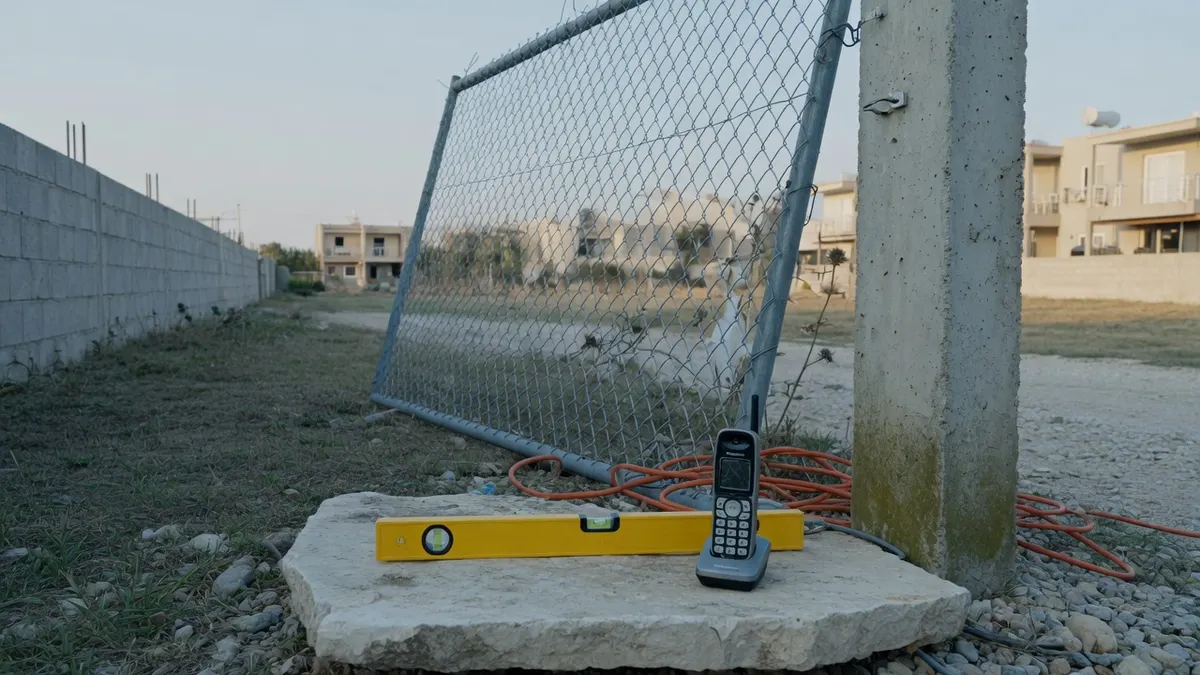
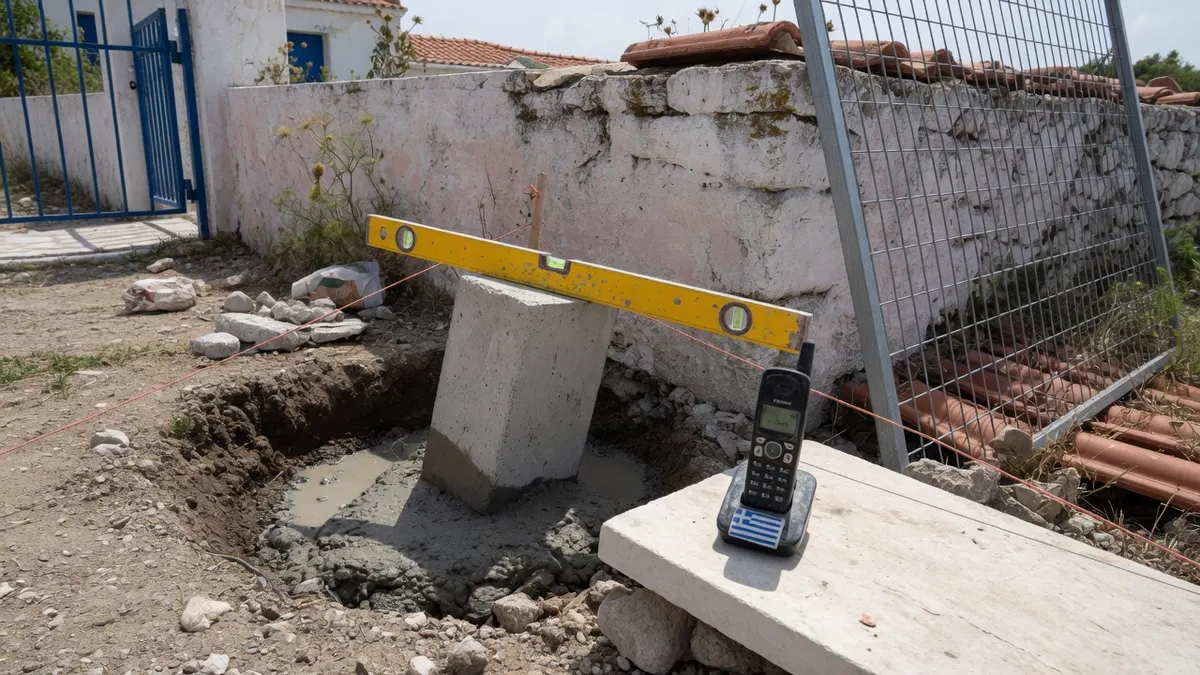
You are on a plot in Koropi. A post is in the ground. Both hands are on the level. The neighbour is already standing at the line. The phone in your pocket rings. Across town the other person is cutting mesh in the yard. There is no third pair of hands at the beige phone on the metal desk.
You put the assistant on the number already on the van and on the yard gate. It answers when you cannot. Then it does one of two things. It books a measure that is actually free. Or it takes a request you will price after the tape has been on the run.
The first question is not “what morning would you like?”. The first question is what kind of visit this is. Mesh is not a masonry wall. A wall is not an electric sliding gate. A jammed motor is not a forty-metre line. Two neighbours arguing about a boundary are not a quote from a photo of a hedge. An assistant that opens with a free hour will put a dispute into a gate slot and leave the person who needed a measure without a morning.
A caller who rang in English gets the confirmation in English. A caller who rang in Greek gets it in Greek. The assistant works in 70+ languages. The SMS follows the language of the call.
A post in the ground, and the phone still ringing
One of you has a post and a level. The other is in the yard with a roll of mesh. The published number still rings.
It is a burst. April, when plots start and everyone wants a line before the summer. The morning after a storm, when panels are down and three motors have jammed. The week a notary sent two buyers out with your card. A second line with the same two hands still leaves the third caller on a busy tone.
The person who sent a photo of a hedge this afternoon will not wait on voicemail. They have your number and two other crews in the same search. They hang up and dial the next one. The person whose sliding gate will not close, with a car in the road, will not leave a message either.
People whose posts you already set will often wait. A person who cannot get a measure, and a person who cannot start a gate look, will not. If those two wait behind the line you are already setting, the new run is gone, and the jammed gate arrives as an angry visit at five — or the next crew has already put a tape on that plot.
Whoever takes the measure often takes the order. That is why a missed photo-call is not only a missed note.
Mesh, wall, electric gate, repair — then the address
Measure for mesh. They want a line you have not seen. Garden, plot, a side towards the olive trees, a school yard. The assistant asks which run, then the address. It books a visit only if that morning is free. It does not invent a figure from a photo of a hedge. It does not promise Thursday’s install. The quote is yours, after the tape.
Masonry wall. A τοιχίο, a low wall with railings, a replacement after the neighbour’s side came down. A wall is not a mesh morning. The assistant takes the run. It does not say the footing can be done from a picture. It does not take a side about whose land the old wall sat on.
Electric sliding gate. New motor, photocells, a gate that will not close, a remote that died. A gate look is shorter than a forty-metre measure. Mark it as its own kind of morning, or you will spend an hour on a plot with someone who only needed a motor. If a car is in the road and the gate will not close, that is a flagged note or a transfer to a phone you actually hold.
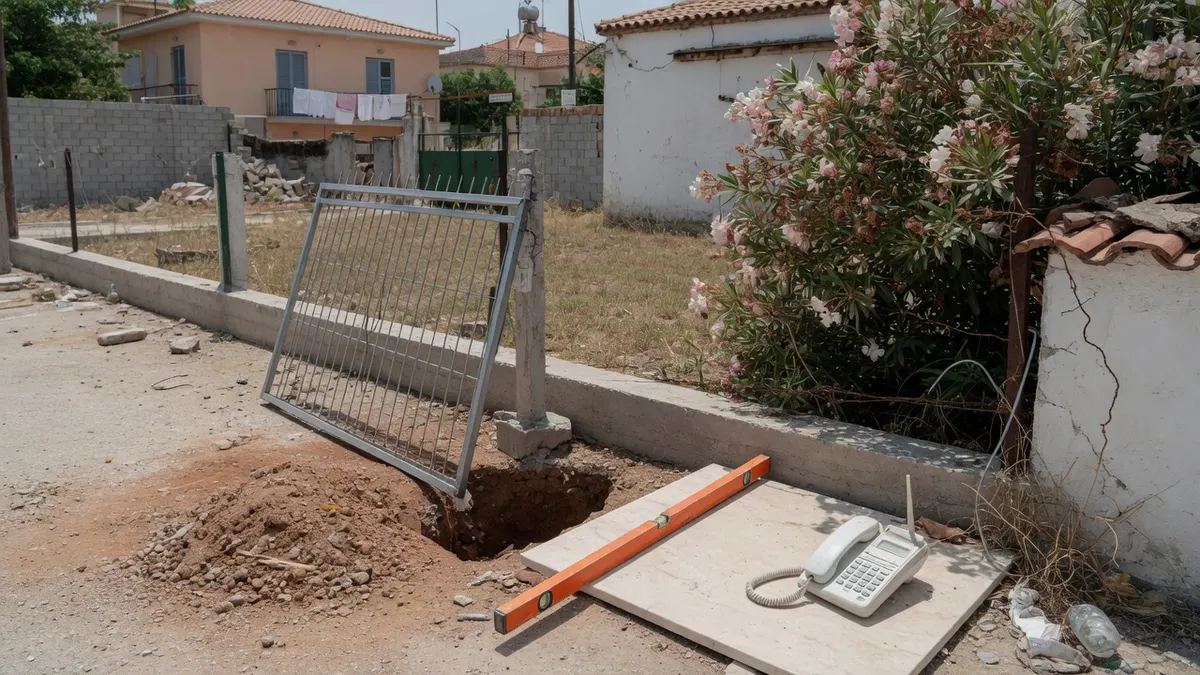
Repair. Storm panels down, a bent post, a kicker plate that tore. The assistant takes which run and the address. It does not say the mesh can be patched from a description. It does not invent an arrival.
People remember the hedge. They do not remember whether they want mesh, a wall, or a gate. Ask which of those first. Then the address. One run is enough to put the visit on the right plot. None is still a request, not a guess at forty metres from a picture.
A sentence the assistant is not allowed to say
“Can you tell me the wall is on my land?” is the question on this phone. It comes with a photo of a hedge. It comes with a neighbour shouting in the background. It comes from a buyer who has the notary on Friday.
The assistant does not answer it. Not with yes. Not with “from the photo it looks like yours”. Not with “the other crew was right”. A side taken on a recorded line is a side the crew now owns, and the assistant cannot see the cadastral plan, the pins, or the old footing under the weeds.
The line you give it is short: it takes the measure. It does not take a side. The quote comes after the tape.
“Is the neighbour allowed to put posts there?”, “can you write that it’s mine?”, and “just tell them to stop” are still dispute questions. The assistant names the topic so the callback is useful, and refuses the side.
Do not put a cadastral screenshot in the notes. It will describe the screenshot.
After a storm, April, and everyone at once
April is new lines. By nine, people have started ringing about plots. You are already on a post. The pad is already a list of runs.
A storm night is panels and motors. By eight, three sliding gates will not close and a run of mesh is in the road.
A notary afternoon is two buyers walking out with your card. They want a fence before they sign. They will not leave a message. They will try the next crew in the same search.
The assistant has to treat that burst as several conversations, not as a queue behind your post. A measure in that hour is a morning in the book. A jammed-gate call is a shorter look, or a transfer if the car is in the road. If the assistant parks the person who wants a new sliding gate behind the tenth mesh report, that person rings the next yard.
Shorten the ring-time before forwarding on those mornings. After a storm the third caller should not hear a busy tone. A Tuesday in August is people asking for holiday-plot repairs, and one person left in the yard.
A price nobody can give from a photo of a hedge
When someone describes a line on the phone — they think forty metres, mesh, the neighbour already has a wall — the tempting answer is a number. The assistant does not give one.
Length, slope, posts already in, rock, access for the van, electric or manual, whether the neighbour’s footing sits on the line — all of those change the work. A number quoted before anyone has put a tape on the run is a number you then spend the measure taking back.
It can repeat a published call-out or a visit fee you typed in and marked as speakable. Unseen walls, a full plot, an electric gate, a school yard — those do not get a number on this call. The assistant takes the request and books the measure. Last year’s price for the next plot is not this run. The assistant does not quote it.
If they press — “just a round figure, I have the other crew on the other line” — the assistant still refuses. Book them as soon as a morning is free. Flag it if the gate will not close and a car is in the road.
Standing at a gate that will not close
Some of these callers are in a drive, with the leaf in the road, with a car behind them and a neighbour watching. They want to know whether to force the motor, whether the photocells are dirty, whether you can come now.
The assistant is not on the drive. It cannot see the motor. It cannot decide whether the leaf is off the track.
What it can take: the address, whether the gate is electric, whether a vehicle is blocking the road, and a name. What it can repeat, if you typed the line in: do not force the motor; someone who can see the van will call. Come-now or this-afternoon is yours, after you know where the crew is.
If they say the gate is on a child’s path, or a vehicle has hit the leaf, that is a transfer. You give the assistant a short list: path blocked, vehicle hit, leaf in the road. It collects a name and a number while it is connecting. It does not tell them to lift the leaf off the motor.
A caller who is already home, with a photo of a hedge on their phone, is a measure request and, if a morning is free, a time.
Neighbours, motors, and “can you fit it Thursday?”
Boundary. Two voices, one line. The assistant books a measure. It does not take a side. It does not ask the neighbour for their version on the same call unless you marked that. One booking, one plot, one tape.
Motor versus manual. They want to know which to put on the drive. The assistant takes that as a measure question, not as advice. It does not say a motor is worth it. It does not say a crank will do.
Photocells and remotes. The gate opens by itself, or will not see the car. A short look, if you marked that type. Not a full plot measure.
Install Thursday. They have already had a quote, or they think they have. The assistant does not put an install in the book because someone is in a hurry. If a signed quote exists, that is a different visit type, from a list you control. If it does not, this is still a measure.
August needs its own dates. Do not let the assistant book a measure into a week when the yard is dark.
How CITT handles it
- Your number stays on the van and on the yard gate. A forwarding rule sends what you do not answer. Calls the yard picks up never leave, and are never charged.
- Every line is answered at once. An April morning is several conversations, not a stack of busy tones.
- It knows the crew you described. What you build, whether you do electric gates, whether you take masonry, who is out on Monday.
- It asks mesh, wall, gate or repair first, then the address, and only then looks at the book.
- It takes a photo-price as a measure request, never as a figure said out loud, and never as a side in a dispute.
- It checks the real book before it offers a morning, and writes the visit into the same calendar the crew already uses.
- It confirms by SMS, in the language of the call — 70+ languages — and can remind them to be on the plot, not only the neighbour.
- It escalates a gate in the road, a boundary fight, a price question, and an install-before-the-tape as a tagged note or a transfer.
- You get the transcript, the summary, the address, and the run the caller named.
What it will not do
It will not invent a price from a photo, a description, or last year’s next plot. It will not take a side about whose land the line is on. It will not read a cadastral plan on the phone. It will not promise Thursday’s install before the tape has been on the run. It will not tell them to force a motor. It will not treat a measure, a gate look and an install as the same morning.
What these calls sound like
The order is the split, then the address, then a morning the book can honour, then the refusal said out loud. There is no round figure over a hedge nobody has measured. There is no “it’s your land”. There is no “twenty minutes” to a drive with a leaf in the road.
If the assistant is friendly and still answers the boundary question, you own that side. Put the person who rang about the Koropi wall at 11:10 on a measure, not on the neighbour’s tape.
What you set up first
Put the assistant on the number on the van with a forward-on-no-answer rule, so a free pair of hands in the yard still takes the call. Then the four-way split, the address question, and the sentence that forbids a side in a dispute.
Write down what you actually build and whether you take electric gates this month. Give it the fields you want on every note: address, mesh or wall or gate, approximate run if they offer it, whether a neighbour is involved, whether the gate still closes. Mark two kinds of visit: a measure that needs you on the plot, and a short look at a motor or photocells.
Give it the same-day phone list: leaf in the road, path blocked, vehicle hit. Do not give it a metre tariff it would read out. Write one line that forbids photo-prices, boundary sides, and install days before the tape. Add who is out on Monday, April hours, August dates, where the van may wait.
Rates live on the pricing section of the home page. They are not repeated here.
AI receptionist, in-house staff, or a call centre
| CITT | In-house | Call centre | |
|---|---|---|---|
| Answers while a post is in the ground | Always | Only if they can let go of the level | Yes |
| Several callers after a storm | Every line at once | One, then a busy tone | Depends who was rostered |
| Asks mesh, wall or gate first | Yes — before it looks at the book | Yes, if they heard the start | Often jumps to what morning |
| Takes a side in a boundary dispute | Never — books the measure | Can refuse until they have seen the line | Tempted, if the caller is angry |
| Invents a fence price from a hedge photo | Never | Quotes after the tape | Often reads a range |
| Speaks the caller's language | 70+ languages | One or two | Whoever is on that shift |
| What it will not do | Price unseen work, or say whose land it is | Can look at the line | Reads whatever is on the sheet |
What one unanswered weekday morning costs a two-person fence crew
Worked from these assumptions — change any of them and the answer changes:
- Two people, a normal weekday in April. One of you is on a plot with a post. The other is cutting mesh in the yard.
- About 12 inbound calls that morning. Five arrive while both pairs of hands are on steel.
- Of those five, 3 are new measure-ups for a garden line or a sliding gate. 1 is a jammed motor. 1 is a neighbour dispute.
- A garden fence that becomes an order is worth about €2,200 of work here — put your own average ticket in first. This is the number to change.
- This example assumes 2 of the 3 measure-up callers do not leave a message and ring the next crew on the listing.
- 3 new measure-up requests reach nobody on a normal Tuesday morning.
- 2 of them do not call back.
- 2 × €2,200 = €4,400 of work that morning that never reached the book.
- A morning like that once a week, 40 weeks — 40 × €4,400.
About €176,000 a year on those assumptions. Change the ticket, the conversion, and how often a morning like that happens.
What it costs
CITT is pay as you go: no packages, no minimum, no contract. The current rates — the monthly fee per number and the per-minute rate — are on the pricing section of the home page, which is the only place they are published.
Frequently asked questions
Do I have to change the number on the van?
No. The number on the van, the yard gate, the cards, and the Google listing stays yours. You add one forwarding rule — every call, or only the ones still ringing after the seconds you choose. If you pick up, the call never leaves and is never charged.
Can it give a price if they send a photo of the hedge?
It must not. A photo does not show the run, the slope, the posts already in, or whether the neighbour's wall is on the line. It takes the address and what they named — mesh, wall, gate — and books a measure if that morning is free. You price what the tape has been on.
The two neighbours disagree about the boundary. Can it say who is right?
No. It books a measure. It does not read a cadastral plan on the phone. It does not tell either voice that the wall is on their land. If they want you to stand between them, that is a visit you decide after you have seen the line, not a side taken by the greeting.
What is a measure, and what is an install?
A measure is you, a tape, and a line. An install is a crew, posts that have already been cut, and a morning that a neighbour or the weather can stop. The assistant books the first. It does not put Thursday's install in the book because someone is in a hurry. After the quote is signed, you — or the assistant, from a list you gave it — book the fit.
The electric gate will not close and a car is in the road. Can it send us now?
It can put the call in front of a human who can see where the van is. It will not invent “we will be there in twenty minutes”. A gate that will not close is a flagged note or a transfer, not a guessed arrival. You decide whether to leave the posts you are already setting.
What do we actually see afterwards?
A transcript, a short summary, whether this was mesh, a wall, an electric gate, a repair or a move, the address and the run they named, and whatever was booked or left for you. Confirmations go out by SMS in the language of the call.