AI phone receptionist for hotels and guesthouses
Quick summary
- Check-in hour: one person at the desk, a passport and a key in their hands, and the phone ringing.
- The first question is what they want — a room, a pickup from the airport, or to arrive late.
- It checks the book you already use before it says a date is free. It does not invent a room.
- A published rate it may repeat. A number it made up it must not give.
- Guests call in their own language. That is the work, not a courtesy.
- A late ferry is a different call from a new booking. Mix them and the night goes wrong.
TL;DR
Check-in hour. One person at the desk has a guest's passport and a key in their hands. The phone rings. The caller wants a room for two nights, a lift from the airport, or to arrive after the ferry. Those are three different requests. An assistant answers, asks which one it is, and checks the book you already use. It will not say a room is free or name a rate unless you put that figure in. It speaks the language the guest started in — 70+ languages — and texts the confirmation in that language.
Key takeaways
- Put the assistant on the published number with a forward-on-no-answer rule, so whoever is free at the desk still takes the call.
- Teach it the first split: availability, airport pickup, or late arrival. Nothing useful happens before that.
- Connect the book you already use. If the book does not show a free room, the assistant takes a request. It does not invent one.
- Give it only the published rates it may repeat. Do not give it a number you would take back at the desk.
- Treat the guest's language as the working language. English, German, French and Italian are how people book, not extras.
- Write the late-arrival rule you already use: last check-in, key box, who to call after midnight.
What an AI phone receptionist does at a small hotel
Someone is standing at your desk with a passport open. You are writing the name into the book, finding the key, saying when breakfast starts. The phone rings. You cannot pick up. The person in front of you is not finished.
An AI phone receptionist answers that number and then does something with what it heard. It takes the dates. It writes down a pickup. It tells a late guest the rule you actually use. Or it puts a note in front of whoever is free.
The first thing it has to get right is the kind of call. A new stay, a lift from the airport, and a late arrival are three different requests. They need different facts. An assistant that opens with “what dates would you like?” will treat a delayed ferry as a fresh booking and leave the night guest at a locked door.
It asks what they want. Then it checks the book you already use. It offers a room only if that book shows one. It repeats a rate only if you wrote that figure down. It texts the confirmation in the language of the call. The assistant works in 70+ languages. A caller who rang in German gets the text in German.
Check-in hour
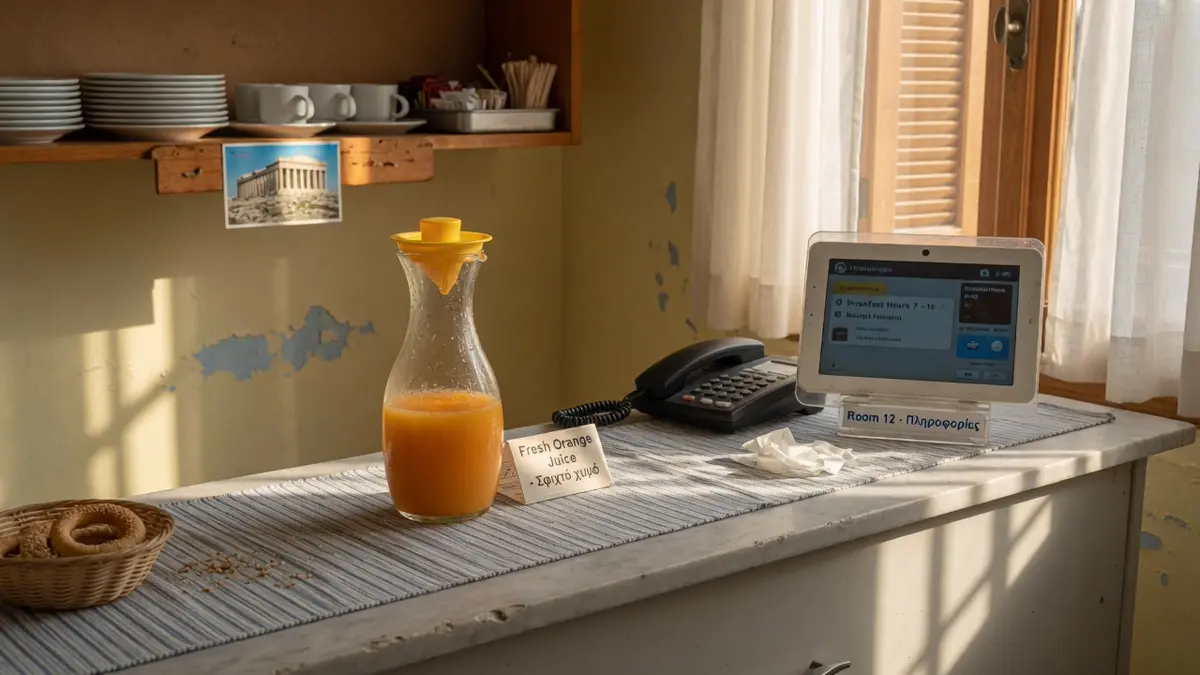
It is three in the afternoon in a small Greek hotel. Check-in has started. One person is at the desk. A couple is in front of them with passports, a card, and two bags in the doorway. You are halfway through the name. The phone starts.
If you pick up, the people in front of you wait with their documents open. If you do not, the caller hangs up. There is nobody else. On a house this size you are often the person at the desk, and after this guest you are upstairs with a towel.
The calls bunch in the same hours the walk-ins arrive, the taxis pull up, and the people who booked on the site want to know where to park. A second line with the same two hands still leaves the third caller on a busy tone.
The caller is often already looking at the next house on the street. They have your name and two others in the same glance. They will not wait for a beep. They hang up and ring the next door, or they open it.
Morning is no quieter. Breakfast is out. You cannot leave the room. Evening is later still: you are at dinner, or you have locked the desk, and the person on the last boat is still on the water.
Availability, airport pickup, or late arrival
A stay. Dates, how many people, what kind of room they asked for. That is an availability call. The assistant takes those three facts and looks at the book. It does not skip to a yes. It does not skip to a price. If the book cannot confirm a free room, it takes a name and a number and leaves the answer to you.
A pickup. Flight or boat, time, how many bags, whether you even offer a transfer. That is not a room. Treating it as a room books a bed and leaves a family on the kerb at the airport. The assistant asks whether this is a pickup. It only promises a driver if you already run that service and someone is free. If you do not, it says so and takes the request as a note.
A late arrival. They already have a bed, or they think they do. The ferry ran late. The flight was held. They want to know if anyone will still be there, or how the key works after the desk closes. This is not a new booking. An assistant that opens a fresh stay for a guest who is already on tonight’s list makes a mess of the night and of the book.
A single call can hold two of these. “Do you have a double for Friday, and can you collect us at eleven?” is a stay and a pickup. The assistant has to hear both. It notes both. It confirms neither until the book and the roster say so.
Write the first question the way you would for a new person on the desk: stay, pickup, or late. One sentence is enough. An assistant that skips it will put the wrong night in the book.
A room it must not invent
The last room may already be sold on the channel you use. The walk-in in the doorway may be about to take the only double left. The book on the desk and the book on the site list the same rooms. If the assistant says a date is free because it sounded likely, two parties arrive for one room.
It checks the book you connected. If that book shows a free room of the type they asked for, on those dates, it may say so and take the next step you allow — hold, request, or a callback for you to finish. If the book is silent, slow, or down, it does not fill the gap with a yes. It takes the dates and the number and stops.
Do not put a hopeful sentence in the notes. “We usually have something in June” will be read out. If a room is not free until you have looked, do not give the assistant a sentence that sounds like it is.
A booking that already exists on the site is not something the assistant moves on the phone. Date changes and “can we come a day later” on a stay that did not start with you are requests. You or the channel decide.
A walk-in who rings from the corner and a guest who already paid on the site are not the same person. The first needs the book. The second needs the reservation that is already there. Ask which they are before anyone talks about a free room.
A rate it must not invent
When someone describes a stay on the phone — two nights, two adults, they want the sea if you have it — the tempting answer is a number. The assistant does not give one it was not given.
Sea view and the room at the back are not the same price. Breakfast in or breakfast out changes the figure. July is not October. A third person on an extra bed is not two people. A number quoted before anyone has looked at those facts is a number the desk then has to take back, often in a language you do not speak well, with the bags already in the hall.
It can repeat a published rate you typed in for those dates and that room type. If you have no published figure for that combination, it takes the request. Leave the number to someone who can see the book. Do not put a “from” price in the notes. It will read the number out.
A complaint about last night’s room is the same kind of call: take the name, take what they said, put it in front of you. Do not offer a free night from the phone. You look at the room. You decide.
The language the guest started in
They call in the language they think in. English from a family off the Athens flight. German from a couple who have your name on a paper in the hire car. French, Italian, Dutch, in the same afternoon. Greek from the cousin who is booking for someone else.
You may have enough English for check-in. You do not have enough of everything, and you do not have it while a passport is open on the desk. The assistant picks up the language from the first sentence and stays in it. The SMS follows that language. You do not set a language per room.
If they switch mid-call — English, then a husband takes the phone in German — it follows.
On a small Greek hotel this is most of the afternoon. A caller who cannot finish the question in Greek will not leave a long message in Greek. They will ring the next house that answers in their language.
After the desk closes
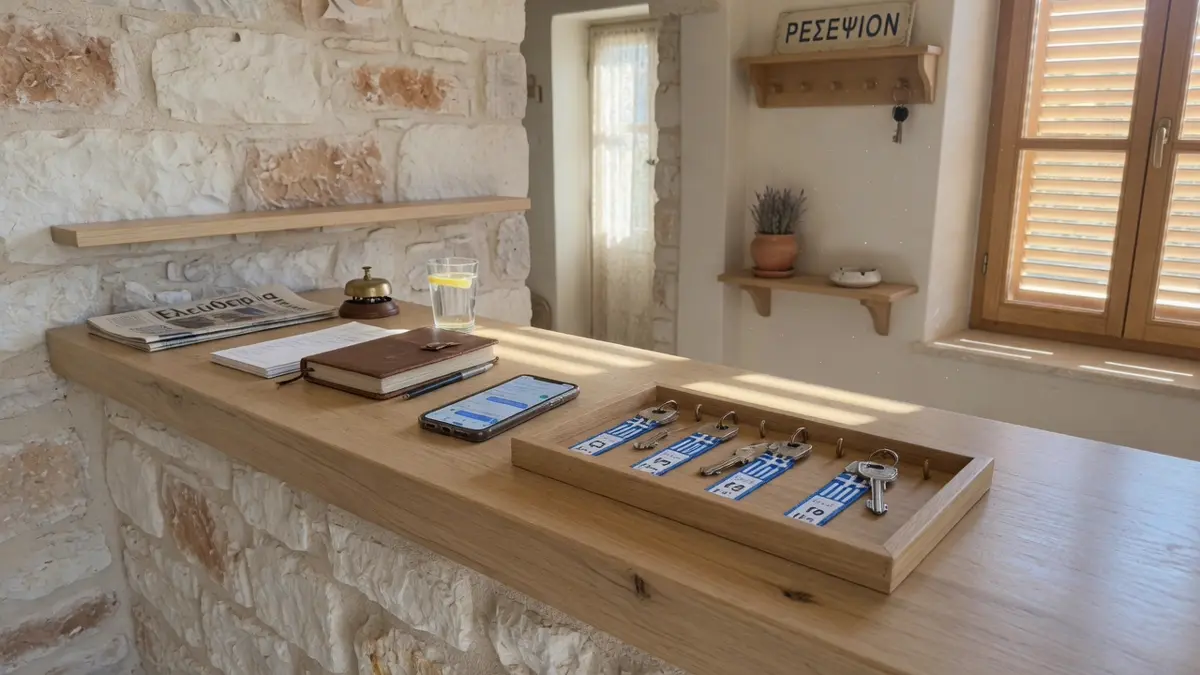
Plenty of small houses lock the desk in the evening. The ones that do it well have a rule they can say out loud: last check-in at a time you set, a key box with a code you send, a mobile that still rings, or no, we do not take arrivals after that boat.
A guest on the last ferry from Piraeus is asking whether anyone will be there, and what to do if not. The honest answers are short: yes until a time you set; here is how the key box works; ring this number when you are at the door; or no, we cannot take you tonight.
An assistant that answers with “someone will wait” when you are asleep has not heard the question. Write the rule once, the way you would text it to a guest at ten. Last time. Key or no key. Who, if anyone, still answers. If the rule is empty, it will invent a welcome you cannot keep.
A no-show in the morning is a different call. The assistant does not release the bed, refund it, or offer it unless you wrote that down.
Breakfast, bags, and the questions it may answer
Not every call is a room. People ask when breakfast is, whether they can leave bags after checkout and collect them before the evening boat, where to park, and whether the house is a walk from the port.
Those answers live in what you typed in. The assistant may repeat them. It may not invent a shuttle, a sea-view table, or a parking space you do not have. If the door is down the lane and not on the main street, that sentence belongs in the first things it can say.
A call about a broken air conditioner, a noise, or a shower is a note. It is not a promise of a new room.
How CITT handles it
- Your number stays on the site and the card. A forwarding rule sends what you do not answer. Calls the desk picks up never leave the house.
- Several calls are answered at once. A check-in burst is a set of conversations, not a stack of busy tones.
- It knows the house you described. Room types, pickup, what happens after the desk closes, parking, breakfast.
- It asks stay, pickup or late arrival first, then takes the facts that belong to that request.
- It checks the real book before it says a room is free, and writes only what you allow into the same book the desk already uses.
- It confirms by SMS, in the language of the call — 70+ languages.
- It escalates what cannot be finished on the call — an unpublished rate, a room the book will not confirm, a complaint, a date change on a site booking — as a tagged note.
- You get the transcript, the summary, and which of the three requests the caller made.
What it will not do
It will not invent a free room. If the book does not show one, the caller gets a request taken, not a yes.
It will not invent a rate, a driver, or a person waiting at a locked door. Pickup is only if you offer it. A night welcome is only the rule you wrote.
It will not move a stay that already lives on the booking site. It will not offer a free night, a refund, or a different room because the caller is unhappy. It takes the request. A human decides.
What these calls sound like
The order is the kind of call, then the facts, then the book, then the rule for the night said out loud. There is no invented room and no invented price. There is no “I’m sure we can collect you at eleven” when you do not run a transfer.
If the assistant is friendly and still says the last double is free, two parties meet in the hall. Put the person who rang about the twelfth to the fourteenth on a request the desk can finish, or on a bed the book actually shows.
What you set up first
Put the assistant on the number on the card with a forward-on-no-answer rule, so a free pair of hands at the desk still takes the call. Then the first split — stay, pickup, late arrival — and the book you already use.
Give it only the published rates it may repeat. Write the late-arrival rule, breakfast hours, bags, parking, and how to find the door from the port. Write one line that forbids a free night or a new room from the phone.
Rates for the service live on the pricing section of the home page. They are not repeated here.
AI receptionist, in-house staff, or a call centre
| CITT | In-house | Call centre | |
|---|---|---|---|
| Check-in hour | Answers while the desk finishes the guest in front of them | One call, if they can put the passport down | Depends who was rostered |
| First question | Availability, pickup, or late arrival | Yes — they can hear it | Often jumps to dates |
| Invents a free room | Never — book or callback | Sometimes from memory | Risk, if the sheet is stale |
| Invents a rate | Repeats only a published figure you gave it | Can look at the board | Reads a list that may be last year's |
| Airport pickup vs a room | Treats them as two requests | Yes | Books a room and hopes |
| Guest's language | 70+ languages | Greek, and English if they have it | Whoever is on that shift |
| Late arrival after the desk closes | Follows the rule you wrote | If they are still awake | Takes a message for the morning |
What one unanswered check-in hour costs a small guesthouse
Worked from these assumptions — change any of them and the answer changes:
- One person at reception. Check-in runs from 14:00 to 17:00 on a normal summer afternoon.
- About 18 inbound calls in that window. The desk reaches perhaps 7, between guests.
- Of the ones nobody reaches, 4 are new availability calls for two nights.
- A two-night stay is worth about €160 to the house — YOUR figure will differ, and this is the number to change first.
- Not every call would have been a stay you could take. This example assumes 2 of those 4 would have been bookable on your book. Change that if yours is lower.
- Two of those four callers book the next guesthouse on the same street instead of leaving a message.
- 4 new availability calls reach nobody in one check-in hour.
- 2 of them do not call back and book somewhere else.
- If 2 of the 4 would have been stays you could take, that afternoon is €320 that never arrives.
- Check-in hours alone, over a 20-week summer — 20 × €320. Put your own weeks in.
About €6,400 a season, from one recurring three-hour window — and only if you accept the conversion above. Change it.
What it costs
CITT is pay as you go: no packages, no minimum, no contract. The current rates — the monthly fee per number and the per-minute rate — are on the pricing section of the home page, which is the only place they are published.
Frequently asked questions
Do I have to give up the number on the site and the cards?
No. The number on the website, the Google profile and the printed card stays yours. You add one forwarding rule with your telephony provider — every call, or only the ones still ringing after the seconds you choose. If someone at the desk picks up, the call never leaves the house and is never charged.
Can it tell a caller a room is free?
Only if the book you connected shows a free room for those dates at that moment. If the book is silent, stale, or unreachable, the assistant does not guess. It takes the dates, the room type they asked for, and a number, and leaves the confirmation to you. Saying a room is free when the channel already sold it is worse than a missed call — two parties arrive for one bed.
Can it quote a rate over the phone?
It can repeat a published rate you gave it for those dates and that room type. It must not invent a figure from a description, round a sea-view room down to the garden price, or guess what August costs this year. A number spoken on your number is your number. Anything else is a callback.
What if they are arriving after the desk closes?
That is a late-arrival call, not a new booking. The assistant follows the rule you wrote: last check-in time, key box, who to ring after midnight, whether someone will wait. It does not promise a person at the door if you do not wait. It does not invent a lock box you do not have. A guest who is already on the last ferry needs the true rule, not a hopeful one.
The caller speaks no Greek. Can it still take the call?
It picks up the language from the first sentence and continues in it, including switching mid-call. In a Greek hotel that is the ordinary afternoon: English, German, French, Italian, Dutch, and more in the same week. The SMS confirmation follows the language of the call. You do not configure a language per room.
What do we see after a call?
A transcript, a short summary, whether they asked for a stay, a pickup or a late arrival, the dates they named, and whatever was booked or left for the desk. Confirmations go out by SMS in the language of the call.