AI phone receptionist for restaurants and tavernas
Quick summary
- Saturday night both hands are on plates; the person who would pick up is running food or standing at the pass.
- Ask reservation, walk-in or takeaway first — those are three different jobs and they must not share a table.
- A table that is not in the book is not a table you can give. It checks before it offers.
- A walk-in who gets voicemail hangs up and sits down somewhere else.
- Seasonal hours and the terrace change. November on an island is not July.
- It will not invent a menu price. Catch of the day and dinner-for-two stay with someone who can see the board.
TL;DR
Saturday night the phone rings and nobody can pick up. Both hands are on plates. The caller wants a reservation, a walk-in, or a takeaway — three different jobs — and a table that is not in the book is not a table you can give. They will not wait on voicemail; they ring the next place or walk in there. An assistant answers every line at once, asks which of the three they mean, checks the real book, writes the reservation in, texts the confirmation, and says the hold you actually use. It will not invent a table, and it will not invent a menu price.
Key takeaways
- Put the assistant on the existing restaurant number with a forward-on-no-answer rule, so whoever is free at the door still takes the call.
- Give it three jobs first: reservation, walk-in, takeaway — and which of those you actually do on Saturday night.
- Tell it never to offer a table it cannot see in the book, and never to invent a menu price.
- Mark the terrace months and the winter hours. Do not let it reserve the terrace in a month you have it closed.
- Use the hold you already say out loud, and treat a cancel inside that hold as a table that is free again.
- Large parties, name days, and allergy questions are notes or a callback. The assistant does not confirm twelve and does not decide if a dish is safe.
What an AI phone receptionist does in a restaurant
An AI phone receptionist answers the restaurant number, talks the way a person at the door would, and then does something with what it heard. It puts a reservation in the book, tells a walk-in whether it is worth coming down, takes a takeaway if you still do them, or writes a note for whoever is free.
The first thing it has to get right is the job. A reservation, a walk-in and a takeaway use the kitchen differently and the room differently. They must not be given the same table. An assistant that opens with “what time would you like?” will hold a terrace table for four for someone who wanted two gyros at the door. It asks what they need. For a reservation it then asks how many, which night, and inside or on the terrace. After that it checks the book you already use, offers only a table that is free, writes it in, texts the confirmation, and says the hold you actually use.
If they rang in English, the confirmation is in English. If they rang in Greek, it is in Greek. The assistant works in 70+ languages, and the SMS follows the call.
Saturday night, both hands on plates
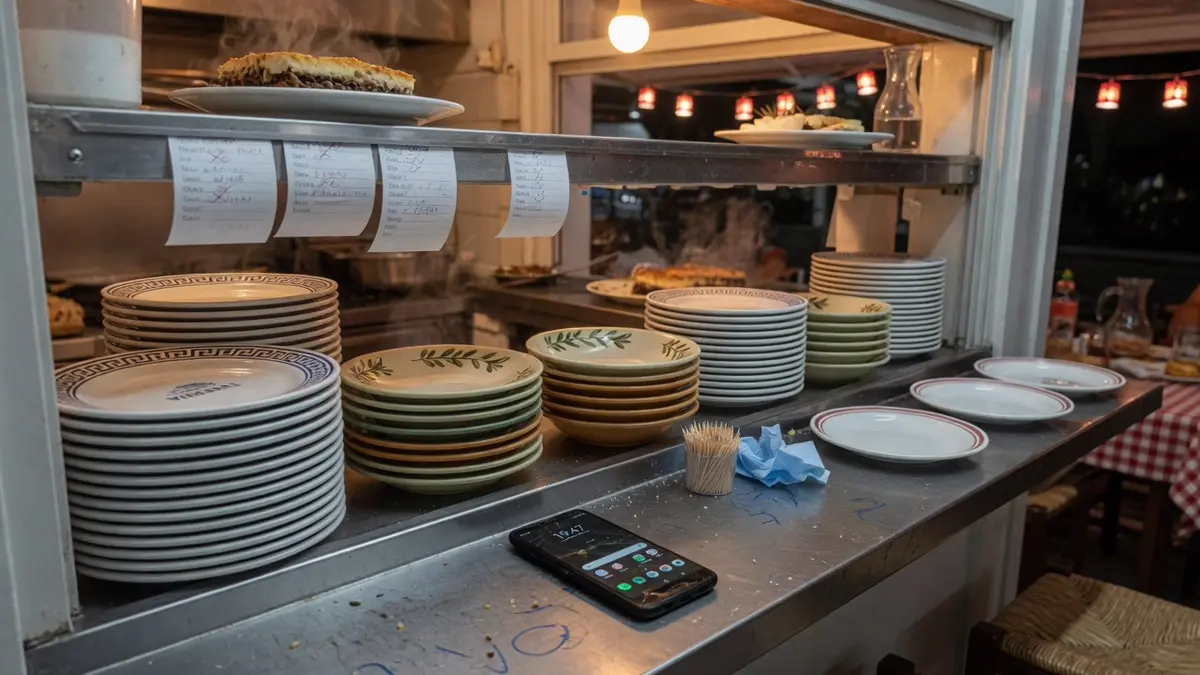
Saturday night, mid-service. Both hands are on plates. One person is at the pass. Another is in the room with a tray. The kitchen is sending food out. The phone rings, and nobody can pick up, because both hands are full and the guests at that table cannot be left.
It is a burst from the first seating through to last orders, on the one night you cannot spare a pair of hands. A second person hired for Tuesday lunch does not touch Saturday night. A second line with the same two hands still leaves the third caller listening to a busy tone.
The caller who wanted a table is often already in the street or on the harbour road. They are not going to wait on voicemail. They hang up and sit down somewhere else.
How many you can take is not a feeling you invent on the phone. “We have tables” is wrong the moment a table for eight is in, or the terrace is wet, or the kitchen has already sold the last fish.
Walk-ins, reservations and takeaway share the same Saturday night. If the assistant treats every call as a reservation, the walk-in you have always taken at the door disappears. If it treats every call as a walk-in, it tells people to come down when the book is already full. If it takes a takeaway the kitchen cannot cook during service, the people already seated wait for their food. The assistant has to be told, in the setup, or Saturday night will have a reserved four, a walk-in four, and two souvlaki tickets at the same pass.
Sunday lunch is the same kind of crush in a lot of Greek rooms, only earlier. If that is your busy service, mark it the way you mark Saturday.
Reservation, walk-in or takeaway
Reservation. How many people, which night, what time, inside or terrace. A table for two at seven and a table for eight at nine are two different pieces of work. The assistant asks which of those the caller means, then looks only at tables that actually fit.
Walk-in. The caller is asking whether it is worth crossing the street, not for a time next Thursday. The honest answers are short: yes, come now; yes, but you will wait; no, the book is closed, here is the next night we can reserve. An assistant that answers that question with Thursday at 20:00 has not heard it.
Takeaway. A different ticket, sometimes not offered at all once the room is full. Two gyros for pickup is not a table. If you stop takeaway at nine on Saturday, mark that. If you do not do takeaway, say so, so it stops taking those orders and offers what you do.
Party size is the question that has to be written down: “How many are you?” An assistant that skips it holds a table for two for a party of six. A table for four is not two tables for two pushed together, not unless you have said the assistant may do that. Combining tables is a decision in the room.
The terrace, winter hours, and a book that is not July
Plenty of tavernas in Greece do not run the same book in July and in November. The terrace is open when the weather allows. On an island, Tuesday lunch in winter may not exist. In a city, Sunday lunch may be the service you protect. The assistant has to know which week it is answering for.
A caller who asks for the terrace in January is not asking for the same table as a caller in August. If you have marked the terrace closed, the assistant says so and offers inside, or takes a note.
A caller who asks “are you open next Tuesday?” in November is asking whether you still run that day. If Monday and Tuesday are closed from October, mark them. An assistant that takes a Tuesday in November because the summer hours are still in the notes will have people arrive to a dark dining room.
August, Easter, the fifteenth of August, a name day in the village — those nights are not a normal Saturday. If you stop taking reservations at a count you set, or you want a human on anything over a number you choose, write that down. The assistant will honour a list it can see.
Tourists call in English, German, French. Locals call in Greek. If the Saturday SMS goes out in the wrong language, they ring again during service to ask whether they are in.
Do not offer a table that is not there
When someone asks for Saturday at nine for four, the tempting answer is yes. The assistant does not give a table it cannot see. If the time is gone, it offers the next time that fits, or it takes a callback. If it says yes when the book is full, four people arrive and there is nowhere to sit.
It can repeat what you published. Saturday lunch is open. The terrace is open in July. Last seating is 22:30. It cannot invent a spare table behind the one that is already reserved, and it cannot hold two sittings on one table unless you have said that you turn that table. Write “always say yes” into the notes and it will say yes.
Parking, the door on the side street, whether you take cards — those are facts you write once. They are not a reason to invent a table.
Menu prices the phone cannot give
When someone asks what dinner will cost — for two, for a family, for the fish they have not seen — the tempting answer is a number. The assistant does not invent one. Catch of the day, lamb by the kilo, and a wine they have not named all change the bill. It can repeat a listed main or a set lunch you gave it. Tonight’s fish, and “how much for two people”, cannot. A guessed average spend in the notes will be read out.
Fifteen minutes, last seating, takeaway tickets
A guest who rings at eight to cancel a twenty-past-eight table is still inside the hold most of you already say out loud, and that table can still be offered to the next person who calls.
Set the hold you actually enforce. Fifteen minutes past the time is the figure many of you already use. The assistant should say it at the end of a reservation, and treat a cancel inside that hold as a table that is free again, not as a note for Monday. If the cancel rule is written for the next day, a cancelled nine o’clock stays empty through the service that needed it.
Last seating is not the same as the kitchen closing, and neither is the same as the bar still serving. A caller at twenty-three who wants dinner is asking for a table, not a drink. If last seating is 22:30, the assistant says so. It does not seat four people at 23:00 to be kind.
Takeaway during service has the same kind of line. If the kitchen can send two gyros at 21:30 on a Saturday, you have said so. If it cannot, the assistant must not promise twenty minutes — the people already seated then wait for their food.
Twelve for a name day, and a note about nuts
A caller wants a table for twelve. A caller is booking a name day. A caller asks if the fish is safe for a child with a nut allergy. A caller wants to know whether they can bring a cake.
The assistant does not rearrange the room and it does not decide if a dish is safe. It can write “no nuts” on the booking you actually take. It cannot say that a plate is safe, what a guest should eat, or whether something will make them ill. Those calls are a note. They are never advice.
For a party over the number you set, take a callback if that is your rule. Some of you take eight on the phone and want a human at ten. Some of you want a set menu talked through first. The assistant follows your rule. It does not invent one.
A complaint about last night: take the name, take what they said, put it in front of you. Do not offer a free meal from the phone. A high chair, a dog on the terrace — write the policy once. The assistant repeats it.
How CITT handles it
- Your number stays on the door. A forwarding rule sends what you do not answer. Calls the door picks up never leave the restaurant.
- Every line is answered at once. A Saturday burst is conversations, not a stack of busy tones.
- It knows the room you described. Which jobs you take, whether Saturday night still does takeaway, when the terrace is open, how the hold works.
- It asks reservation, walk-in or takeaway, then how many, then looks at the book. A table is offered only after those facts exist.
- It checks the real book before it offers a table, and writes the reservation into the same book you already use.
- It confirms by SMS, in the language of the call — 70+ languages — and can remind before the night.
- It escalates a twelve for a name day, an allergy question, a complaint — as a tagged note, not as a guess.
- You get the transcript, the summary, and which of the three jobs the caller named.
What it will not do
It will not invent a table or a menu price. It will not decide if a dish is safe. It will not treat walk-in hours, reserved tables and takeaway tickets as the same book. It will not open the terrace in a month you have it stacked, or take a Tuesday in November if you marked winter closed. It takes the request. A human decides.
What these calls sound like
The order is the job, then how many, then the offer, then the hold said out loud. There is no invented table and no dinner-for-two price. There is no “come down, we will find something” over a book that is already full. Put the person who rang at 21:10 for four in the book, or tell them the truth — not on voicemail outside, looking at the next doorway.
What you set up first
Put it on the number on the door. Forward only what nobody answers, so a free pair of hands at the entrance still takes the call. Then the three jobs and which of them you do on Saturday night, the party-size question, the terrace months, the winter hours, and the hold you already say out loud.
Give it the published prices it may repeat — the listed mains, the set lunch — and do not give it a catch-of-the-day figure it would read out. Write one line that forbids allergy advice. Add last seating, whether takeaway stops once the room is full, and who wants a human on parties over your number.
Rates live on the pricing section of the home page. They are not repeated here.
AI receptionist, in-house staff, or a call centre
| CITT | In-house | Call centre | |
|---|---|---|---|
| Saturday night burst | Every line answered at once | One call, if someone can put the plates down | Depends who was rostered |
| Asks reservation, walk-in or takeaway first | Yes — before it looks at the book | Yes | Often jumps to what time |
| Offers only a table that is in the book | Checks, then offers what is free | Yes — they can see the room | Says yes and hopes |
| Terrace months and winter hours | Honours the months you marked | Yes, if they remember | Reads the summer board |
| Fifteen-minute hold, same-night refill | Releases the table and offers it | If someone is free to take the next call | Takes a message |
| Speaks the caller's language | 70+ languages | One or two | Whoever is on that shift |
| What it will not do | Invent a table or a menu price | Can look at the room and the board | Reads a list aloud |
What one unanswered Saturday night costs a small taverna
Worked from these assumptions — change any of them and the answer changes:
- A Saturday service, roughly 25 inbound calls during the hours both hands are on plates.
- Of the calls nobody reaches, 4 are new Saturday tables for two or four.
- A Saturday table for two is worth about €70 to the house — YOUR figure will differ, and this is the number to change first.
- Three of those four callers sit down somewhere else instead of leaving a message.
- If you close for winter, put your own Saturday count in. Forty-eight is a city year, not an island year.
- 4 new reservation calls reach voicemail on a normal Saturday night.
- 3 of them do not call back and sit down somewhere else.
- 3 × €70 = €210 of that Saturday's book, gone during service.
- Saturdays alone, over the weeks you are actually open — 48 × €210, or fewer if you shut after October.
About €10,080 a year from Saturday nights in a city year — less if your season is shorter. Put your spend and your weeks in.
What it costs
CITT is pay as you go: no packages, no minimum, no contract. The current rates — the monthly fee per number and the per-minute rate — are on the pricing section of the home page, which is the only place they are published.
Frequently asked questions
Do I have to give up the restaurant number?
No. You keep the number on the door, the Google listing and the cards on the table. You add one forwarding rule — every call, or only the ones still ringing after the seconds you choose. If someone at the door picks up, the call never leaves and is never charged.
Can it tell a caller what dinner will cost?
It can repeat a published menu item you gave it — a listed main, a set lunch, a fixed meze. It must not invent a price from a phone description. Catch of the day, lamb by the kilo, and “how much for two” all change once someone has seen the board. It takes the request and, if you allow it, puts the reservation in.
Will it give away a table that is not free?
Not if you connected the book and told it never to offer what it cannot see. If Saturday at 21:00 for four is gone, it offers the next time that fits or it takes a callback. It does not invent a spare table, and it does not push two twos together unless you have said it may.
We take walk-ins. Can it still take reservations?
Yes, once you mark what Saturday night actually is. The assistant can say you are taking walk-ins until a time you set, or offer the next reservable table. Mixing the two without a mark is how a reserved four and a walk-in four meet at the same pass. Mark whether the kitchen still does takeaway once the room is full.
What if someone asks about an allergy?
The assistant does not decide if a dish is safe. It can write “no nuts” or “no shellfish” on the booking you actually take. It cannot say that a plate is safe, what a guest should eat, or whether something will make them ill. Those calls are a note, never advice.
What do we see after a call?
A transcript, a short summary, whether it was a reservation, a walk-in or a takeaway, the party size, inside or terrace if they said, and whatever was written in the book or left for the door. Confirmations go out by SMS in the language of the call.