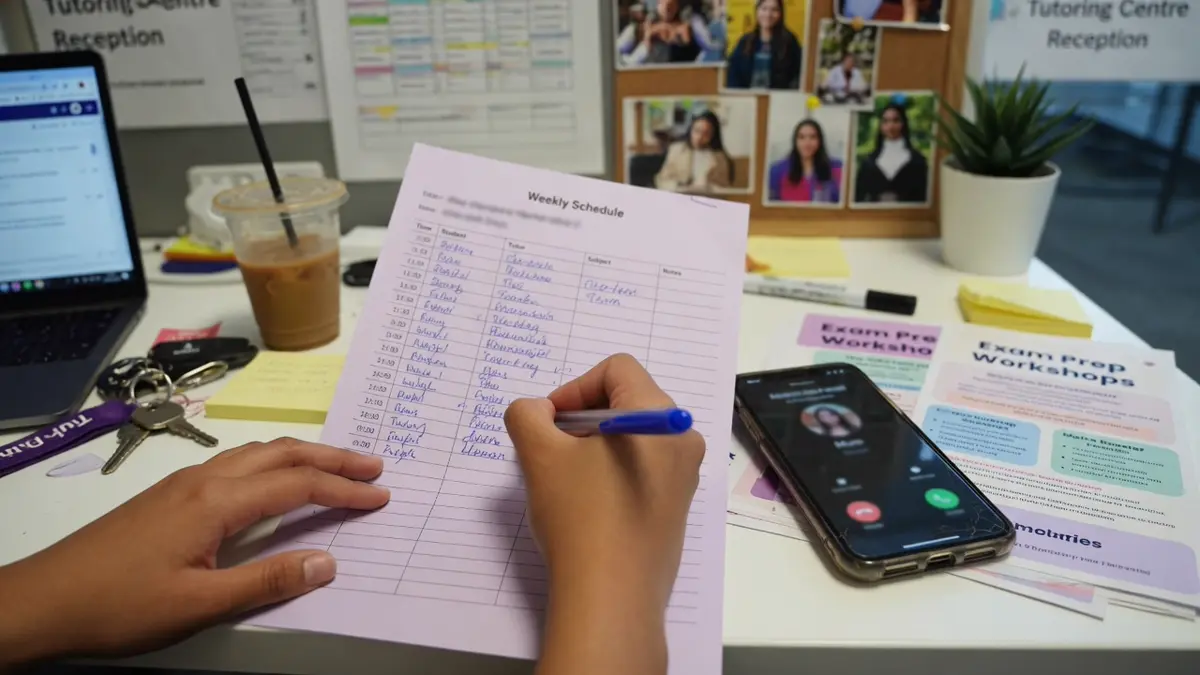
AI phone receptionist for tutoring centres
Quick summary
- After school the teachers are already in a room; the person who would pick up is at the board.
- Ask subject, class year, and whether this is Πανελλήνιες or a regular lesson — those three pick the group.
- A place in a group is a counted seat. If the group is full, say so. Do not add one more.
- The caller is almost always a parent. Speak to them that way, and send the text to them.
- It checks the roster before it offers a group, writes the child in, and texts the confirmation.
- A makeup or a change of day only goes into a matching group that actually has a place.
TL;DR
After school the phone rings and nobody can pick up. The teachers are already in a room. The caller is a parent: they name a subject, a class year, and they mean either the Πανελλήνιες programme or a regular lesson. Those three facts pick the group. A place in that group is a counted seat on a list you already keep. If the group is full, the honest answers are a waitlist or a note that you may open another group. An assistant answers every line at once, asks those three things, checks the real roster, offers only a group with a free place, writes the child in, and texts the parent. It will not invent a seat, and it will not choose a university direction from the phone.
Key takeaways
- Put the assistant on the existing frontistirio number with a forward-on-no-answer rule, so whoever is free in the corridor still takes the call.
- Give it your groups first: subject, class year, exam programme or regular lesson, days, time, teacher, and the maximum you actually allow.
- Tell it to ask subject, year, and exam-or-regular before it looks at days.
- Tell it never to add a child to a group that is already at the maximum — waitlist or a note for you.
- Write the makeup rule you already use, and the rule for moving a child to another day.
- Tell it not to advise on university direction, and not to invent a sibling discount.

What an AI phone receptionist does in a frontistirio
An AI phone receptionist answers the number on the door, talks the way someone at the desk would, and then does something with what it heard. It puts a child on a group that actually has a place, sends the parent a text, or writes down what they asked and puts that note in front of you.
This is a frontistirio, not a tutor who drives from house to house. The child sits with others of the same year, on fixed days, with a teacher already at the board. A parent does not ring for “a lesson”. They ring for maths or physics or ancient Greek, for a child in a specific year, and they mean either the Πανελλήνιες programme — the university entrance exams — or help keeping up with school. An assistant that opens with “what time suits you?” will put a Γ Λυκείου exam student into a B Lykeiou homework group.
After those three facts it checks the roster you already keep, offers only a group with a free place, writes the child in, texts the parent, and says how a place is held — usually once they finish the enrolment at the desk.
A parent who rang in English gets the confirmation in English. A parent who rang in Greek gets it in Greek. The assistant works in 70+ languages. The SMS follows the language of the call.
After school, when every teacher is already in a room
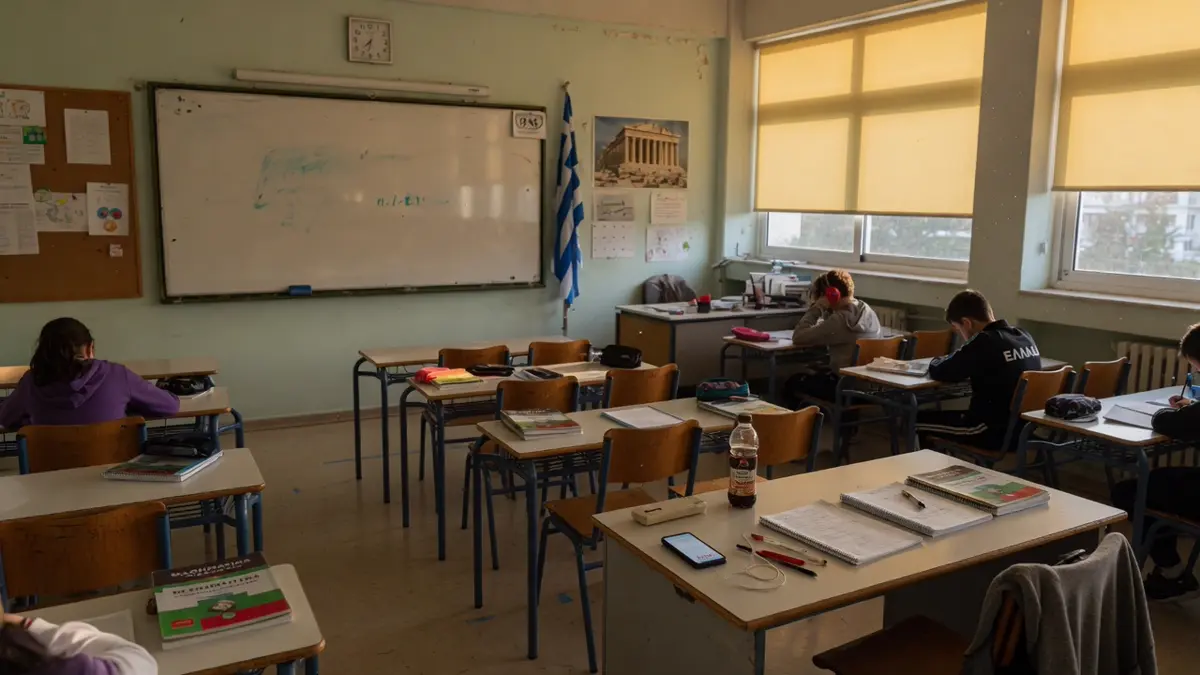
It is 16:40 on a Tuesday. School finished an hour ago. Behind the glass doors the B Lykeiou maths group is already at the board. Next room, chemistry. The owner is covering Γ Λυκείου because the usual teacher is off. The phone on the desk rings.
Nobody can pick up. The person who would have walked to the corridor is explaining a problem, or watching six children write, and they cannot leave the room.
These calls arrive from the moment school lets out until the last group of the evening. A person hired for the morning does not hear them. A second line on the same empty desk still leaves the parent listening to a ring. They already have your flyer and the one from the frontistirio on the next street. They hang up and dial the next number.
September is the same window with more new names. January is the child who changed school, or the parent who waited for the first marks. In the weeks before Πανελλήνιες the calls are extra hours and mock exams, not first enrolments. Mark which groups still take new names, which only take makeups, and which weeks you add hours.
Subject, class year, exam or regular lesson
Subject. Maths is not physics. Ancient Greek is not modern Greek. English as a school subject is not the chemistry exam group. If you do not offer a subject, the assistant says so and stops. If you do, it still needs the year and the programme before it looks at days.
Class year. A, B, or Γ of Γυμνάσιο. A, B, or Γ of Λύκειο. A Γ Λυκείου child in a B group sits through work they have already done, and the B children get pulled forward. The assistant asks the year. It does not guess from the child’s age.
Exam programme or regular lesson. A parent who says Πανελλήνιες means more hours, mock exams, a pace that is not the homework group. A parent who says the child is struggling with next week’s test means the regular group. Mixing them puts an exam student in a room doing exercises from the school book. The assistant asks which of the two they mean. If the parent is not sure, it does not pick the shorter group to sound fast. It takes a note for you.
Only then does it look at days. Write the three questions the way you would for a new person at the desk: which subject, which year, exams or school. An assistant that skips any of them books the wrong room.
A place in a group is a counted seat
You already know how many chairs are in that room and how many names are on the list. Six was the number you set because seven means the child at the back cannot ask. A place is a name that is not there yet, under a maximum you wrote down.
The assistant has to see that list: subject, year, programme, days, time, teacher, maximum, how many names now. If Tuesday and Thursday B Lykeiou maths for the exam programme is at the maximum, that group is full. The honest answers are the other matching group, if it has a place; a waitlist; or a note that you may open another group. An assistant that has not looked at the list, and still says there is a place, has invented one.
Do not give it a sentence that lets it “use judgement” on a full group. It will hear a worried parent and add the name. You open another group, or you do not. The assistant does not decide that from the phone.
A trial lesson follows the same rule. It goes into a group that has a place, for the subject and year the parent named. A parent who wants maths and physics is asking for two groups and two places. Check both. Two children in the same family are two enrolments. Each needs a place.
A place is held the way you already hold it — usually once the parent comes in and finishes the enrolment. The assistant should say that at the end of the call, so the parent does not think the place is theirs because someone said yes at 17:05.
The parent on the line
The student is at school, or already in a room down the corridor. The person on the phone is a mother or a father, sometimes a grandmother. They know the year and the subject. They do not always know whether they mean the exam programme. They often want a day that fits the rest of the week.
Speak to the parent. Send the SMS to the parent. A confirmation that goes to the child’s number is a confirmation nobody reads.
They will ask how many children are already in the group. The assistant can say the count and the maximum if you allow it. “There is one place” is clearer than “the group is nice and small”.
They will ask for a named teacher. “Can he have Kostas?” Only if that teacher’s matching group has a place. If it is full, say so. Offer another teacher only if that group matches, has a place, and you allow the swap. If the parent will not take anyone else, the answer is the waitlist — not a promise that Kostas will take one more.
They will ask whether the child can start next week, in October, in January. Mid-year is possible when a place exists. Whether the child can catch up is a conversation with you. The assistant books a place or a talk. It does not promise the year can be repaired from the phone.
Makeup lessons and a change of day
A child missed Thursday because the school had a test. The parent wants a makeup this week. That is not a new enrolment. It is a request to sit in another group of the same subject and year, or a note for the teacher if you do makeups as extra time.
Write the rule you already use. Same week only, or until the next lesson. Only a group that matches. Only if that group has a place. If Friday’s group is a different year, it is not a makeup. If Friday’s matching group is full, it is not a makeup. The assistant takes a note.
A change of day is the same test. School moved the timetable; the parent wants Wednesday. Wednesday’s matching group either has a place or it does not. Moving the child into a full group, or into the wrong year because the hour was empty, leaves Wednesday’s teacher with a name the room cannot take.
If you do not offer makeups at all, say so in the notes. The assistant should not invent a Friday hour to keep the parent on the line.
Fees it may repeat, and questions it must not answer
It can repeat a published monthly fee you gave it — one subject, one year, exam programme or regular lesson, the figure on your sheet. A parent who wants two children, three subjects, and “something on the price” is not a number the assistant should invent. Those calls are a note or a time with you. Do not put a discount table in the notes. It will read the number out.
A parent asks whether the child should take θετική or οικονομία. A parent asks which university is realistic. A parent asks how many extra hours will be enough for Γ Λυκείου in four months. The assistant does not answer those. It has not seen the child’s marks. It books a conversation with you, or it writes the question down.
A complaint about last month’s teacher, or a mark that did not move: take the name, take what they said, put it in front of you. Do not offer a free month from the phone.
How CITT handles it
- Your number stays on the door. A forwarding rule at the provider sends what you do not answer. Calls someone in the corridor picks up never leave the building.
- Every line is answered at once. An after-school burst is a set of conversations, not a stack of rings.
- It knows the frontistirio you described. Subjects, years, exam or regular groups, the maximum on each, the makeup rule, the floor.
- It asks subject, class year, and exam-or-regular, then looks at the roster. A group is offered only after those three facts exist.
- It checks the real roster before it offers a place, and writes the name into the same list the teachers already use.
- It confirms by SMS, in the language of the call — 70+ languages — and can remind before the first lesson.
- It escalates what cannot be finished on the call — a direction question, a discount, a complaint — as a tagged note, not as a guess.
- You get the transcript, the summary, and the subject and year the parent named.
What it will not do
It will not invent a place in a group. A full group is full.
It will not put a child in the wrong year, or in the exam programme when the parent asked for school support, because an hour happened to be free.
It will not choose θετική, θεωρητική, or οικονομία, and it will not say which university is realistic.
It will not invent a sibling discount or a two-subject price, or promise a named teacher whose matching group is full.
It will not decide a makeup that has no place, or a change of day into a group that does not match.
It will not tell a parent the child can catch up from January to June. That is your conversation.
What these calls sound like
The order is the subject, then the year, then exam or regular, then a group that matches and has a place, then how the place is held, said out loud. There is no “I’m sure we can add one more”. There is no direction advice. There is no fee that is not on the sheet you gave it.
The parent who rang at 16:40 about B Lykeiou maths should leave the call with a real place or a waitlist. They should not leave with a yes that the roster cannot support.
What you set up first
Put the assistant on the number on the door with a forward-on-no-answer rule, so whoever is free in the corridor still takes the call. Then the groups: subject, class year, exam programme or regular lesson, days, time, teacher, maximum, how many names are on each list now. Then the three questions, in that order. Then the makeup rule and the rule for moving a day. Then the published monthly fees it may repeat — and no discount figure it would read out.
Write one line that forbids advice on university direction, and one that forbids adding a name to a full group. Add opening hours, who is in on which afternoon, where to park, which floor.
Rates live on the pricing section of the home page. They are not repeated here.
AI receptionist, in-house staff, or a call centre
| CITT | In-house | Call centre | |
|---|---|---|---|
| After-school burst | Every line answered at once | One call, if someone can leave the room | Depends who was rostered |
| Asks subject, year, exam or regular first | Yes — before it looks at groups | Yes | Often jumps to what time |
| Checks a real place on the roster | Offers only a group with a free place | Yes — they can see the list | Says yes and hopes |
| Group already at the maximum | Waitlist or a note, never an extra name | Yes, if they remember the count | Takes a message |
| Makeup or change of day | Only into a matching group with a place | Yes | Writes it down |
| Speaks the parent's language | 70+ languages | One or two | Whoever is on that shift |
| What it will not do | Invent a seat or choose a direction | Can talk to the parent in person | Reads a brochure aloud |
What one unanswered September week costs a small frontistirio
Worked from these assumptions — change any of them and the answer changes:
- A small frontistirio, four rooms, a normal September week of after-school calls.
- Of the calls nobody reaches, 4 are parents asking to place a child in a subject group.
- A new enrolment is worth about €160 a month to you — YOUR figure will differ, and this is the number to change first.
- Two of those four parents enrol at another frontistirio that week.
- A child who starts in September typically stays through June — eight months. Put your own stay in if it is shorter.
- 4 new-enrolment calls reach voicemail in that week.
- 2 parents do not call back and take a place somewhere else.
- 2 × €160 × 8 months = €2,560 of that year's group fees, gone before October.
- September is not the only week. Use the same arithmetic on any week you actually miss.
About €2,560 from one September week of unanswered after-school calls — only the children who never started.
What it costs
CITT is pay as you go: no packages, no minimum, no contract. The current rates — the monthly fee per number and the per-minute rate — are on the pricing section of the home page, which is the only place they are published.
Frequently asked questions
Do I have to give up the frontistirio number?
No. You keep the number on the door, the flyer, and the Instagram bio. You add one forwarding rule with your telephony provider — every call, or only the ones still ringing after the seconds you choose. If someone in the corridor picks up, the call never leaves the building and is never charged.
Will it put a child into a group that is already full?
Not if you gave it the maximum and the current names. It checks the roster before it offers a group. A full group is a waitlist or a note that you may open another one. It does not add a seventh child to a group of six to sound helpful. If the list is empty, it cannot check — fill the list first.
Can it tell a parent what a subject costs per month?
It can repeat a published monthly fee you gave it — one subject, one year, exam programme or regular lesson, the figure on your own sheet. It must not invent a sibling discount, a two-subject price, or a mid-year catch-up fee. Those numbers change in the room. It takes the request and leaves the figure to you.
What if a parent asks which direction the child should choose?
The assistant does not choose. Θετική, θεωρητική, or οικονομία is a conversation with you, not a sentence on the phone. It can book a time for that talk, or take a note. It must not say which field will “suit” the child, which university is realistic, or how many hours will be enough. Those calls wait for a person.
Can it handle a missed lesson or a change of day?
Yes, once you write the rule. A makeup only goes into a group of the same subject and year that still has a place, in the window you already use — often the same week. A change of day is the same test against the other group. If that group is full, it does not move the child. It takes a note for you.
What do we see after a call?
A transcript, a short summary, the subject, the class year, exam programme or regular lesson, and whichever group was offered, put on the waitlist, or left for the desk. Confirmations go out by SMS in the language of the call. You read the evening list the way you already read the paper roster — except the parents nobody could reach are on it too.