AI phone receptionist for IT services
Quick summary
- Both hands are inside a chassis; the person who would pick up is holding a cable or a screw and cannot walk to the counter.
- Ask drop-off, on-site, or already with us first — those are three different jobs, not three times on one book.
- A status call needs the name on the ticket and the day they left it. Then read only what you marked. Do not guess it is almost done.
- The caller with a laptop under their arm does not leave a message. They take it to the next shop.
- It checks the book before it offers a time, writes the drop-off or the on-site in, and texts the confirmation.
- It will not say what is wrong with a machine it cannot see, and it will not quote a repair from a phone description.
TL;DR
Someone at the bench has both hands in a chassis. The phone sits on the counter. The person calling wants to drop a laptop off, wants you at their office, or is asking whether the machine they already left is ready. Those are three different jobs. An assistant answers more than one call at a time, asks which of the three it is, checks the book you already use, writes a drop-off or an on-site into the hours that actually fit, texts the confirmation, and on a status call only reads what you marked on the ticket. It will not say what is wrong. It will not quote a repair. You look at the machine.
Key takeaways
- Put the assistant on the shop number with a forward-on-no-answer rule, so whoever is free at the counter still takes the call.
- Give it the first question first: drop-off, on-site, or already with us.
- For a status call, take the name on the ticket and the day they left it, then read only what you marked.
- Mark bench hours and van hours as two resources. A one-person shop cannot be on-site and at the bench at the same time.
- Do not give it a repair price or a diagnosis it would read out. The sentence you already say before you take the machine is the most it may repeat.
- Forbid format, wipe, and reinstall advice. It takes the request. You decide what happens to the drive.
What an AI phone receptionist does in an IT shop
The assistant picks up the shop number and talks the way you would at the counter if your hands were free. Then it writes a drop-off, books a visit, reads a ticket, or puts a note in front of you.
The first thing it has to get right is which job this is. A laptop that is not in the shop yet, a visit to an office, and a machine already on the shelf are three different conversations. An assistant that opens with “what time would you like?” will send the van out for a laptop someone was about to carry in, or tell Papadopoulos he can drop a machine off on Tuesday when that machine has been on your bench since Tuesday.
It asks: do you want to drop it in, should we come to you, or is it already with us? After that it checks the book you already use, offers only a time that is free for that job, writes it in, and texts the confirmation. On a status call it does not book anything. It reads what you marked.
If they spoke English, the SMS is in English. If they spoke Greek, the SMS is in Greek. The assistant can do that in 70+ languages.
Hands in the chassis
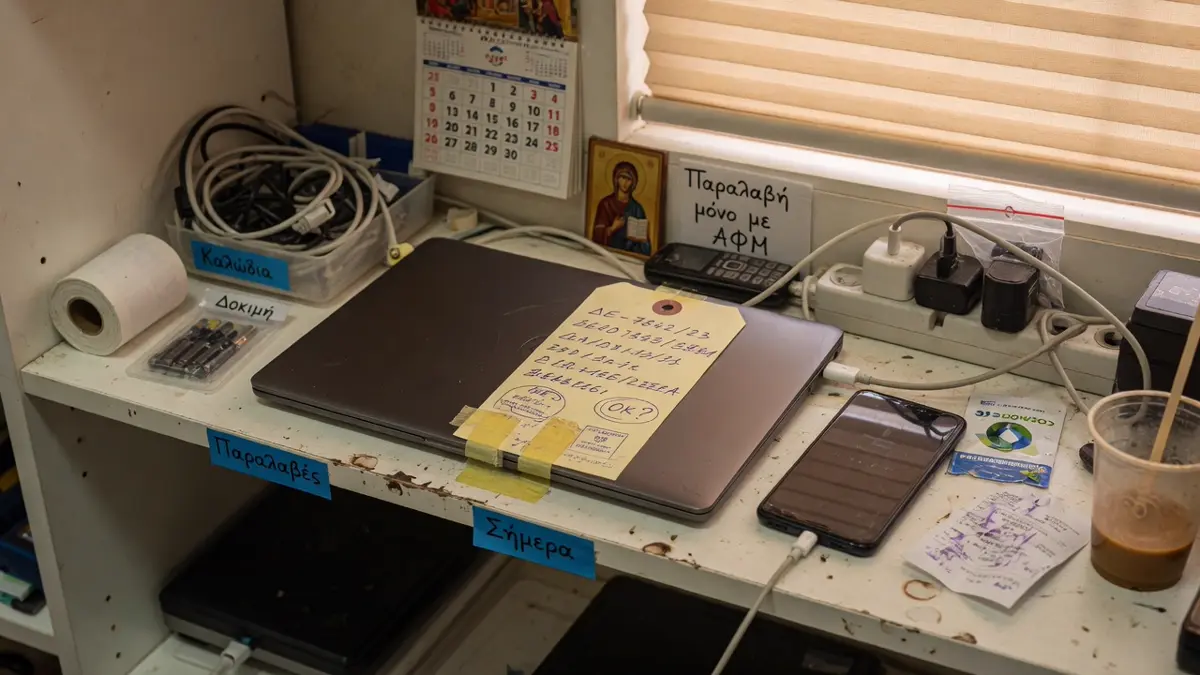
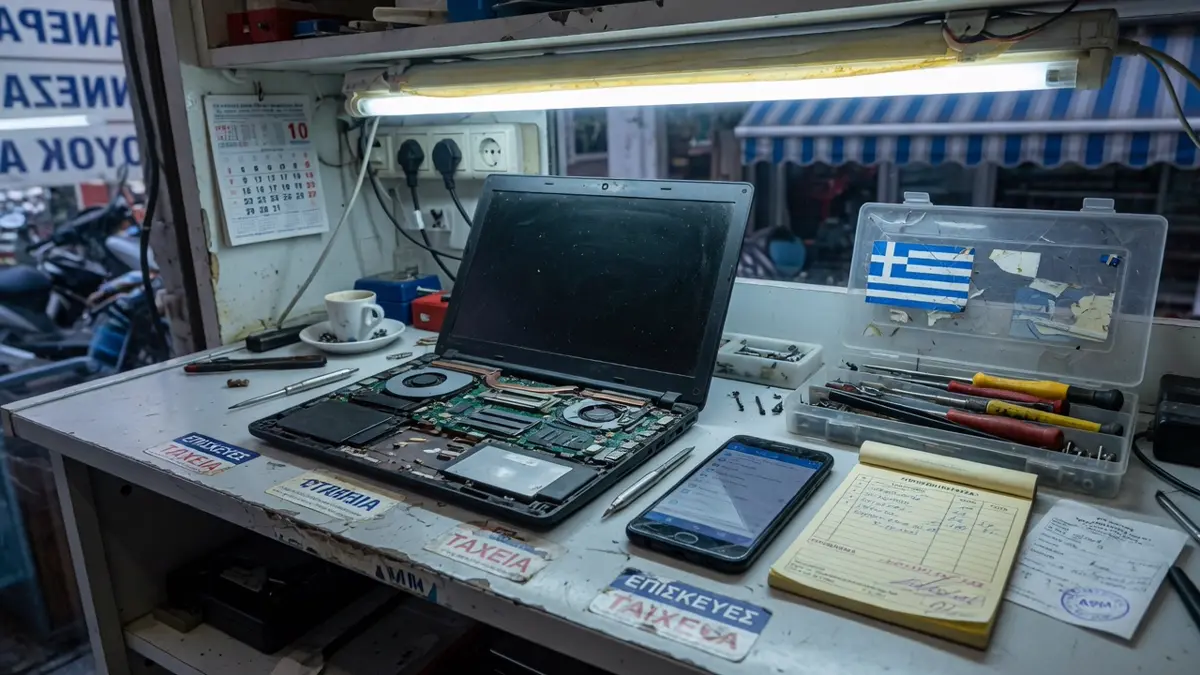
Late morning. A tower is on its side. Both hands are inside the case — one holding a cable, the other a screw that must not fall into the board. The next laptop is already open beside it, bottom plate off. The phone is on the counter, three metres away.
Nobody can pick up. If they put the chassis down they lose the screw, or the memory is not seated, and they will not walk to the counter with the case open.
People keep ringing before you have closed the case. They ring in the hours the bench is actually open. Hiring someone for the quiet morning does not help you at noon. A second number that still rings on the same counter still leaves the third caller on the engaged tone.
The person with a laptop under their arm already passed another shop on the way. They will not speak after a beep. They hang up and walk in there.
The office that cannot print will do the same with a different technician. They need a time at their door, not a message on the shop phone.
The person whose machine is already with you will ring again in twenty minutes, or they will come and stand at the counter. That call is not a new job. Treating it as one is how you book a second drop-off for a laptop that is already on the shelf.
Drop-off, on-site, or already with us
Drop-off. The machine is not here yet. The caller will bring a laptop, a small desktop, a charger, sometimes a printer they can lift. What you need on the ticket is a name, a phone number, what the device is, and what they see — will not power, screen, slow, will not print — in their words. Then a window when someone is actually at the counter to take it. The work starts after you have looked.
On-site. They want you at a house or an office. A cupboard server, a room that will not print, a shop till, a machine they will not carry down the stairs. That is the van, or the bag, and a window at their door. It does not belong on the bench book. If the caller says none of the PCs will print, that is still not a diagnosis. It is a reason to come. Take the address, take the window they can do, check the van hours, write it in.
Already with us. Name on the ticket, day they left it, what the device looks like if two jobs share a surname. Then only what you marked: still on the bench, waiting for a part, ready for pickup. If nothing is marked, the honest sentence is short: I do not have a status I can give you; I will leave a note so you can ring them. “Almost done” is a guess. Do not let the assistant say it.
A caller who wants remote help is another kind of job only if you actually offer it. Write it down. A machine that will not power on cannot take a remote session. The assistant must not offer one to be helpful.
The bench and the van
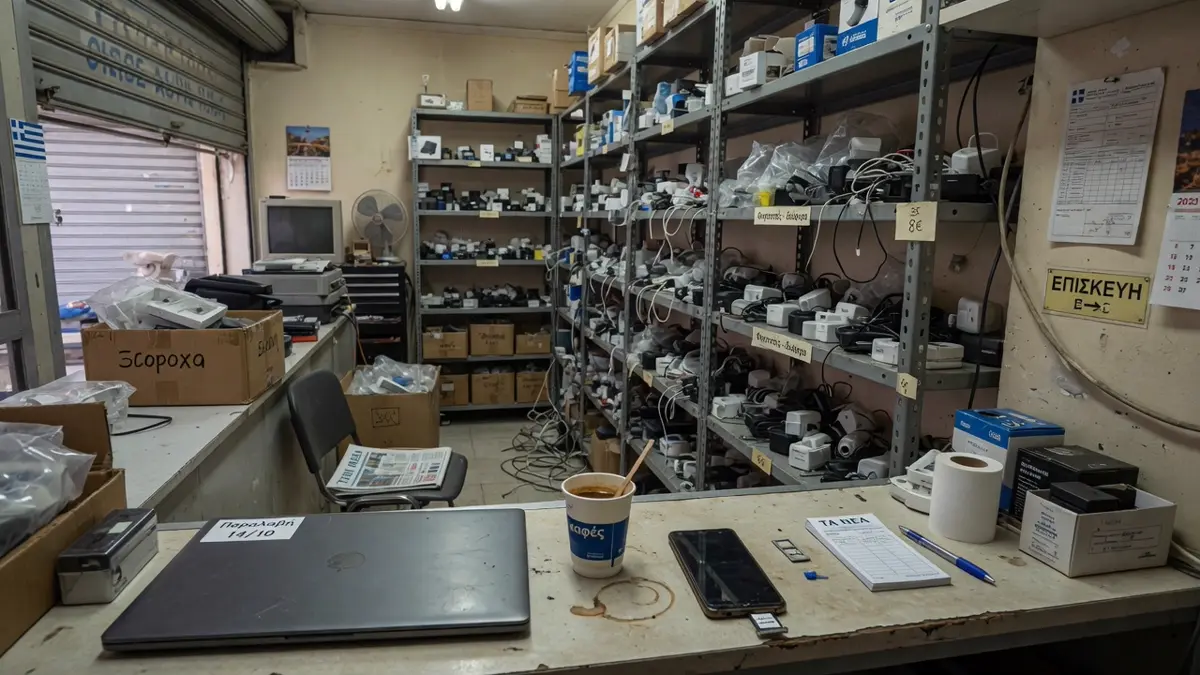
In a one- or two-person shop the counter is empty most of the morning. You are inside a case, or you have the bag open at someone’s office. The person who would have picked up is the person whose hands are busy.
The assistant has to know who can take which job. If only one of you does on-site, an afternoon visit can only go on that person’s hours. If you are a one-person shop and you leave in the van, nobody is at the bench. Write it that way. An assistant that sees one open book will send you out while a chassis is still open, and the person who was told “today until 14:30” will stand at a locked door with a laptop.
Saturday morning is its own mark. Plenty of you take a drop-off or a pickup then and do not take on-site. If Saturday is pickup only, say so. A caller who asks “are you open Saturday if I only want to collect?” wants to know whether it is worth crossing town. Yes until a time you set; no, Monday from 09:00; or yes for pickup, no for a new drop-off. If they asked about Saturday pickup and the answer is Thursday at 16:00, the assistant answered a question they did not ask.
If one of you is off in August, the list has to show it. The assistant will honour a list it can see. If the list is empty, it will offer the van on a day nobody can leave the bench.
“Is it ready”
This is the call you already know. They left it Tuesday. It is now Thursday. They want the laptop back for the weekend, or for work in the morning.
The assistant is not looking at the bench. It can only read the ticket. That is why the mark has to exist. Ready for pickup is a box you tick, or a line you write, in the same place you already keep jobs. Until that mark is there, the answer is not ready.
A caller who then asks what is wrong is asking for a diagnosis. The assistant does not have one. It can repeat a line you wrote on that ticket — “waiting for a part”, “we need to speak to you before we continue” — and nothing else. It does not say the board is gone. It does not say it is only the charger. It does not say the files are safe.
If they want to come and wait, do not invite them unless you said that is allowed. Offer the text when you mark it ready.
A charger or a bag left with the machine is a note on the same ticket. The assistant can read that note. It cannot invent that the charger is in the drawer.
A price and a diagnosis nobody can give from a description
When someone describes a laptop on the phone — it will not turn on, they think it is the charger, there was a noise last week — the tempting answer is a number, or a name for the fault. The assistant does not give either.
A screen you have not seen is not a screen price. A board you have not opened is not a board job. “Probably the charger” said out loud is a promise the next person at the counter has to undo.
It can repeat the sentence you already say before you take the machine — the line on the wall, if you have one. A repair you have not opened does not have a price yet. The assistant takes the request and books the drop-off or the on-site. The price comes after you have opened it.
Do not type a screen price or a board price into the notes. The assistant will say the number. If you do not want that number on the phone, do not give it the number.
If they ask about warranty, the assistant does not decide. It takes the make, the age if they know it, and books the look. You decide.
Data, passwords, and “just format it”
A caller asks if the files are still there. A caller wants you to reinstall Windows. A caller starts to read a password onto the line. A caller asks you to wipe the drive before their cousin picks it up.
The assistant does not promise the data. It has not seen the drive. The honest line is: I will note that the files matter, and someone here will talk to you before any wipe or reinstall. That is a request. It is not a recovery.
Do not let it walk anyone through a format, a BIOS reset, or a reinstall over the phone. That is how a drive gets emptied before you ever hold it. If you offer remote help on a machine that still starts, mark that as its own job. If you do not, say so.
A password does not belong on the recording. The assistant should ask them to bring it written down, or to wait until they are at the counter. It should not take the password as a string on the call.
If they are unhappy about last week’s job, take the name and what they said. Do not offer to do it again from the phone. You look at the machine.
How CITT handles it
- Your number stays on the glass. A forwarding rule at the provider sends what you do not answer. Calls the counter picks up never leave the shop.
- More than one call is answered at the same time. When three people ring during one open case, each of them talks to the assistant.
- It knows the shop you described. Drop-off windows, van hours, Saturday pickup, where to park, how you mark a ticket ready, the sentence you actually say before you take a machine.
- It asks drop-off, on-site or already with us, then looks at the book. A time is offered only after that fact exists, and only on the resource that matches.
- It checks the real calendar before it offers a time, and writes the drop-off or the on-site into the same book the bench already uses.
- It confirms by SMS, in the language of the call — 70+ languages — and can text again when you mark a ticket ready.
- It escalates what cannot be finished on the call — a diagnosis, a repair price, a data question, a complaint — as a tagged note.
- You get the transcript, the summary, and which of the three jobs the caller named.
What it will not do
It will not open the machine, name the fault, or quote a repair. A screen, a board, a “probably the charger” figure is a number you have to take back.
It will not say a laptop is ready because the caller sounded tired of waiting. Ready is a mark on the ticket.
It will not treat bench hours and van hours as the same book. Mark the difference, or it will send you out while a case is still open.
It will not promise the files, take a password on the line, walk anyone through a format, or offer remote help on a machine that will not power on. It takes the request. A human decides.
What these calls sound like
The order is which job, then the facts for that job, then the offer. On new work, the assistant says the sentence you already use before you take a machine. It does not give a repair price. It does not say it can do the job today over a bench that is already open.
If it still books the van over a drop-off window, someone stands at the counter with a laptop and the door is locked. Kostas who rang at 11:10 about a Dell that will not power should be a name on a ticket. He should not be standing in the next shop with the same laptop.
What you set up first
Put the assistant on the number on the glass with a forward-on-no-answer rule, so a free pair of hands at the counter still takes the call. Then the first question, bench hours and van hours, the Saturday rule, and the sentence you already say before you take a machine.
Give it the published line it may repeat. Do not give it a repair figure. Write one line that forbids a diagnosis, a format, a wipe, and a password spoken on the call. Add opening hours, who is in, where to park, how you mark a ticket ready.
Rates live on the pricing section of the home page. They are not repeated here.
AI receptionist, in-house staff, or a call centre
| CITT | In-house | Call centre | |
|---|---|---|---|
| Hands in a chassis | Several calls at once | After the screw is back, if at all | Depends who was rostered |
| Asks drop-off, on-site or already here | Yes — before it looks at the book | Yes | Often jumps to what time |
| Status from the ticket | Reads only what you marked | Yes — they can see the bench | Guesses or takes a message |
| Bench hours vs van hours | Honours the split you set | Yes, if they remember | Treats every hour as one book |
| Speaks the caller's language | 70+ languages | One or two | Whoever is on that shift |
| What it will not do | Diagnose or quote an unseen repair | Can open the machine | Reads a parts list aloud |
What one unanswered afternoon of new drop-offs costs a one-bench shop
Worked from these assumptions — change any of them and the answer changes:
- One person on the bench, a normal weekday, roughly 25 inbound calls.
- About a third arrive in the stretch where both hands are inside a case.
- Of the calls nobody reaches, 4 are new people who want to drop a laptop or book an on-site.
- A first job that becomes a repair is worth about €70 to the shop — YOUR figure will differ, and this is the number to change first.
- Three of those four callers take the machine to the next shop. They do not leave a message about a laptop under their arm.
- 4 new jobs reach an unanswered phone in one afternoon.
- 3 of them never come through the door.
- 3 × €70 = €210 of work that never reached the bench.
- Two such afternoons a week, over 46 weeks — 92 × €210.
About €19,320 a year, from machines that never reached your bench.
What it costs
CITT is pay as you go: no packages, no minimum, no contract. The current rates — the monthly fee per number and the per-minute rate — are on the pricing section of the home page, which is the only place they are published.
Frequently asked questions
Do I have to give up the shop number?
No. You keep the number on the glass, the Google listing and the last invoice. You add one forwarding rule with your telephony provider — every call, or only the ones still ringing after the seconds you choose. If someone at the counter picks up, the call never leaves the shop and is never charged.
Can it tell a caller what is wrong with the laptop?
No. “It won’t turn on” is not a diagnosis. A cracked screen, a machine that will not power, and a machine that is slow are three different jobs, and none of them can be named from a phone description. The assistant takes what the caller sees, in the caller’s words, and books a drop-off or an on-site. You open the machine.
Can it quote a repair?
It can repeat the sentence you already say before you take the machine. It must not invent a screen price, a board price or a “probably the charger” figure. A number quoted before anyone has opened the case is a number you then have to take back. It takes the request and books the look.
Will it tell someone their laptop is ready when it is not?
Not if you mark the ticket. Ready for pickup is a mark you put on the job. If the ticket says still on the bench, the assistant says so and offers a callback or a text when you mark it ready. If nothing is marked, it does not guess. It takes a note for you.
We do on-site and drop-off. Can it keep them apart?
Yes, once you mark bench hours and van hours as two resources. A caller who wants you at the office is not asking for a gap on the bench. A caller who will bring a laptop is not asking for the van. If only one of you is in, leave the van hours blank, or the assistant will send you out while a case is still open on the bench.
What do we see after a call?
A transcript, a short summary, whether it was a drop-off, an on-site or a status check, the name on the ticket if they had one, and whatever was booked or left for the bench. Confirmations go out by SMS in the language of the call. You see the new drop-offs and on-sites next to the tickets you already had open, including the ones that rang while your hands were in the case.