AI phone receptionist for auto repair shops
Quick summary
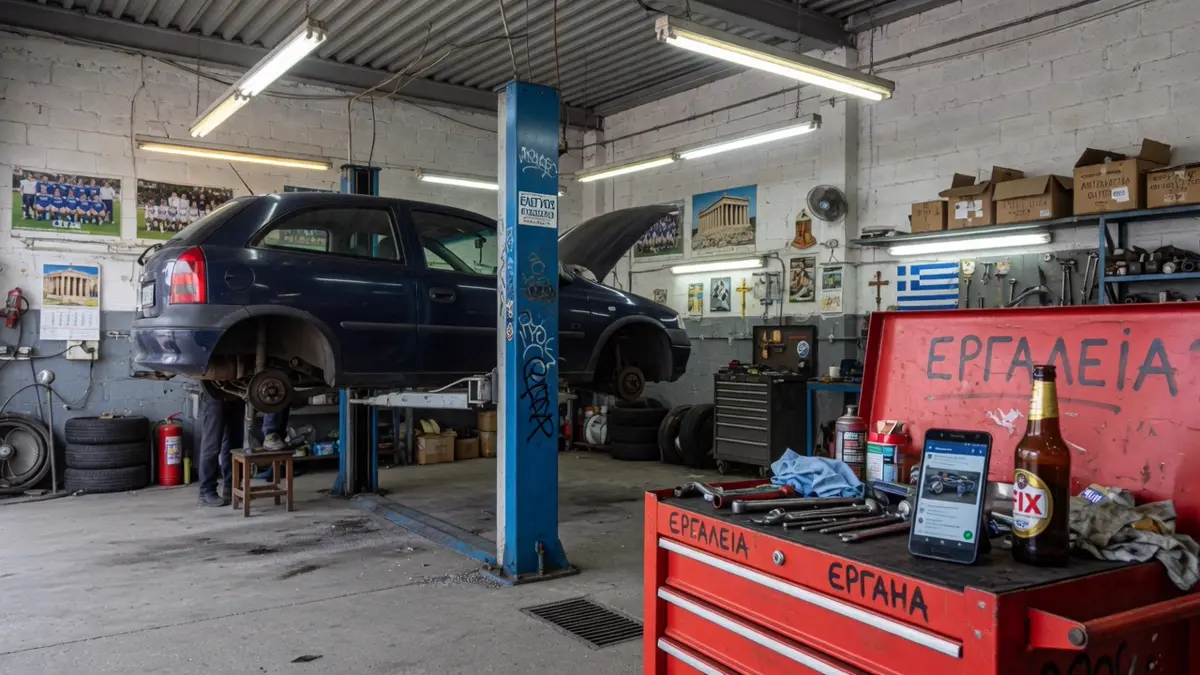
- The lift is up and both hands are greasy; the person who would pick up is under the car or at the wing with a rag they cannot put down.
- Ask service, KTEO or breakdown first — those are three different jobs, and only one of them belongs in the book.
- A KTEO sticker is a deadline, not a service. Write down whether you do the official test, the prep, or neither.
- Do not invent a ready time or a parts price from a plate. The office has to take both back.
- It checks your calendar before it offers a bay, writes the job in, and texts the confirmation.
- You do not sell cars. A caller who wants a used Golf is told this is a garage.
TL;DR
The lift is up and both hands are greasy. Nobody can pick up. The caller wants a service, a KTEO, or they are already in a car park because the car has stopped — three different jobs, and only one of them belongs in the book. They will not wait on voicemail. An assistant answers every line at once, asks which job it is, then takes the plate, checks the real calendar, books a bay when a bay is the right answer, and texts the confirmation. It will not invent a ready time. It will not invent a parts price. It will not take a used-car enquiry. You do not sell cars.
Key takeaways
- Put the assistant on the existing garage number with a forward-on-no-answer rule, so whoever is free in the office still takes the call.
- Give it three job families first: service, KTEO, breakdown — and what you actually do for each.
- Tell it never to invent a ready time or a parts price. It takes the plate and books a bay, or it takes a note.
- Write whether you do official KTEO, a pre-KTEO check, or neither, so it does not promise a test you cannot issue.
- Mark how you handle a car that cannot be driven — a tow number you keep, collect, or bring it if it moves.
- Tell it you do not sell cars, and that it does not diagnose from a noise on the phone.
What an AI phone receptionist does in an independent garage
An AI phone receptionist answers the garage number, talks the way you would if you could wipe your hands, and then does something with what it heard. It books a bay, sends the confirmation, or writes down what the caller asked for and puts that note in front of whoever is next off the lift.
The first thing it has to get right is the job. A service, a KTEO, and a car that has already stopped are three different things. An assistant that opens with “what time would you like?” will put a breakdown into Thursday’s book and leave a car sitting in a supermarket car park. It asks which of those three it is, takes the plate, checks the calendar you already use, offers only a bay that is free, and does not invent when the car will be ready.
A caller who rang in English gets the confirmation in English. A caller who rang in Greek gets it in Greek. The assistant works in 70+ languages. The SMS follows the language of the call. You do not sell cars. There is no salesman. There is a lift, and there is a car on it.
The lift is up
Tuesday, half past eight. One car is on the lift. The other bay has a service already open. Both hands have grease on them. The phone is in the office, or on the tool chest, or in a pocket you will not touch with these hands.
Nobody can pick up. The car is in the air. You cannot leave it on the locks to walk to the desk and guess a pads price.
It is a burst when people sit in traffic and notice the noise, or when they look at the KTEO sticker on the way to work. A second person hired for the afternoon does not touch eight o’clock. A second line with the same two greasy hands still leaves the third caller listening to a busy tone. The caller who wanted a service is already looking at the next garage on the map. They will not wait on voicemail.
“Is it ready?” is the other morning. The car has been with you since yesterday. You do not have a time until you have opened it, or until the part you ordered is actually on the van. An assistant that says “this afternoon” to be helpful is a time the office then has to take back.
A small independent garage in Greece often has no one whose only job is the desk. You are under the car, or at the wing. The person who would have picked up is the person whose hands are dirty.
Service, KTEO, or the car already stopped
Service. Oil, filters, a booked inspection, pads if you have already seen them. This can go in the book. The assistant needs the plate or the make, model and year, the kilometres if they know them, and what they think is due. It offers a bay only after it has checked the calendar.
KTEO. The sticker is a deadline. That is not a service, even when the caller says “service” because they want both done in one visit. A caller who says MOT means the same sticker. Write down what you actually do: the official test, if you run a station; a pre-KTEO check — lights, brakes, wipers, emissions — if that is your work; or neither, in which case the assistant says so and does not book a test you cannot issue. A lot of independent garages in Greece do the prep and send the car on. The assistant follows the line you wrote. It does not invent a station you do not have.
Breakdown. The car has already stopped. A car park, a side street, outside the house. This is not Thursday at half past eight. The assistant takes where the car is, whether it will move, and whether they need a tow. If you do not run a truck, it does not pretend you do. If you keep a tow number, it can give that number. Then it takes a note or a callback, not a diary slot that assumes the car will arrive under its own power.
A caller who wants a service and a KTEO on the same visit is not two bookings. It is one bay, the longer of the two, in the order you use. You write the order once. Ask which of the three it is before anyone looks at a clock: “Is this a service, a KTEO, or has the car already stopped?” An assistant that skips it will treat every caller as a Thursday service.
A ready time nobody can give from the phone
When someone asks “when will it be ready?”, the tempting answer is five o’clock. The assistant does not give one. A service that looks like oil and filters becomes a leak. A pre-KTEO check becomes pads. A clutch you have not seen is not “ready Friday.” A time said before anyone has opened the car is a time the office then has to take back.
It can repeat a collection window you already use once the job is done and you have marked the card. “It is ready now” is a fact on the job card. “It will be ready at five” is a guess. If a caller needs the car for Saturday, the assistant takes the date and puts it on the note. It does not promise the bay will meet that date. A car waiting on a part is not a free bay, and it is not a finished job. Mark it.
A parts price nobody can give from a plate
When someone reads the plate and asks for pads, a clutch, a timing belt, the tempting answer is a number. The assistant does not give one. The car on the lift is not the car in the catalogue. Axle, engine code, whether the discs come off with the pads — you know this after you have seen it, or after you have the part number in front of you.
It can repeat a published menu item you gave it. A listed oil service can have a list price. A diagnostic can have a list price if you publish one. Unseen parts cannot. The assistant books a bay or a diagnostic. Leave the parts figure to someone who can see the car. Do not put a pads tariff in the notes and hope it will “use judgement”. It will read the number out.
You do not sell cars
A maps pin, a neighbour, a caller who has you mixed up with a dealer two streets away — they ask if you have a used Golf, or if you take trade-ins, or what you have in stock.
You have bays. You have a lift. You have no stock. The assistant says this is a garage, and that you repair. It does not take a name “for the salesman.” There is no salesman. A lead like that is a wasted callback and a caller who arrives expecting keys.
If you ever sell a customer’s car as a favour, that is a conversation you have, not a line the assistant offers. Finance, test drives, “do you have that model in white” — those calls are not your work.
Who is on the tools
Write it down the way you would for a Saturday hire. Who is in. Who does diagnostics. Who does gearboxes. Who is off. Whether a lift is down. If only one person does diagnostics, that bay can only go on that person’s hours. A car waiting on a part is occupying a hole even when it is parked against the wall. Mark it, or the assistant will book a second car into the same morning.
Breakdowns and cars that will not move
A caller whose car will not start is not asking for a time. They are asking whether you can help today, and how the car gets to you.
You already know your rule. Some of you collect. Some of you have a truck. Most independent garages in Greece do not, and they say so in the first sentence. Write that sentence down. The assistant takes the location, whether the car will roll, and a number that can be called back. It does not diagnose from a noise. “It sounds like the starter” belongs to a person who will open the bonnet. If they can drive it in, the assistant can look at a bay the same day, if you have one. A warning light described on the phone is the same kind of call: it can book a diagnostic. It cannot say what the light means.
“Is my car ready?”
This call is not a booking. The car is already with you. The owner wants a time, or a price you have not finished, or to add the wipers while it is here.
The assistant does not guess from the diary. If you mark jobs as ready, it can say so and tell them the collection hours. If the card is still open, it takes a note and a callback. It does not say “almost” and it does not add work to a car it cannot see.
A caller who wants to add a job while the car is on the lift is useful, if you want that work. The assistant writes what they asked for and puts it in front of you. It does not quote the extra from the phone. A complaint about last week’s invoice is the same shape: take the plate, take what they said. Do not offer a free redo from the phone.
Collection, the shutter, and the hours you actually keep
Plenty of independent garages in Greece close the shutter at lunch, or on Saturday at noon. The phone does not close. A caller who hears voicemail at half past two will ring the next place.
The assistant has to know when a car can be dropped and when it can be collected. Those are not always the hours on the sign. A caller who asks “can I leave it tonight for the morning?” wants to know whether anyone will be there, and where the keys go. An assistant that answers with Thursday at 16:00 has not heard it. Mark a drop-off window if you use one.
The assistant asks for the plate first. If the caller does not have it, make, model and year will do, and the plate is taken when they arrive. Kilometres matter for a service. They do not matter for a car that will not start.
How CITT handles it
- Your number stays on the sign. A forwarding rule at the provider sends what you do not answer. Calls the office picks up never leave the garage.
- Every line is answered at once. A morning burst is a set of conversations, not a stack of busy tones.
- It knows the garage you described. Which jobs you take, whether you do KTEO or only the prep, whether a car that will not move is your problem, where to find the shutter.
- It asks service, KTEO or breakdown, then the plate, then looks at the book. A bay is offered only after those facts exist, and only for a job that belongs in the book.
- It checks the real calendar before it offers a time, and writes the booking into the same book the team already uses.
- It confirms by SMS, in the language of the call — 70+ languages — and can remind before the appointment.
- It escalates what cannot be finished on the call — a parts price, a ready time, a car that will not start — as a tagged note.
- You get the transcript, the summary, and the job the caller named.
What it will not do
It will not look at the car. A caller who wants a clutch price from the plate gets a bay or a callback, not a number.
It will not invent a ready time. “This afternoon” is not a kindness if the part is still at the factor.
It will not diagnose from a noise, a smell, or a warning light described on the phone.
It will not sell a car. There is no stock. There is no test drive. There is no finance.
It will not book official KTEO if you only do the prep, and it will not book a pre-KTEO check if you do not do that work.
It will not treat a breakdown as a Thursday service. Location first, then whether the car will move.
It will not decide a redo or a discount on last week’s invoice. It takes the name and what they said. You look at the car.
What these calls sound like
The order is the job, then the plate, then the offer if there is one. There is no parts price. There is no “it’ll be ready at five.” There is no “I’m sure we have a used one out front.” If the assistant is friendly and still books a dead car into a service hole, the person in the car park is still in the car park. Put the person who rang about a KTEO at 08:12 on the book.
What you set up first
Put the assistant on the number on the sign with a forward-on-no-answer rule, so a free pair of hands in the office still takes the call. Then the three job families and what you actually do for each, the rule on ready times, the rule on parts prices, and whether a car that will not move is your problem.
Give the assistant the published prices it may repeat — a listed oil service, a listed diagnostic — and do not give it a pads figure it would read out. Write one line that says you do not sell cars, and one that forbids a diagnosis from a noise. Add opening hours, who is in, where to park, how to find the shutter.
Rates live on the pricing section of the home page. They are not repeated here.
AI receptionist, in-house staff, or a call centre
| CITT | In-house | Call centre | |
|---|---|---|---|
| Morning burst, car on the lift | Every line answered at once | One call, if someone can wipe their hands | Depends who was rostered |
| Asks service, KTEO or breakdown first | Yes — before it looks at the book | Yes | Often jumps to what time |
| Ready time from the phone | Will not invent one | Knows once they have opened the car | Often says this afternoon |
| Parts price from a plate | Repeats only a published menu item you gave it | Looks at the car | Reads a list aloud |
| Car that will not start | Takes location and whether it can move | Yes, if they can pick up | Books Thursday |
| Speaks the caller's language | 70+ languages | One or two | Whoever is on that shift |
| Used-car enquiry | Says this is a garage | Says the same | May take a sales lead |
What one unanswered weekday morning costs a two-bay garage
Worked from these assumptions — change any of them and the answer changes:
- Two bays, a normal weekday, roughly 25 inbound calls.
- About a third arrive between eight and ten, when both lifts are already up.
- Of the calls nobody reaches, 4 are new service or pre-KTEO bookings.
- A booked service visit is worth about €150 to the garage — YOUR figure will differ, and this is the number to change first.
- Three of those four callers ring the next garage instead of leaving a message.
- 4 new service or KTEO-prep enquiries reach voicemail on a normal weekday morning.
- 3 of them do not call back and book somewhere else.
- 3 × €150 = €450 of that morning's book, gone before the first car comes down.
- Weekday mornings, over a 48-week year — 48 × €450.
About €21,600 a year, from one recurring two-hour morning window.
What it costs
CITT is pay as you go: no packages, no minimum, no contract. The current rates — the monthly fee per number and the per-minute rate — are on the pricing section of the home page, which is the only place they are published.
Frequently asked questions
Do I have to give up the garage number?
No. You keep the number on the sign, the Google listing and the job cards. You add one forwarding rule with your telephony provider — every call, or only the ones still ringing after the seconds you choose. If someone in the office picks up, the call never leaves the garage.
Can it tell a caller what pads will cost?
It can repeat a published menu item you gave it — a listed oil service, a listed diagnostic. It must not invent a parts price from a plate. Axle, engine code, and whether the discs come off with the pads all change the work. A number quoted before anyone has seen the car is a number the office then has to take back. It takes the request and books a bay or a diagnostic, depending on what you allow.
Will it promise the car will be ready at five?
No. A ready time said before anyone has opened the car is a guess. The assistant does not give one. It can repeat a collection window you already use once you have marked the job card ready. If the caller needs the car for a Saturday trip, the assistant takes the date and puts it on the note. It does not promise the bay will meet that date.
We don't run official KTEO. Can it still take those calls?
Yes, once you write what you actually do. A lot of independent garages in Greece do the pre-KTEO check — lights, brakes, wipers, emissions — and send the car on. The assistant can book that check, or say you do not do KTEO at all. It must not book an official test you cannot issue. A caller who says MOT means the same sticker. Treat it as KTEO.
What if someone asks if we have a used car for sale?
The assistant says this is a garage, and that you repair. It does not take a name for a salesman. There is no salesman and there is no stock. A maps pin that also lists dealers is how this call arrives. Answering it as a sales lead wastes the callback and sends someone to the shutter expecting keys.
What do we see after a call?
A transcript, a short summary, whether they asked for a service, a KTEO or a breakdown, the plate if they gave one, and whatever was booked or left for the office. Confirmations go out by SMS in the language of the call. You read the morning list the way you already read the job cards — except the ones nobody could pick up are on it too.