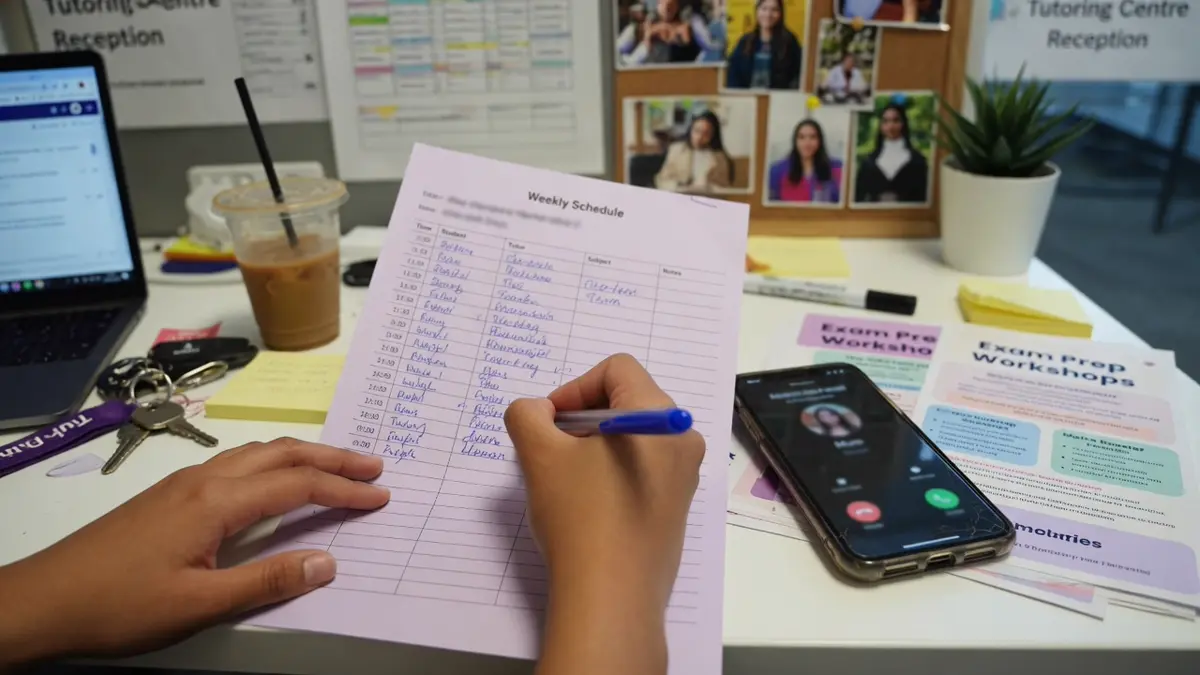
Missed calls at a tutoring centre after school
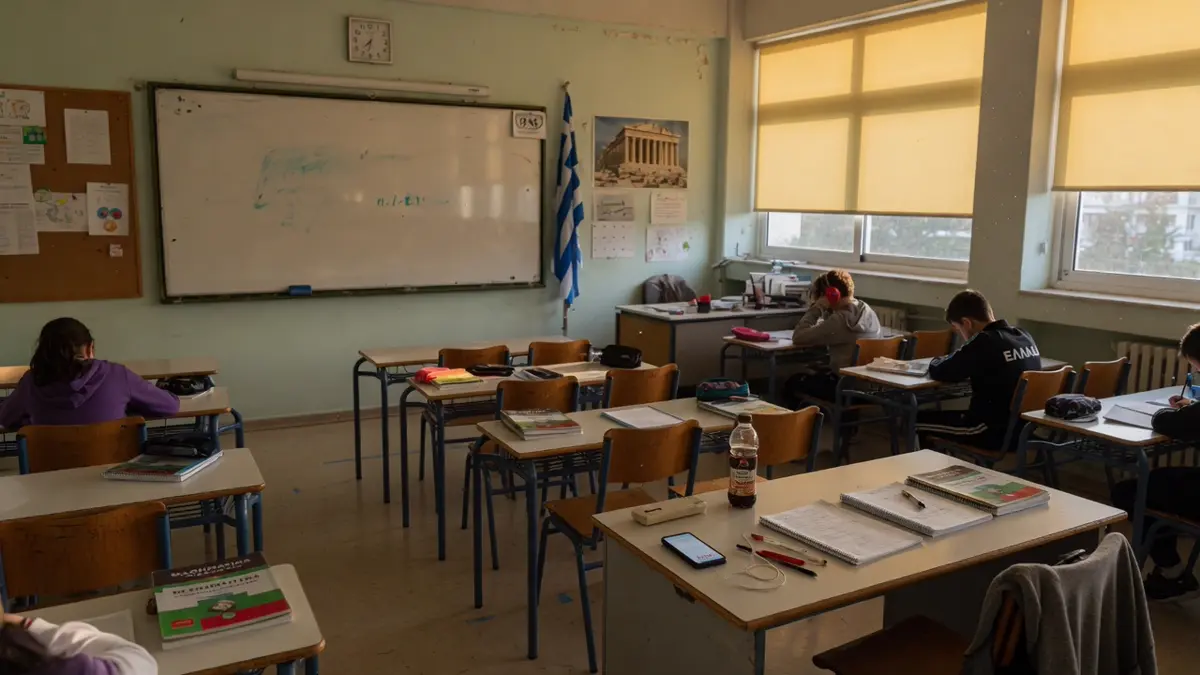
Quick summary
- At 16:40 the teachers are already at the board. The person who would pick up cannot leave the room.
- A parent who wants a place in a group hangs up at the beep and dials the next frontistirio.
- The parent who leaves a message already has a child with you — a makeup, a change of day.
- Ask subject, class year, and Πανελλήνιες or regular lesson even on the overflow. Those three pick the group.
- Do not invent a place in a full group just to keep the parent on the line.
- Pull unanswered calls by hour from the provider. Isolate the after-school window before you change a rule.
TL;DR
After school the phone rings and nobody can pick up. The teachers are already in a room. The parent who wants a place for September does not leave a message. They have your flyer and the one from the next street. They hang up and dial. An assistant answers every line at once, asks subject, class year, and whether this is Πανελλήνιες or a regular lesson, then checks the roster you already keep. It offers only a group with a free place, or it writes a waitlist. It will not add a seventh child to a group of six. The parent who rang at 16:40 should leave with a real place or a waitlist, not a yes the list cannot support.
Key takeaways
- Ask the provider for unanswered calls by hour, four weeks back. Look at 16:00 to 20:00 on its own.
- Do not judge the week by the tape. New-enrolment parents hang up. Existing parents leave the makeup message.
- Forward after a short delay so whoever is free in the corridor still takes the call.
- Tag new enrolment, makeup, change of day, and waitlist. They are not one unanswered pile.
- Never add a child to a group that is already at the maximum. Waitlist or a note for you.
- Pull the same after-school window after four weeks. If it has not dropped, the forward is wrong.
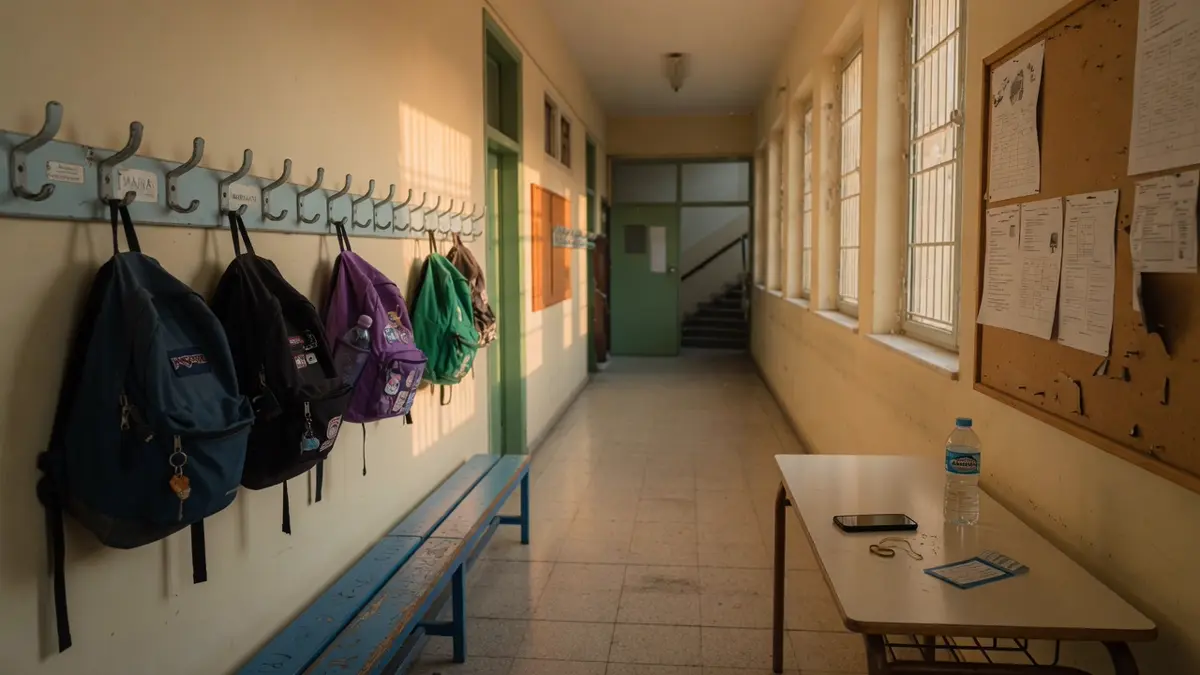
Nobody can pick up. The teacher is at the board.
It is 16:40 on a Tuesday. School finished an hour ago. Behind the glass doors the B Lykeiou maths group is already at the board. Next room, chemistry. The owner is covering Γ Λυκείου because the usual teacher is off. The phone on the desk in the corridor starts.
Nobody can pick up. The person who would have walked to the corridor is explaining a problem, or watching six children write, and they cannot leave the room.
The parent on the line opened your flyer at the school gate. They have the one from the next street in the same bag. They are asking whether there is a place in B Lykeiou maths for the exam programme. They will not wait through a beep. They hang up and dial.
That is a normal after-school hour in a Greek frontistirio. You already count the children in each group, the no-shows, who finished enrolment at the desk. The number that usually is not in any of those lists is how many parents tried to reach you today and could not.
A person hired for the morning does not hear these calls. A second line on the same empty desk still leaves the parent listening to a ring. September is the same window with more new names. January is the child who changed school. In the weeks before Πανελλήνιες the calls are extra hours and mock exams, not first enrolments. Mark which groups still take new names, which only take makeups, and which weeks you add hours.
Who hangs up, and who you hear on the tape
Not every unanswered call costs the same.
The parent who leaves a message already has a child with you. They want Thursday’s makeup. They want Wednesday instead of Tuesday because school moved the timetable. They will wait until you play the tape at twenty past eight. These are the voices that shape the story of “we don’t miss much”.
The parent who wants a place for September does not leave a message. They wanted a yes, a subject, a year, and a group that still has a seat. A beep is a no. They still have the other flyer. The next frontistirio is one dial away.
The parent who already tried twice is quieter still. They rang in the first week of September. They rang again on a Tuesday. Both times the line rang out. They are not in this week’s unanswered log as a new miss. They have decided you are the frontistirio that does not pick up. Inbound volume can drift down into October and you will look for the cause on the roster, where it will not be.
If you judge the week by the tape, you staff for makeups and changes of day. You miss the enrolment. That is the one with eight months of group fees attached.
The after-school window
Look at the log by hour before you look at it by day. The unanswered calls sit in a clump: from the moment school lets out until the last group of the evening. 16:00 to 20:00. That is when every teacher is already in a room, and when the parent is free to ring.
Tuesday at 10:30 often looks fine. Someone is at the desk. The parents who can actually place a child are not free at 10:30 on a Tuesday. They are free after they have collected the child, or after they have read the flyer at the gate. Those hours are also when the person who would pick up is at the board.
Hiring someone for the quiet mornings does not put a pair of hands on the after-school phone. A second person at the desk still has one pair of hands. When school lets out and four parents ring in twelve minutes, callers two to four hear ringing that nobody will take.
Pull 16:00 to 20:00 on its own before you look at the rest of the week. If that window is quiet in the log, you are not looking at a typical frontistirio, or the log is the wrong line. If it is loud, start here.
September is the loudest version of the same window. New names, two flyers, a parent who has not decided. January is smaller and sharper: a child who changed school, or a parent who waited for the first marks. The weeks before Πανελλήνιες are extra hours and mock exams. Those three seasons are not one unanswered pile. Tag them.
Subject, year, exam or regular — even on the overflow
Answering is not enough if the answer is the wrong group.
A parent who says “maths, after school, whatever you have” has not given you enough. Maths is not physics. B Lykeiou is not Γ Λυκείου. The exam programme is not the homework group. An assistant that opens with “what time suits you?” will put a Γ Λυκείου exam student into a B Lykeiou homework group, and you will spend Thursday evening undoing it.
The three facts that pick the group are the same on a missed-call overflow as they are at the desk: subject, class year, Πανελλήνιες or a regular lesson. Only then does it look at days. Only then does it look at whether that group has a place.
A Γ Λυκείου child in a B group sits through work they have already done, and the B children get pulled forward. The assistant asks the year. It does not guess from the child’s age. A parent who says Πανελλήνιες means more hours, mock exams, a pace that is not the homework group. If the parent is not sure, it does not pick the shorter group to sound fast. It takes a note for you.
Write the three questions the way you would for a new person at the desk. An assistant that skips any of them books the wrong room, and a wrong room is worse than a miss. The parent turns up. The teacher has a name the year cannot take.
A full group is full
The missed-call problem tempts people to put something — anything — on the line so the parent stays. That is how a frontistirio ends up adding a seventh child to a group of six, at ten to five, with every teacher already in a room.
You already know how many chairs are in that room and how many names are on the list. Six was the number you set because seven means the child at the back cannot ask. A place is a name that is not there yet, under a maximum you wrote down.
If Tuesday and Thursday B Lykeiou maths for the exam programme is at the maximum, that group is full. The honest answers are the other matching group, if it has a place; a waitlist; or a note that you may open another group. An assistant that has not looked at the list, and still says there is a place, has invented one.
Do not give it a sentence that lets it “use judgement” on a full group. It will hear a worried parent and add the name. You open another group, or you do not. The assistant does not decide that from the phone.
A parent who heard “I have Tuesday and Thursday at 17:00, that group has a place, and a place is held once you finish the enrolment at the desk” is still on your books. A parent who heard “yes, we can add one more” and then met a room of six with no chair is a September you spend apologising.
A trial lesson follows the same rule. It goes into a group that has a place, for the subject and year the parent named. A parent who wants maths and physics is asking for two groups and two places. Check both. Two children in the same family are two enrolments. Each needs a place.
A makeup is not the same miss
“He missed Thursday. Is there a makeup this week?” is a parent you already have. They will often leave a message. They will often try again after the last group. Missing that call is rude. It is not the same loss as the September enrolment.
The assistant applies the rule you already use. Same week only, or until the next lesson. Only a group that matches — same subject, same year, exam or regular. Only if that group has a place. If Friday’s group is a different year, it is not a makeup. If Friday’s matching group is full, it is not a makeup. The assistant takes a note.
A change of day is the same test. School moved the timetable; the parent wants Wednesday. Wednesday’s matching group either has a place or it does not. Moving the child into a full group, or into the wrong year because the hour was empty, leaves Wednesday’s teacher with a name the room cannot take.
If you do not offer makeups at all, say so in the notes. The assistant should not invent a Friday hour to keep the parent on the line.
Do not let makeups be the measure. The measure is unanswered enrolment calls after school in September, and unanswered mid-year calls in January. Those two hang up.
One number, several kinds of parent
The number on the door, the flyer, and the Instagram bio is one number. A parent who wants B Lykeiou maths for the exams and a parent who wants Thursday’s makeup both dial it. If nobody picks up, those two misses go into one pile.
If you treat every unanswered call as a new enrolment, you will staff September and leave the makeup rule empty. If you treat every unanswered call as a change of day, you will hire for the existing list and still lose the parent with two flyers.
Tag them. New enrolment. Makeup. Change of day. Waitlist. Named teacher. Direction question. The weekly total is useless if those are one number.
A parent who is already a customer — they named the child, they said Thursday, they asked for a makeup — belongs on the existing roster. A parent who named a subject, a year, and Πανελλήνιες belongs on a new place. The person at the desk already hears that split without thinking. The log will not, unless you make the assistant ask subject, year, and exam-or-regular first.
A parent who asks whether the child should take θετική or οικονομία is not an enrolment. That call waits for you. If it rings out, they will ask the next frontistirio, and that frontistirio may answer. The assistant takes a time for the talk, or a note. It does not choose a direction from the phone.
The flyer on the next street
If you miss “do you have a place in B Lykeiou maths for the exam programme”, you have not only lost a caller. You have lost the child who would have started in September, sat in that group through June, and perhaps brought a sibling in January. The next frontistirio on the same street gets them. Your teacher comes out of the room at 18:10, plays an empty tape, and wonders why the B group is still short.
A parent who comes in for a place you confirmed from memory, and finds the group full, will not ring you a second time. That is worse than a miss. Answering is not enough if the answer is a guess.
The Instagram form is the other trap. You tell yourselves the messages are the real channel and the phone is for existing parents. Then you look at which children actually started in September and find that a share of them started with a call. The people willing to type a name into a form will wait. The people who ring after school will not.
Count unanswered calls on the number that is actually printed on the flyer. If Instagram shows one number and the door shows another, you will count the wrong line.
A parent who cannot get through in the first week of September starts ringing the next frontistirio that handed out a flyer at the same gate. That does not show up as a cancelled enrolment. It shows up, in October, as a thinner B Lykeiou maths group and a story about the year.
What the transcript is for
It is how a teacher who was at the board at 16:40 walks into an 18:30 callback already knowing B Lykeiou, maths, exam programme, Tuesday and Thursday, and that the Monday group was full. That is the difference between “sorry I missed you, which subject was it” — which is a second cold call — and “you asked about B Lykeiou maths for the exams, Tuesday and Thursday at 17:00”. The second sentence is why they do not dial the next street while you are asking them to start again.
If the transcript does not contain subject, class year, exam or regular, and what was offered, waitlisted, or left for the desk, the setup is wrong, even if every call was answered. An answered call that produces “enquired about lessons” is a message with a longer recording.
A makeup transcript that does not have the day they missed, and the matching group that was offered or refused, is the same failure. The teacher cannot act on “someone rang about a lesson”.
A parent who rang in English gets the note and the SMS in English. A parent who rang in Greek gets them in Greek. The assistant works in 70+ languages. The confirmation follows the language of the call. Send the text to the parent. A confirmation that goes to the child’s number is a confirmation nobody reads.
The rule it must obey
A place is offered only when the roster shows a free seat in a group that matches subject, year, and exam or regular. A makeup goes only into a matching group that has a place. A change of day is the same test. A place is held the way you already hold it — usually once the parent finishes the enrolment at the desk.
It will not invent a seat. It will not put a child in the wrong year, or in the exam programme when the parent asked for school support, because an hour happened to be free. It will not choose θετική, θεωρητική, or οικονομία. It will not invent a sibling discount or a two-subject price. It will not promise a named teacher whose matching group is full.
Tell parents it is an assistant. The greeting can still use the frontistirio name.
Why another person at the desk still cannot take the third call
Hiring another receptionist is the answer every owner reaches for. It is the right answer to a different problem. If the desk is buried in enrolment forms and paper rosters, hire. If four parents ring at 16:45 and every teacher is already in a room, a second person at the counter still has two ears.
Callers three and four still hear the engaged tone. On a Tuesday in September that second person is also the one you pull into a room the first time a teacher is off. You have then paid for a salary and you are back to one pair of ears on the phone.
The calls arrive together, in the hour nobody can leave the board. An assistant that can take several at once matches that. Keep the people you have. Give them the overflow. Let the teacher stay at the board. Let the owner stay in Γ Λυκείου.
What you configure first
- The unanswered-by-hour log. Four weeks, after-school hours included. Without it you are guessing.
- Forward on no-answer, not always. Fifteen to twenty seconds if someone can hear the desk phone from the corridor. Shorter if the published number is a mobile that sits face down in a room.
- Subject, class year, exam or regular, written as required questions before it looks at days.
- Tags. New enrolment, makeup, change of day, waitlist, named teacher, direction question.
- The two forbidden sentences, in the same words the desk already uses when they are being careful: we do not add a name to a group that is at the maximum; we do not choose a university direction from the phone.
- Pull the same log after four weeks. If 16:00 to 20:00 has not dropped, the forwarding rule is wrong, or the assistant is not on the number on the flyer.
Then the groups: subject, class year, exam programme or regular lesson, days, time, teacher, maximum, how many names are on each list now. Then the makeup rule and the rule for moving a day. Give it the published monthly fees it may repeat — one subject, one year, exam or regular, the figure on your sheet — and do not give it a discount figure it would read out.
The number on the door stays yours. One forwarding rule at the provider. Calls someone in the corridor takes never leave the building. Every line is answered at once. The assistant checks the roster before it offers a place, and confirms by SMS only when the name is on the list.
They ring after school, sometimes in English
In a Greek frontistirio, English is how a share of the parents who can actually finish an enrolment start. They ring after school, often looking at two other flyers, one of them in English. If nobody picks up, they do not leave a message in a language they are not sure you speak. They dial the next frontistirio.
The assistant picks up the language from the first sentence and stays in it, including if the parent switches mid-call. Seventy-plus languages. Write down the subject, the year, and exam or regular. Do not invent a place.
A parent who asks which direction the child should choose, in any language, is a request. The assistant books a time for that talk, or takes a note. It must not say which field will “suit” the child.
Before the first live September week
Write down which mobile gets a direction question and a discount request after the last group. Write down the sentence for a group that is full, and the sentence for a fee that is not on the sheet. Mark who is in on which afternoon, where to park, which floor.
After four weeks, pull the same log. If 16:00 to 20:00 has not dropped, fix the forwarding rule, or check that the assistant is on the number printed on the flyer.
Take the structure of the calculation above and put your own figure in. If the answer still justifies the change, it is a real answer. If it only works with the number chosen here, that number was doing the work, not the argument. Four weeks of after-school hours are enough to know whether this is you.
Rates live on the pricing section of the home page. They are not repeated here.
AI receptionist, in-house staff, or a call centre
| CITT | In-house | Call centre | |
|---|---|---|---|
| After-school burst, every teacher in a room | Every line answered at once | One call, if someone can leave the board | Depends who was rostered |
| Parent who will not leave a message | Answers | Only if someone is in the corridor | Yes |
| Asks subject, year, exam or regular | Yes — before it looks at groups | Yes | Often jumps to what time |
| Group already at the maximum | Waitlist or a note, never an extra name | Yes, if they remember the count | Says yes and hopes |
| September after school | Same as a quiet Tuesday in November | Nobody — every room is full | A message for the morning |
| Existing parent about Thursday's makeup | Matching group with a place, or a note | If they can leave the room | Writes it down |
| Invents a seventh seat | Never | Tempting, to stop the next flyer | Risk, if they cannot see the list |
What the after-school tape does not show in a small frontistirio
Worked from these assumptions — change any of them and the answer changes:
- A small frontistirio, four rooms, a normal September week of after-school calls.
- About 18 inbound calls land between 16:00 and 20:00. Someone in the corridor reaches 8. The other 10 ring out.
- Of those 10, 3 leave a message and 7 hang up.
- 4 of the 7 silent calls were a parent asking to place a child in a subject group. Put your own split in before you trust the sum.
- A new enrolment is worth about €160 a month to you — YOUR figure will differ, and this is the number to change first.
- This example assumes 2 of those 4 parents enrol at another frontistirio that week. Change that if yours is lower.
- A child who starts in September typically stays through June — eight months. Put your own stay in if it is shorter.
- The tape on Thursday evening shows 3 people. That is the number the desk believes.
- The provider's log shows 10 unanswered. The other 7 never left a trace you look at.
- 2 lost enrolments × €160 × 8 months = €2,560 of that year's group fees, gone before October.
- September is not the only week. Use the same arithmetic on any week you actually miss.
About €2,560 from one September week of unanswered after-school calls — only the children who never started. Change the fee and the two lost names.
What it costs
CITT is pay as you go: no packages, no minimum, no contract. The current rates — the monthly fee per number and the per-minute rate — are on the pricing section of the home page, which is the only place they are published.
Frequently asked questions
How do I find out how many calls we are actually missing?
Ask your telephony provider for a log of unanswered calls by hour, four weeks back. Open that before you change a forwarding rule. Isolate 16:00 to 20:00. If you have never opened the log, the voicemail box is the only count you have, and it only holds the parents who waited for a beep — usually the ones who already have a child with you.
Would another person at the desk fix this?
It helps with the paper roster and the enrolment forms. It does not fix four parents ringing at 16:45, when school has just let out. Two people take the first two. Parents three and four still hear busy. In a four-room frontistirio that extra person is also the one you pull into a room the first time a teacher is off.
Does voicemail not catch them?
It catches the parent who wants Thursday's makeup moved, or who already knows the group and is asking about a day. It does not catch the parent who found two flyers this afternoon and is placing a child for September. That parent hangs up. So the box systematically keeps the existing names and drops the enrolment that has a year of fees attached.
What happens to the calls we do answer?
Nothing changes, and nothing is charged. The forwarding rule only sends a call on when it has rung unanswered for the seconds you choose. A call someone in the corridor picks up never leaves the building.
Will parents notice they are talking to software?
They will notice they got an answer. The greeting can use the frontistirio name and still say it is an assistant. If someone asks directly, it does not pretend to be a teacher. Most of the friction parents complain about is the ring-out, not who is on the other end.
How soon can we tell whether it worked?
Four weeks, on the same unanswered-by-hour figure you pulled at the start. Do not use “calls the assistant handled.” That only counts what the assistant did. It cannot tell you whether a parent is still ringing out at 16:50.