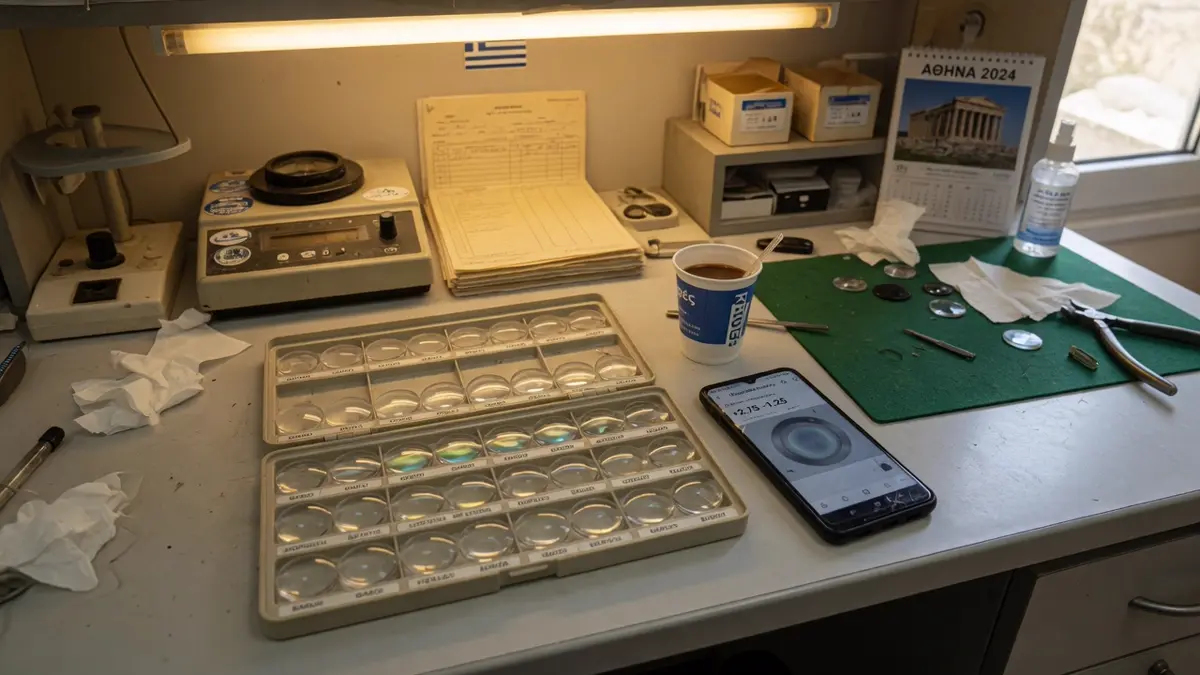
Book eye tests and fittings at an optician

Quick summary
- Ready glasses, an eye test or a repair first. Those go to different people and take different times.
- An eye test holds the tester, on a day they are in. A free Thursday morning is not a test if Anna is off.
- Ready glasses can walk in. Mark the hours you keep for the boards, so a booked test does not land on the same table.
- A move is one change: release Thursday's test, then place the new time, or they are told their own hour is taken.
- A pair is ready only when you have marked it. A promised Friday is not a booking and not a status.
- The SMS goes out after the booking is in the book, in the language of the call.
TL;DR
Someone rings to book an eye test, to come in for ready glasses, or to drop a broken pair. Those are three visits. You have both hands on a fitting and cannot finish the book by hand. The assistant asks which of the three they mean, then looks at the diary you already use. It offers a test only on a day the tester is in, in a stretch that is free. It does not invent a prescription. It does not invent a frame price. A move is one change. The confirmation goes out by SMS after the booking exists.
Key takeaways
- Make ready glasses, eye test or repair the first question, and give it the tester's days. Do not let it offer Monday for a test if Anna is off.
- Mark the hours you keep for walk-in ready glasses and repairs. A booked test must not land on the same table.
- Tell it never to invent a prescription, speak a complete-pair price, or say a pair is ready unless you marked it.
- Test a move on a caller who already has Thursday at 17:30. Watch whether their own hour blocks the new one.
- A repair drop-off and an eye test on the same afternoon are two facts, not a test with a screwdriver squeezed after it.
- Turn SMS confirmation on the same morning you turn booking on. Read the first thirty bookings by hand.
Three visits, one number
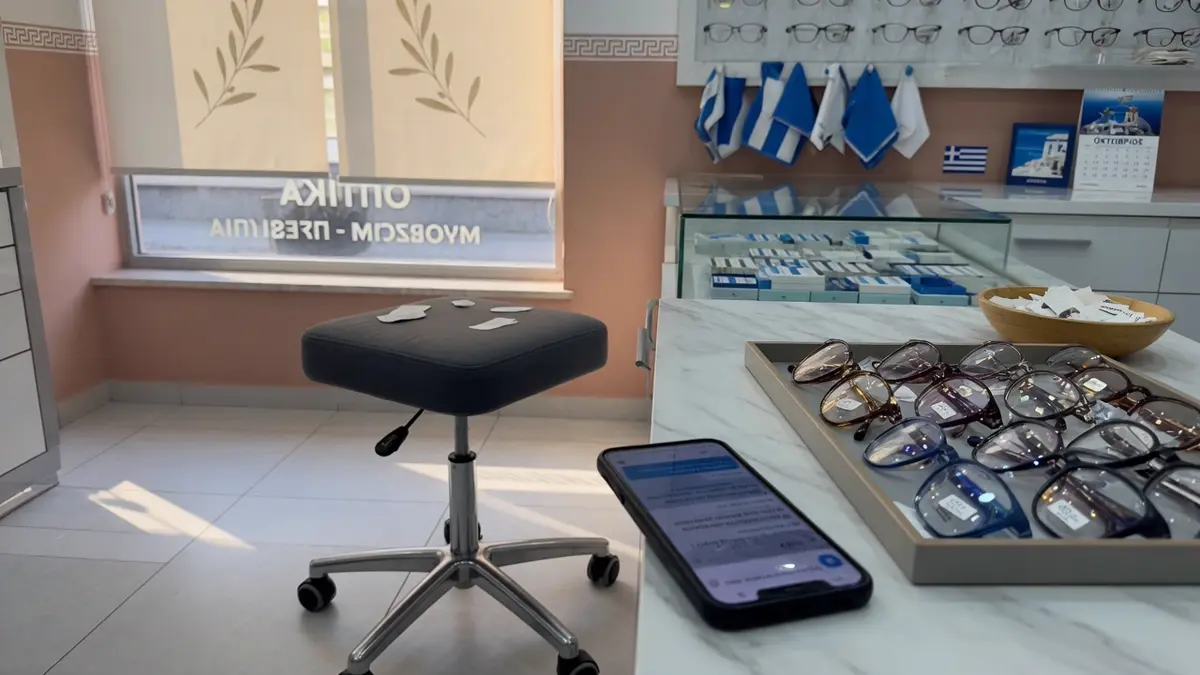
The number on the window, the bag and the listing is one number. A caller who wants an eye test on Thursday, a caller who wants ready-readers this afternoon, and a caller who sat on their glasses all dial it. Before anyone says yes to a time, the assistant has to know which visit this is.
Ready glasses are chosen at the boards. Ready-readers, sunglasses off the rack, a pair they want to try because they already have a written prescription in a pocket. These can often walk in. They do not need Anna. They do need to know if the table is already held for a test.
An eye test holds the tester, on a day they are in, for a stretch of time the chair cannot share with people trying frames. In a small Greek shop that person may come on Tuesday and Thursday, or only after five.
A repair goes to the workshop bench. A screw out, an arm bent, a lens popped, a nose pad gone. They want to know if they can drop the pair today. That is usually a walk-in, not a test.
Those are three facts. They do not use the same person, the same stretch of table, or the same length of time. If the assistant treats every caller as a test, a parent who wanted ready-readers spends three minutes being offered Thursday at 17:30. If it treats every caller as a walk-in, the person who needs Anna is told to come down.
Thursday makes the split sharper. A caller who has not had a test in a while wants 17:30. You are already mid-fitting. The temple is in the heater. Someone at the boards is trying frames. The phone on the desk rings.
Nobody at the desk can finish the booking by hand. Both hands are on the frames. The person who would have looked at Anna’s book is the person whose hands are busy.
Taking a message and promising that someone will look at the book later is the job a voicemail already does. Finishing the call means the time it offers is free when they sit down, and that Anna is actually in.
Read the matching fact before you offer. Write the booking before you confirm. If the diary cannot be reached, say so and take a callback. A time the caller was promised and the desk has never seen is worse than no booking.
What goes wrong when the three are one book
The failure is not “the phone rang”. The failure is a time that sounded finished and was not.
A caller is given Thursday at 11:00 for a test. Anna is only in after five. They take the morning off. The test room is empty. You spend the afternoon taking the number back.
A parent is given Thursday at 16:00 from Anna’s book. They wanted ready-readers. They arrive with a child. The table is held for a booked test. They wait, or they leave.
A test is booked because a gap looks free. That gap is the walk-in window you keep for people at the boards. A queue trying frames and a booked test arrive at the same chair.
A caller wants to move Thursday at 17:30 to Saturday morning. Handled as cancel-then-book, 17:30 is still in the book while the assistant looks for Saturday. They are told Saturday is tight. Sometimes they are told their own Thursday is the reason. Then, if the new time fails, Thursday is gone as well, and they have dropped out of the diary.
A repair drop-off and an eye test get written as one visit with a screwdriver squeezed after the test. The pair is not looked at. The test runs late. Nobody decided the order.
None of that is a missed call. It is a booking that should not have been spoken.
Ready glasses, an eye test, or a repair — then the matching fact
The first question is the split the person at the desk already asks without thinking. Ready glasses, an eye test, or a repair. Then the book that matches.
Ready glasses. Open, until when, and whether the boards are free. Yes until a time you set; no, the table is held for tests; or yes for a screw, no for a test. An assistant that answers with Thursday at 16:00 has offered a test time to someone who was already on the pavement.
If they already have a written prescription, ask them to come in with the paper. The assistant does not decide that the paper is current. It does not read numbers off it and turn them into a pair.
Eye test. Who does the tests, which days they are in, how long the stretch is. The assistant looks only at the days and hours you marked for that person. Monday at 11:00 on a week Anna is not in is an empty room.
Repair. They can drop the pair today, or they cannot. The assistant can take the drop-in. It cannot say from a phone description whether the arm will take a new screw or whether the frame is finished. It cannot promise the pair back at five.
A caller who says only “I just need glasses” gets the next short question: boards, test, or a pair broken. If they still cannot say, the assistant does not decide they only wanted ready-readers. It takes a callback.
A caller who is already a customer — they left a pair last week, they want to know if it is ready, they want to move Thursday’s test — should not be asked whether they want ready glasses. Listen for the bag, the name on the tray, the word “ready”. Those calls belong to collection, or to a change on a test that already exists.
The assistant may offer a time only when the type, the person and the length all match, and only after it has read the diary you actually work from. A free walk-in hour is not a test. A free test hour is not a reason to tell someone at the boards to come down.
The tester has to be in
Callers who ask for a test want a yes or a no, then a time. You cannot answer the first part from a card in the window.
“Eye test” on the glass is not a day you can hold. Anna may only be in on Thursday. She may only be in after five. Last week’s rota is not this week’s rota.
The assistant books a test only on a day you marked the tester in, in a stretch the diary can confirm. If those days are not written down, it will offer them anyway. If the diary is silent, stale, or unreachable, it takes the request and leaves the confirmation to you.
A caller who takes Thursday morning off for an empty room will not ring you a second time. The next person who asked for a test was told Thursday was full.
If they want Thursday after work, book a stretch Anna is actually in. If only a morning gap exists, take a callback. Do not put a name against an empty chair.
The same rule covers “can I come in this afternoon for a test” when the afternoon is a walk-in window. Move them. Otherwise a queue at the boards and a booked test arrive at the same chair.
Walk-ins at the boards, booked time in the test room
Plenty of shops still take walk-ins for ready glasses and small repairs. Protect the hours the tester is not in, and keep the test book closed over those hours.
A caller who asks “can I come in this afternoon for ready-readers?” wants to know if the boards are free, not a time in Anna’s book. Yes until a time you set. No, the table is held. Yes for a screw, no for a test.
Saturday is the same rule with more people on the street. Tourists and locals both ring. The assistant still asks which of the three they mean, and still only offers a test on a day the tester is in.
Mark those hours the way you already mark Anna’s lunch. If the assistant treats every Saturday hour as a free test, the boards sit idle and walk-ins are told to book. If it treats every Saturday hour as walk-in, Anna waits and callers are told to come down.
Do not let a “quick test” be squeezed into a twenty-minute gap between two fittings. A test has a length you already use. Stack it and the next sit starts late, or the test is rushed and they leave without a pair.
A mixed visit is two facts
A repair drop-off and an eye test on the same afternoon is not a test with a screwdriver squeezed after it. It is a drop-in plus a booked stretch with the tester, on a day that person is in.
Do not let the assistant invent the order. You decide once whether the pair is looked at before the test or after. Write that once. The assistant follows it. If you have not decided, it takes both facts and leaves the order to you.
A caller who wants sunglasses made up from a paper in a drawer, and also wants the broken everyday pair looked at, is the same kind of mixed visit. Frames from a written prescription can often walk in. The repair is a drop-in. Neither of those is a reason to invent a test they did not ask for, and neither is a reason to skip a test if they also said they have not had one in a while. Ask. Write both. Book only what they named.
Lenses you send out are a third fact. If glazing leaves the shop, the assistant must not promise Friday because that is what you said last month. It takes the request. A human looks at the job. Do not let a promised Friday become a collection booking.
Moving Thursday
The caller already has a time. They are not making a new booking. They are changing one.
Handled as “cancel, then book”, Thursday at 17:30 is still in the book while the assistant looks for Saturday. The caller is told their preferred hour is taken — by a system looking at their own test. Then, if the new time fails, Thursday is gone as well.
The order is: find the existing appointment, release it, offer two times that are actually free on days the tester is in, place one, send the new confirmation. In that order.
A moved test still needs the tester. Saturday morning is not Thursday evening moved. Anna may not be in on Saturday. Confirm the day before you offer it.
A moved ready-glass visit is usually not a move at all. It is a new question about whether the boards are free on the new day. Do not put a walk-in into Anna’s book to make the change look tidy.
Test this before anything else. Pick a caller who already has Thursday at 17:30 with Anna. Ask the assistant to move it to Saturday morning. Watch whether their own hour blocks them, and whether Saturday is actually a test day.
After a move, the reminder goes to the new number and the new date, not the old ones. The old SMS must not still say 17:30.
Collection is not a booking
“Are my glasses ready?” is not a test, and it is not a time you offer. The assistant reads the mark you made. Ready, not ready, still at the workshop. If you marked them ready, it can say so and tell them how to collect. If you did not, it takes a name and a number. It does not invent Friday because that is when you usually finish. It does not offer a new time to collect as if that were a test.
An adjustment on a pair they collected last week is a drop-in, not a collection and not a test. The assistant can say they can come in. It cannot say the adjustment will take five minutes. You have not seen how the frame sits.
A cancel should free the test the way you already free it, so the next person who asked can take Thursday. Set the notice you already say. The assistant should say it at the end of a test booking.
What it must not place
It will not invent a prescription. An old paper in a drawer gets a visit, not a verdict that the numbers are still good.
It will not quote a complete pair or an unseen repair. A ready-reader figure you published is different. Whatever figure it says, they will treat as yours. If the file has no figure, the assistant takes the request and you call back.
It will not give clinical advice. A red eye, flashes, a sudden blur, or a request for drops is a note, not a routine test.
It will not book a test into the hours you keep for people at the boards, or on a day the tester is not in. It will not say a pair is ready because Friday was the promise. If there is no mark, it takes a callback.
It will not decide a remake, a refund, or whether the hinge can be saved. It takes the request. A human decides.
A complaint about last week’s fitting is the same kind of call: take the name, take what they said, put it in front of you. Do not offer a free remake from the phone. You look at the frames on the face.
The text after the call
Send the confirmation at the moment of booking, not at the end of the day. A caller who leaves the call unsure whether Thursday is real will ring again, or will book a test at the next shop “just in case”. The assistant sends the SMS itself, in the language of the conversation. Seventy-plus languages. Nobody at the desk types a number.
The rule is mechanical. The message goes out after the diary entry exists. For a test it names the hour and the tester. For a walk-in it names the window you are willing to put in writing — open until, boards free — not a fake appointment. For a repair it names that they can drop the pair, not a ready time the workshop has not marked.
No entry, no message. An entry against a day the tester is not in, no “see you Thursday” — a flag to you instead, or a text that says someone will call. A text for a test on a day Anna is off is worse than no text. The caller takes the morning off. You own the wasted hour.
The reminder is a different job. An empty test hour costs the same whether they were never booked or booked and forgot, and the second kind is easier to prevent. A day ahead is the usual starting point. A same-morning reminder helps a Saturday test more than a Tuesday repair drop-in, because Saturday is when people are already on the street and change their minds.
Once the booking is real, where to park, how to find the door, and the cancel notice you already say can go in the same message if you want them there. A frame price cannot. A prescription cannot.
When they cancel
Let callers cancel through the assistant. A Thursday test released on Wednesday evening can be offered to the next person who asked. The same cancellation arriving as a silent gap at seventeen-thirty is an hour you will not get back.
Write the cancellation back to the diary immediately, the same way a booking is written. A cancellation that is only in a transcript is a cancellation the next caller cannot be offered.
Treat “I need to move it” as a change, not as a cancel plus a hope. Otherwise you open the old time, fail to place the new one, and have lost them from the book entirely.
A cancel the evening before a long test block is worth a flag, if you want one. The assistant can take the cancel and mark it. It does not decide who to offer Thursday to. It does not ring the next name on a list you never gave it.
Say the notice you already say at the end of a new test booking. If you do not charge, still say how much notice you need so the hour can be offered again. Do not invent a fee the desk does not use.
The first thirty bookings
Look at the first thirty by hand. The diary entry, the type, the person, the length, and — for a test — whether the tester was actually going to be in. You are not looking for a system that does not work. You are looking for the type nobody thought to configure, the Saturday Anna does not work, the walk-in hour it sold as a test, the repair it promised back at five. Those exist in every shop. None of them are in the setup form.
Pay particular attention to four things. A test sitting in a walk-in hour. A test booked on a day the tester is not in. A ready-reader given a test-length gap, or the other way around. A pair promised ready when nothing was marked. Any one of those is a configuration problem, and it will repeat until the type is corrected.
Then look at the price questions that tried to become bookings. If any of them received a complete-pair figure from a description, the price rule is not tight enough. Tighten it before you count how many appointments the assistant placed.
After that, spot-check weekly for a month and then leave it alone.
What you turn on first
Start with the split, not with a menu.
- Ready glasses, eye test or repair as the first question, and the tester’s days written down. Do not let it offer Monday for a test if Anna is off.
- Three types only. A first eye test. Walk-in ready glasses inside the hours you marked. A repair drop-in. Lengths from last month’s real diary.
- The walk-in window. Hours the boards stay free. Hours the table is held for tests. Mark them the way you mark Anna’s lunch.
- The three forbidden sentences. No invented prescription. No complete-pair price from a description. No ready unless you marked it.
- The change path, tested with a real name already on Thursday, on a day the tester is in.
- The SMS rule: after the booking exists, never before, never on a day the tester is not in.
- A failure sentence the assistant is not allowed to improve: if the diary cannot be reached, it says someone will call back. It does not hold an hour it cannot see.
Leave collection status, remakes, refunds, and anything with a red eye, flashes or a sudden blur as notes for you. Turn the SMS confirmation on the same morning you turn booking on. Turn the reminder on before the week is out.
When those three types have produced a week of bookings you would have been happy to have made yourself, add the next type. Do not add them all on day one. A shop diary has a test book and a walk-in window and a workshop bench, and the edges are where a caller turns up for the wrong chair.
Add opening hours, who is in on Saturday, whether you close in August, where to park, how to find the door.
Rates live on the pricing section of the home page. They are not repeated here.
AI receptionist, in-house staff, or a call centre
| CITT | In-house | Call centre | |
|---|---|---|---|
| First question on the shop number | Ready glasses, eye test or repair | Yes, if they heard the start | Often jumps to what time |
| Tester only in on certain days | Offers only the days you marked | Yes — they know the week | Treats every day as a test day |
| Walk-in boards vs booked test | Honours the window you set | Yes, if they remember | Treats every hour as a booking |
| Moves Thursday's eye test | One change, then a new SMS | Yes | Two messages, often |
| Mixed repair and test | Drop-in plus a booked stretch | Yes, if they can see both | Writes one of them |
| Says the pair is ready | Only if you marked them | Checks the tray | Repeats the promised day |
| Sends the confirmation | SMS, after the booking exists | If they remember at the desk | Sometimes |
What empty Thursday test hours cost when a cancel never reaches the book
Worked from these assumptions — change any of them and the answer changes:
- One tester, about 12 eye tests a week. Put your own weekly count in.
- About 3 of those 12 are empty: a no-show, or a cancel that never reached the diary. Check your own week.
- An empty Thursday hour is not filled the same afternoon.
- A pair that leaves after an eye test is worth about €160 to the shop — put your own figure in. This is the number to change first.
- A Wednesday-night cancel written back into Anna's book lets you offer Thursday to the next person who asked. This example assumes you would fill 1 of those 3. Change that if yours is lower.
- 3 empty test hours in a week. Writing the cancel back on Wednesday night is what frees Thursday for the next caller.
- If 1 of those 3 would have left with a pair, the week is €160 that never reaches the tray.
- Over 46 weeks, if nothing changes — 46 × €160. Put your own weeks in if you close in August.
- That is only the hour. It does not count the caller who hung up because Thursday still looked full.
About €7,360 a year in Thursday hours nobody used — before the enquiry that never found a free test. Change the €160 and the three empties before you trust it.
What it costs
CITT is pay as you go: no packages, no minimum, no contract. The current rates — the monthly fee per number and the per-minute rate — are on the pricing section of the home page, which is the only place they are published.
Frequently asked questions
Will it put an eye test into a walk-in hour?
Not if you marked the walk-in hours and the tester's days. It asks ready glasses, eye test or repair first, and it only offers a test on a day the tester is in, in a stretch of time that is free. If the diary cannot confirm that stretch, it takes a callback rather than squeezing a test into a gap meant for people at the boards.
Can it book a test if Anna might be off?
Only on a day you marked the tester in. A free Thursday morning is not a test if Anna is off, or only in after five. If those days are not written down, it will offer them anyway. Confirming a test on a day the room is empty is worse than no booking. The caller has taken the morning off, and you own the wasted hour.
How should it move Thursday's eye test?
As one change. Find the test, release it, then place a new time that is actually free on a day the tester is in. If it cancels first and searches second, Thursday at 17:30 is still in the book and the caller is told their own hour is taken. Test this with a real name in the diary before you let it book for real.
Should it book a test if they have not said which of the three they want?
No. Ready glasses are chosen at the boards. An eye test needs the tester. A repair goes to the workshop. The assistant asks which they mean, then looks at the matching fact. If they still cannot say, it takes a callback rather than deciding they only wanted ready-readers.
Who sends the confirmation?
The assistant, by SMS, in the language of the call, and only after the booking exists in the diary. A text that goes out before the tester's day is checked is how a caller takes Thursday off for an empty room. No booking in the diary, no text.
Can a caller cancel through it as well?
Yes, and you want them to. A Thursday test you hear about on Wednesday evening is an hour you can offer to the next person who asked. Write the cancel back to the same diary the booking went into. A cancel that lives only in a transcript is a cancel the next caller cannot be offered.