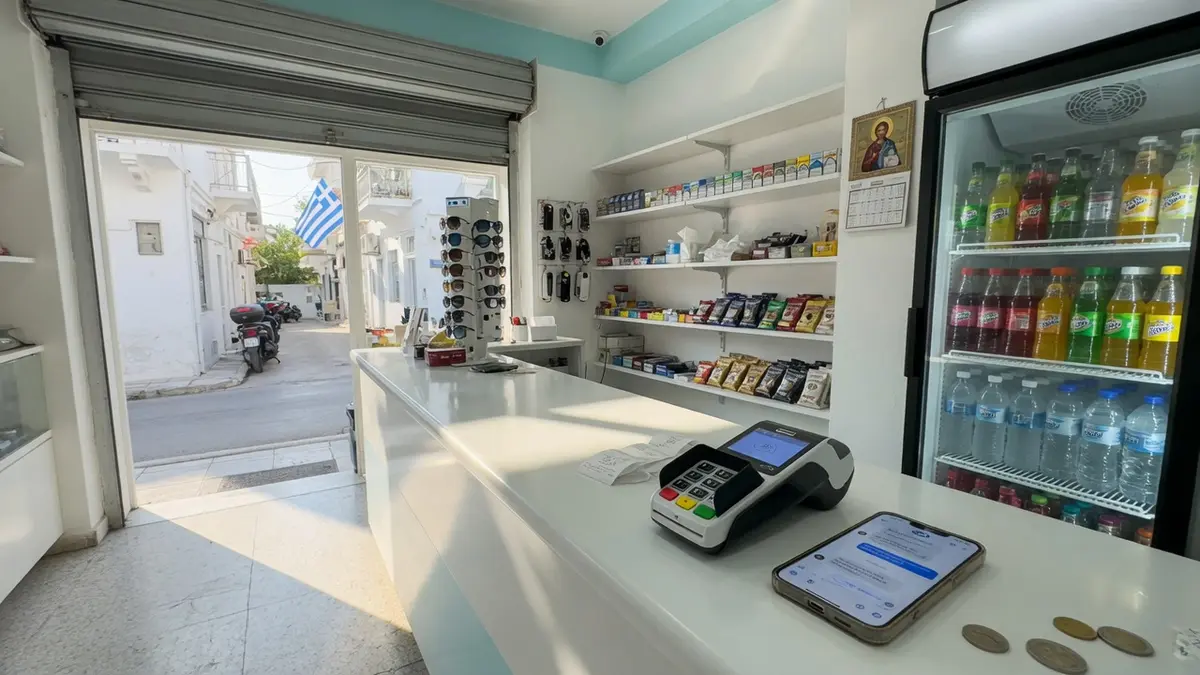
A multilingual phone for a small Greek shop
Quick summary
- On this street the second language is the person at the door who does not have Greek.
- They still ask whether you are open, whether you have the thing, a price, and where Tuesday's order is.
- The assistant continues in the language they started — English, Albanian or Russian on the same number as Greek.
- A price invented in English is still your price. If it is not in the file, it is a callback in any language.
- Hours have to be right in the language they will walk over on, or they find the shutter down.
- Any text you send goes out in the language of the call, or they miss the collection hour.
TL;DR
You run a small shop or workshop in Greece. Some of the people on the street, and some of the people who already ordered, start the call in English, Albanian or Russian. They want Saturday hours, a price, news of Tuesday's order, or they want to complain. You are at the counter, in the back, or in the van. Even if you have a little English, you cannot hold that conversation while a card is in the machine. An assistant answers the number on the door in 70+ languages, says only the hours, prices and stock sentences you wrote down, and takes a name when the file is silent. Fluency is not permission to guess.
Key takeaways
- Put every language on the same number. Do not print a second mobile "for English".
- Write Saturday hours and the lunch close so they can be said cleanly in more than one language.
- Repeat the callback rule in the languages you actually hear: if it is not in the file, we call back.
- Take quote requests as facts — what, how many, by when — not as a chat that ends in an invented figure.
- Send any confirmation text in the language of the call.
- Route a complaint to you the same day even when you do not speak that language. The transcript is the point.
They started in English and you were already taking a card
You are at the counter with someone’s card in the machine when the phone rings. If you picked up you would hear that the first word is not Greek. You do not pick up. The person in front of you has not finished. The caller hears the Greek greeting you recorded last year, then a beep. They hang up.
That is the language problem in a one-person shop. A visitor saw the window. A resident never learned enough Greek for a voicemail. A supplier has always spoken English to you. A customer came in last week with a cousin translating and is now alone with a telephone. They want Saturday hours, a price, Tuesday’s order, or they want to complain.
You are the person who would have answered in English. You are also the person with both hands in the till, on a box, or on a bench in the back. A little English does not help while a card is in the machine. Albanian or Russian you may not have at all.
An assistant can greet them in 70+ languages. That is the easy part. What still has to be right is the hours, the price, and the stock sentence. If you have not written the answer down, the assistant takes a name. Fluency is not a reason to guess.
Who is actually ringing
A visitor who saw the window. They want to know if you are open now, or Saturday, and whether the thing in the glass is still there. They will not leave a Greek message. They will walk until a door answers.
A resident who shops here and still will not use Greek on the phone. They manage at the counter with pointing, or with a relative. On the telephone they start in English or Albanian. The order they are asking about was placed in Greek, under a Greek name, by someone who is not on this call.
A supplier who invoices you in English. They want a name, a delivery, an invoice. If the assistant treats them like a tourist, they get a speech they did not need and you get no flag.
Someone who works during your opening time. They ring after you have pulled the shutter, or at twenty past two, because that is when they are free, or because a cousin is sitting next to them to help. Evening is still hours, a price, an order — in a language you were not there to hear.
What goes wrong when the language is the miss
You will not tag it as language. The log shows a short unanswered call. You may decide tourists do not ring, they just walk in. Some of them did ring. They heard Greek they could not follow, and they walked.
The other miss is a person in the doorway. Someone — you, in a hurry, or an assistant that wanted to be liked — understood “do you have it, how much, can I come now”, and answered so you would not sound difficult. You now own a stock promise or a price in a language you may not read until the argument has started. A figure spoken on your number is your figure.
The third caller is already angry. They collected yesterday. They will tell the whole story in a language you do not speak. If the only option is you, live, struggling at the till, they give up or they come in shouting. A transcript and a flag the same day is how you handle a conversation you cannot have while a customer waits.
The rule the assistant must obey
Same facts, any language. If it is not in the file, we call back.
It may say the hours you wrote, a published price you wrote, or a stock sentence you wrote, including “we do not confirm stock on the phone”. It may speak 70+ languages to do those things. If you keep a calendar for visits or collection windows, it checks a time before it offers it, and it sends the confirmation itself, in the language just spoken.
It may not translate a guess. It may not convert currency because the caller asked in English. It may not tell a visitor to come in for an item it cannot see. It may not settle a complaint with a refund it invented because the caller was upset and clear. It may not improvise an order with a supplier. It may not switch back to Greek because the name on the order looks Greek.
When the file is silent, the English sentence is the Greek one: I cannot answer that from here; I have written down what you asked; a person will call you.
Hours they will walk over for
Most of the non-Greek volume in a lot of shops is hours and how to find the door.
Saturday until two, then until one in August, then closed the Saturday before a name day. The week of 15 August. Lunch. Whether the shutter is up at eight for the first delivery, or only at nine. Whether you still take collections at six after you have nominally closed.
Write the week as it actually runs, so it can be said without “usually” and “I think so”. If Saturday is wrong in English, they stand in front of a shutter and you will not know why the street looked busy and your till did not. When you change Saturday, change the file the same morning.
Parking, which bell, shutter at eight: those sentences save a drive. If you take collections at six, write that, or the assistant will send someone to a locked shutter in perfect English.
People who are uncomfortable on the phone in Greek often ring when they expect a machine, or when a cousin is next to them — evening, and after lunch when the shutter is down. A recording that says “leave a message” after 17:00 is, to them, a closed shop. If you only turn English on for the season, you will still drop the Albanian order-status call in February. Leave it on.
The thing they saw in the window
Visitors point at the window. They want the small white one. That is not a stock code. Matching a window description to the shelf is guessing. Take the description, take the number, call back — or tell them the hours and refuse the promise. A clear English “I cannot confirm that from here” is better than a yes that puts them in a doorway for something you sold this morning.
If you want window items to be confirmable, photograph them into the file with a sentence you are willing to say. If you have not done that work, do not let the assistant do it live. “We do not confirm stock on the phone” is a complete policy. It can be said in English without apology.
A quote they cannot say in Greek
A quote on this phone is a list, not a figure. What they want, how many, by when, a number you can return. “The usual order” is not a list. “Same as last time” is not a price. It does not get better when it is said fluently in English.
Do not let the assistant invent a figure to be hospitable. Do not let it convert into dollars or pounds because the caller asked in English. A number on your line is your number, in euro, unless you have listed something else.
If they want to send a photo on Viber, the assistant takes the request and, if you have written the number, tells them where to send it. It does not pretend to have seen the photo.
Those four fields are why a recording in a language you do not speak is still usable. A long polite conversation with no fields is only a slightly better voicemail.
They ordered with a cousin and they are ringing alone
Someone comes in with a relative who talks. The order goes in the book under a Greek name, in Greek. Later they ring alone, in English or Albanian, about that order. The assistant should not need the cousin. Name, date, the number on the receipt, what they are asking. If you have put a status where the assistant can see it, it may repeat that status. If you have not, it flags you. “Thursday is normally fine” is not a status.
Send the callback, and any collection text, in the language of this call, not in the Greek the cousin used last time. A Greek SMS to that number is how they miss the collection hour and come in angry with the relative in tow.
Keep the language of the last successful conversation on the record if you can. If you cannot, let the current call decide. Do not switch back to Greek because the name on the order is Greek. The book is for you. The sentence is for them.
The supplier who has always spoken English
A supplier ringing in English about a delivery or an invoice is not a visitor. They need a flag, a company name, and you, not a Saturday-hours speech and not a quote form. If they say they are calling from a company that sends you goods, take the company name and put it in front of you.
A date you do not have is still a date you do not have. An invoice copy works the same way as it does in Greek: take the number and the name, and you send the paper.
If you deliver, the area and the rule belong in the file. A helpful English “we can probably send it to the hotel” is a van you do not have. Do not let the English side of the file grow exceptions the Greek side would never have been allowed.
The text they will actually read
If you send a confirmation at all — a collection window, a visit, a “we will call you back” — it goes out in the language of the call. A Greek text to a number that just spent four minutes in English is a text that is not read. They miss the hour, come in at the wrong time, and bring the cousin.
If you keep a calendar for visits or collection windows, the assistant checks the time before it offers it. It does not invent a window because the caller asked in English and sounded in a hurry. Then it sends the SMS itself.
If a partner or a cousin placed the original order, ask whether the text should go to this number or another. The number on the call may not be the person who needs the collection hour.
What you do with a transcript you cannot read
You do not need to speak Albanian to act on a flag that says complaint, or order, or hours. You need the fields and a same-day call. If a phrase is unclear, listen with someone who has that language, or ring them and start in English, or ask them to come in. Do not leave the row because the words look difficult.
A complaint flagged after you lock the shutter is a complaint that has already been told at the next shop. The assistant does not argue, offer money, or decide that the story is small. Those are your sentences, including when the story arrived in Russian.
It is tempting to be warmer and quicker to say yes when the caller is not Greek, so you do not sound difficult. That is how English becomes the language you invent prices in. Same file. Same callback. Same complaint flag. If they need more than the file, they need you.
Listen to the first fifteen non-Greek calls. You are not grading the accent. You are checking that hours were right, that no figure appeared that is not in the file, that nobody was invited in for a thing the assistant could not see, and that a complaint produced a flag rather than a speech. If a call fails those, it failed, however friendly it sounded.
What you configure first
- The same number. The one on the door. No English line.
- Hours in a form that can be spoken, including lunch, Saturday, and the next public holiday.
- The callback sentence in the languages you actually hear on your street, not in a list of seventy you do not.
- Quote fields — what, how many, by when, a number — so a recording you cannot speak is still a usable list.
- The window and stock sentence. A short published list, or we do not confirm stock on the phone.
- A supplier path. Company name, then you.
- SMS language follows the call. Check this with one English collection before you trust it.
- Complaints flagged the same day, on a phone, regardless of language.
Then leave it on in February. The resident who rings about Tuesday’s order in Albanian is not a seasonal extra. They are the same shop, on a quieter week, asking the same question the file already knows how to refuse.
AI receptionist, in-house staff, or a call centre
| CITT | In-house | Call centre | |
|---|---|---|---|
| Caller starts in English | Continues in English | If you have it | If that shift has it |
| Albanian or Russian at lunch | Same rules, that language | Rarely | Whatever was staffed |
| Hours said correctly | From the file you keep | If they picked up | If the sheet is current |
| Invents a price in their language | Never — callback | Tempting, to be helpful | Risk |
| The thing in the window | Description taken, no promise | They can look, if they come | Often a guessed yes |
| Complaint you cannot understand live | Transcript, flagged to you | You struggle, or they give up | A short note |
| SMS language | Language of the call | If you type it | Sometimes |
What one unanswered English "are you open" can cost on a Saturday
Worked from these assumptions — change any of them and the answer changes:
- In season, a handful of non-Greek calls a week ask first whether you are open and whether they can come today or Saturday.
- This example follows 3 such calls in a week that currently hit a Greek voicemail or a ring-out.
- 2 of the 3 do not leave a message. They walk or drive to whoever answered.
- A walk-in that buys is worth about €70 of margin here. Replace this with your own average ticket; many shops will be lower or higher.
- This example assumes 1 of those 2 silent callers would have come in and bought. Lower it if that feels rich.
- 3 non-Greek hours-or-availability calls hit silence.
- 2 vanish. You conclude tourists do not ring, they just walk in.
- If 1 of the 2 would have been a €70-margin visit, the week hid €70.
- In a twelve-week season, 12 × €70.
About €840 a season on a small ticket — enough to matter, not enough to invent a bigger story. Put your own ticket in.
What it costs
CITT is pay as you go: no packages, no minimum, no contract. The current rates — the monthly fee per number and the per-minute rate — are on the pricing section of the home page, which is the only place they are published.
Frequently asked questions
Do I need a separate number for English?
No. The number on the door is enough. The assistant hears the first sentence and continues in that language, and it can switch if they switch. A second mobile is another number you will forget to forward, and the people who already have the door number will never look it up.
What if I do not speak the language the complaint arrived in?
That is what the transcript is for. You get their words, a short summary, and a flag the same day. You can answer in Greek, or in English, or you can ask someone. What you should not do is leave a complaint sitting because you were embarrassed by the language.
Can it tell a tourist we have something in stock?
Only if you have put that fact in the file. "We usually have it" is not a fact. A wrong yes, said clearly in English, produces a person in the doorway holding a translation of a promise you did not mean to make.
Will it start quoting in another currency?
Not unless you wrote that figure down. It should not convert to be helpful. A number on your line is your number, in euro, unless you have listed something else. If the file is silent, it takes what they want and you call back.
Most of my week is Greek. Is this worth turning on?
You do not switch on a separate service. You turn on the same receptionist. On the days the call is not Greek it does not go to a beep. The cost of leaving it off is the Saturday visitor who decided, in the time it took to hear Greek they could not follow, that you were closed.
Does the quote request stay usable if they spoke Albanian?
If you have configured the fields — what they want, how many, by when, a number — yes. Those fields are the point. A long polite recording you cannot use is only a slightly better voicemail.