Lesson reminders and empty hours at a driving school
Quick summary
- The last lesson is back. Tomorrow's list sits on the desk. Nobody will work it tonight.
- Remind tomorrow first — driving lessons from the car list, theory from the room list. Those are not one pile.
- A 16:40 cancel frees 17:00 only if that instructor and that car are actually free. Do not invent a replacement hour.
- Hours left on a package come off the file you connected. If the file is silent, it takes a note.
- A test-morning call repeats only a date the transport office has already given you.
- Take any number off the list that asks not to be called, the same day, before the next pass.
TL;DR
The last lesson is back. Tomorrow's driving lessons and Thursday's theory have not been reminded. A 16:40 cancel left 17:00 empty. Two packages are down to an hour. Nobody rings them, because the hour those calls belong to is the hour both pairs of hands are still in a car. The assistant works the lists you already keep: it reminds tomorrow's times, offers an empty hour that is actually free, and repeats a test date only if you already have one. It will not invent a free hour. It will not invent a Tuesday. It will not say they are ready.
Key takeaways
- Turn on tomorrow's reminders first, from the live lists — the car list for a lesson, the room list for theory.
- Offer an empty hour only when that instructor and that car are free. Do not invent a spare five o'clock.
- Build the remaining-hours list from the file, not from memory. If the file is silent, do not guess.
- Write the outbound script so it cannot confirm a test date unless that date is already on the row.
- Take any number off the list that asks not to be called, the same day, before the next pass.
- Listen to the first fifty outbound recordings for an invented hour, a test Tuesday, or a 'you are ready'.
The last lesson is back. The lists are not.
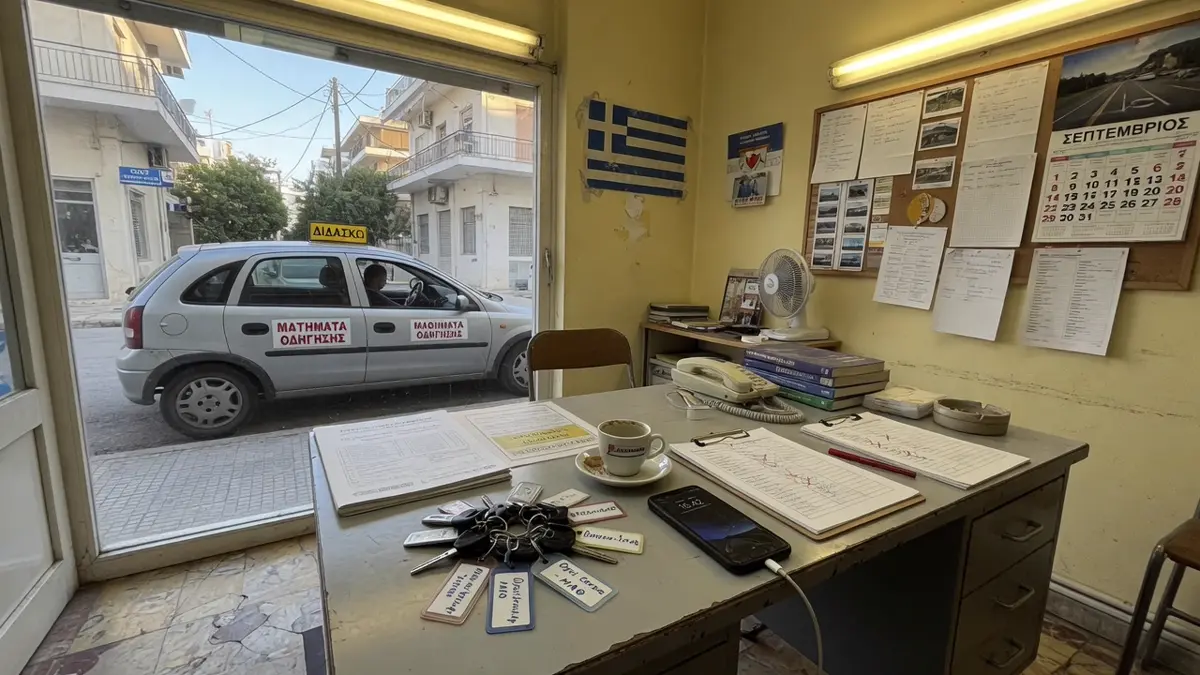
Thursday, 19:20. The last student has been dropped. Keys on the hook. Maria is still on the ring road with a motorcycle hour that ran late. Someone at the desk, if you still have one, is writing tomorrow’s names on a sheet.
On that sheet sit four jobs nobody will finish tonight.
Tomorrow’s driving lessons have not been reminded. Thursday’s theory neither. A 16:40 cancel left 17:00 empty, and the next person who asked for five o’clock was told the week was full. Two packages are down to an hour. One student has a test morning the transport office already gave you. They still do not know where to meet.
Kostas will not ring them. His foot was over the second brake until twenty past. Maria will not ring them. The hour those calls belong to is the hour both cars are out.
That is a normal evening at a two-instructor school. You already count lessons given. The thing you usually cannot see is the empty 17:00 that could have been offered, and the student who forgets tomorrow because nobody said the metro out loud.
Remind tomorrow first
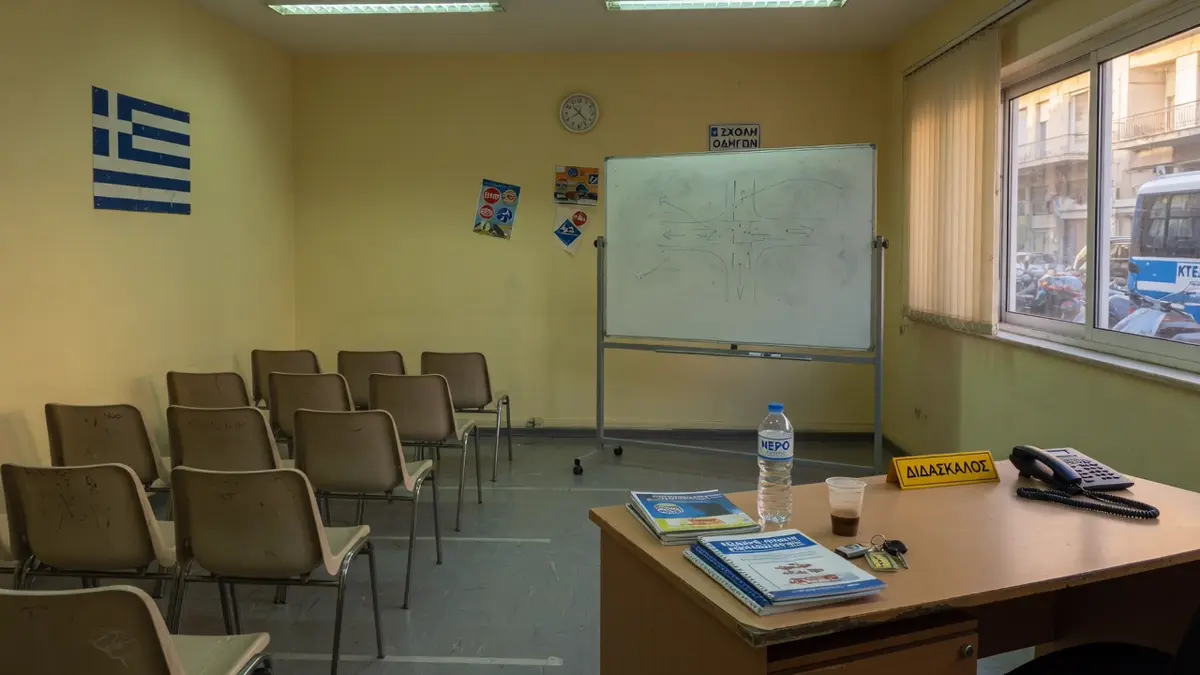
The list is short. It is already in the books. Silence has a concrete cost: an instructor and a dual-control car, or a chair in the theory room.
A reminder is not a new booking. They already have a time. The call confirms they still come, says the pickup if there is one, and stops.
Driving lessons come off the car list. Theory comes off the room list. Those are not one pile. A student who has a lesson with Kostas at 17:30 should not be asked if they are coming to theory. A theory name should not be offered a car hour because the reminder script was written for lessons.
Say who they are with, the hour, and where to meet. “Tomorrow at 17:30 with Kostas, pickup at Agia Paraskevi metro.” That is the call. It does not add “and we can squeeze in an extra hour if you want”. It does not ask if they are ready. It does not invent a test date at the end to sound complete.
If they want to move it, that is a change, not a reminder. Find the existing lesson, release it, offer two times that are actually free, place one, send the new text. If Friday at five is not free, say so. Do not invent five o’clock because this is an outbound call and you want it to finish.
If they do not answer, you set the retries and the message. A short recording that names the school and the hour is enough. After the tries you chose, the name stays on the list, still holding the lesson. Three honest attempts with no answer is a fact for you, not a reason to keep ringing the same number after dinner.
The SMS reminder is a different job from the call. A day ahead is the usual starting point. A same-afternoon ping helps a 17:00 more than a Tuesday theory, because after work is when people are still at the office and change their minds. Send it in the language of the original booking. Seventy-plus languages.
The empty hour after a cancel
A cancel at 16:40 for a 17:00 lesson leaves that hour empty. If nobody offers it, Kostas sits in the car with nobody to teach, or he goes home, and the next person who wanted five o’clock is still on a wait.
The assistant may offer that hour only when that instructor and that car are actually free. A gap on a sheet is not a free hour if Kostas is already out. A gap on the category B list is not a motorcycle hour. A gap on the car list is not a theory chair.
Who it rings is a list you already have, or it is nobody. The next person who asked for after work. The student whose package is down to an hour. Not everyone who ever sat in the car. Not a name from last April.
The script is short. You had asked for a driving lesson after work. An hour has come free tomorrow at 17:00 with Kostas. Do you want it. If they say no, stop. If they say yes, write the lesson, write the pickup, send the text. If they ask for a different hour, look at the list. Do not invent one.
It should not offer a free replacement hour. You do not owe a free extra hour because someone cancelled yesterday. If that is not a rule you already say out loud, do not write it into the outbound notes. It will read the sentence out.
A theory chair that comes free on Wednesday for Thursday evening follows the same rule. Offer it only to someone who wanted that class, on an evening you already run. Do not move them onto a car hour to fill the gap.
Hours left on a package
“How many hours do I have left?” is a file question. The assistant repeats a number only if you connected that file and the row is current. If the file is silent, stale, or unreachable, this is not an outbound call about a number. It is a note for you.
The call, when you do run it, is an offer to book one of the hours that remain, against an instructor and a car that are actually free. It is not a guess. It is not a push to buy another package from the phone. A figure invented on an outbound call is a figure you argue about at the car door, with the next student already waiting.
Two children in one family, or one student on B and a motorcycle, are two files. Do not read the wrong remaining hours onto the wrong licence.
A published starter package on the card in the window can be repeated if they ask to continue and you gave the assistant that figure. “A few more to get confident” cannot. Hours already done, manual or automatic, and whether this is a retake all change the number.
Do not start here. Tomorrow’s reminders and the empty hour are shorter lists with a clearer cost. Remaining hours wait until those two have run a week without inventing a five o’clock.
Theory evening, and a test morning you already have
Thursday’s theory can be reminded the same way as a lesson. The evening, the room, the language of that class if you wrote it down. It is not a driving lesson. Do not offer Kostas’s car at the end of the theory reminder because the script had a spare sentence.
A test morning is a different call, and a narrower one. The transport office gave you a date, or it did not. If you have one, written against that student, the assistant may ring to say the morning, the meeting point you already use, and that the instructor and the car are blocked. If you have none, there is no outbound call. There is a note.
It must not pick a Tuesday because the lesson list looks empty. It must not say they are in. It must not say they are ready. A test morning also takes the instructor and the car. That morning is not offered as a lesson to someone else while you are confirming it.
Where you meet is a fact you wrote down, or it is a note for you. Inventing a building the school has never used is how two people wait in different car parks.
A parent who wants a date before the student has finished theory is still a request. Theory first, then the car, then the test — in that order, and only the steps you actually run. The assistant does not skip a step from the phone.
Saturday motorcycles and rain
If you cancel bike hours in the rain, write that down. Outbound is how Maria’s Saturday list hears it before they leave the house.
The call says the bike hours are off, and offers the next dry day you have already marked. It must not move them onto a category B car to be helpful. That is a different licence and a different instructor. It must not invent a Sunday hour because Saturday is wet.
If you do not cancel in the rain, do not store a sentence that says you do. The assistant will read it out, and Maria will have a dry Saturday with nobody on it.
Category B lessons in the rain are a different rule, if you have one. Write it separately. Do not let a motorcycle weather script cancel Kostas.
Do not say they are ready
The outbound list tempts people to “finish the job”. That is how a reminder becomes a test conversation, and how a remaining-hours call becomes “you should sit it next month”.
The assistant does not decide that. It has not sat through the last junction. It has not seen the reverse into a bay. It books another driving lesson if that is what you allow, or it takes a note. The same rule covers “how do I reverse into a bay” and any other driving advice. Those are a request, never a lesson over the phone.
Fluency makes this worse, not better. An outbound call in English that says they are ready is still your sentence. They will take the morning off work on it.
A complaint about last week’s lesson, or about an instructor they did not want, is a tagged note. It is not a free hour offered from the same call to calm them down.
When they ask you to stop
They come off the list the same day, and they stay off. Outbound only works if the desk is careful with the names it already has.
A student who finished their package and said they are done is not a remaining-hours name. A student who asked not to be called about empty hours can still get tomorrow’s reminder, if they still have a lesson in the book — or not, if you wrote it that way. Write the difference. Do not let one “stop” wipe a reminder they still need, and do not let a reminder list keep ringing someone who asked you to stop.
Set the hours it may ring before the first name goes out. Saturday night is not one of them unless tomorrow is a Sunday lesson you actually run. After 20:00 is a rule you choose, not a default.
A short recording that names the school is enough when they do not pick up. Do not leave a remaining-hours figure on a voicemail. Do not leave a test date on a voicemail unless you already had that date and you chose to send it by SMS instead.
What you listen for
Listen to the first fifty outbound recordings. You are not grading the greeting. You are listening for an invented hour, a Tuesday the transport office has not given you, a “you are ready”, a remaining-hours number that is not in the file, and a motorcycle student moved onto a category B gap.
Any one of those is a configuration problem, and it will repeat until the script is tightened.
Then look at the empty hours that were offered. If any of them were 17:00 when Kostas was already out, the free-hour rule is not tight enough. Tighten it before you count how many hours the assistant filled.
A reminder that went out for the wrong list — theory names called about a car, lesson names called about Thursday’s room — is the same kind of failure. Three lists. Three jobs. One number.
After that, spot-check weekly for a month and then leave it alone.
What you turn on first
Start with tomorrow. Do not start with last year’s almost- students.
- Tomorrow’s reminders, from the live lists. Driving lessons from the car list. Theory from the room list. Hour, instructor, pickup. Nothing else.
- The empty-hour path, only after a cancel has been written back, and only if that instructor and that car are free. A named list of who may be offered that hour. No invented five o’clock.
- The SMS rule: after the booking or the reminder exists in the matching list, in the language of the original call. Never a test Tuesday you do not have.
- Quiet hours and retries, set before the first name goes out. A stop that takes them off the same day.
- Remaining hours, only from the file, only after the first two have run a week. No guessed number.
- A test-morning confirm, only for dates you already have, with the meeting point you already use. If you have none, there is no call.
- A failure sentence the assistant is not allowed to improve: if the diary or the file cannot be reached, it says someone will call back. It does not hold an hour it cannot see. It does not say they are ready.
Leave “ready or not”, driving advice, new packages, and any figure that is not on a published card as callbacks. Turn the reminder on before the week is out. Turn the empty-hour offer on once you have watched a real 16:40 cancel free a real 17:00.
When those two have produced a week of calls you would have been happy to have made yourself, add remaining hours, then the test-morning confirm. Do not add them all on day one. A school diary has a car, a room and a transport letter, and the edges are where someone is told they are ready by a voice that has never sat in the passenger seat.
Add who is in on Thursday evening, whether you pick up from the metro, whether Saturday motorcycle hours come off in the rain, and which mobile gets a “ready or not” note after both cars are back.
Rates live on the pricing section of the home page. They are not repeated here.
AI receptionist, in-house staff, or a call centre
| CITT | In-house | Call centre | |
|---|---|---|---|
| Evening-before reminder | Yes, from the matching list | If they remember in the car | If you sent them the list |
| Offers the empty 17:00 after a cancel | Only if instructor and car are free | When someone has a free minute | A generic “we have a gap” |
| Remaining hours from the file | Repeats only what you connected | From memory, sometimes wrong | Risk, if the sheet is stale |
| Test-morning call | Repeats only a date you already have | Can look at the transport letter | Treats it as another booking |
| Says they are ready for the test | Never — flags a person | Yes, if they were in the car | Should not |
| Mixes a theory name onto a car hour | No — three lists, three jobs | Keeps the piles apart | One script, both jobs |
| Stops when the person says stop | If you configure the list | If they note it | If the list is clean |
What unreminded after-work lessons and unoffered empty hours leave on the road
Worked from these assumptions — change any of them and the answer changes:
- Two instructors, about 40 driving lessons a week. Put your own weekly count in.
- About 3 of those 40 are no-shows, or cancels that never reached the list in time.
- Time for one empty after-work hour — the instructor, the dual-control car — is about €40 in this example. Use your own figure. This is the number to change first.
- A same-day reminder, plus a 16:40 cancel written back, lets you fill 2 of those 3. Change that if yours is lower.
- This example ignores leftover hours on packages nobody called about. Those sit on a different list.
- 3 empty lesson hours × €40 = €120 of after-work time in one week.
- Filling 2 of them from a reminder and a written-back cancel puts €80 back. The third is still gone.
- Over 46 weeks, if nothing changes — 46 × €120. Put your own weeks in if you close in August.
- That figure ignores the test morning nobody confirmed, and the package that ran out in silence.
About €5,520 a year of after-work hours that were already on a list, waiting for a phone call. Change the take-up and the hour figure.
What it costs
CITT is pay as you go: no packages, no minimum, no contract. The current rates — the monthly fee per number and the per-minute rate — are on the pricing section of the home page, which is the only place they are published.
Frequently asked questions
What should it call about first?
Tomorrow's times. The list is short, it is already in the two diaries, and silence has a concrete cost: an instructor and a dual-control car, or a chair in the theory room. After that, the empty hour from a cancel that reached you in time. Remaining hours on a package come third. Leave “are you ready for the test” off the list. That call belongs to a person who was in the car.
Can it offer tomorrow at five if someone just cancelled?
Only if that instructor and that car are actually free. A reminder can confirm that a lesson is in the book. That is a fact about the list, not a licence to invent a spare hour. If Kostas is still out until 19:00, 17:00 is not on offer. If you cannot live with that sentence, send the SMS from the calendar and keep a person on anything that might become a new booking.
What does the remaining-hours call actually say?
That the file shows they have a number of hours left, if you connected that file, and that you can book one if an instructor and a car are free. It does not guess the number. It does not invent a package price. It does not say they should sit the test next. Those are pressure, and they belong to a person who can see the last junction.
Can it tell them their test is Tuesday?
Only if that Tuesday is already written down for that student, the date the transport office gave you. It must not pick a morning because the lesson list looks empty. If you have no date, this is not an outbound call. It is a note for you.
What if someone says they do not want these calls?
They come off the list the same day, and they stay off. Outbound only works if the desk is careful with the names it already has. A complaint about a call they did not ask for will cost more goodwill than the hour you might have booked.
Will it say they are ready, or give driving advice?
No. That is not a reception answer. The assistant offers another driving lesson if you allow it, or it puts their words in front of you. It does not say they are ready. It does not explain a reverse into a bay. A human was in the car. It was not.