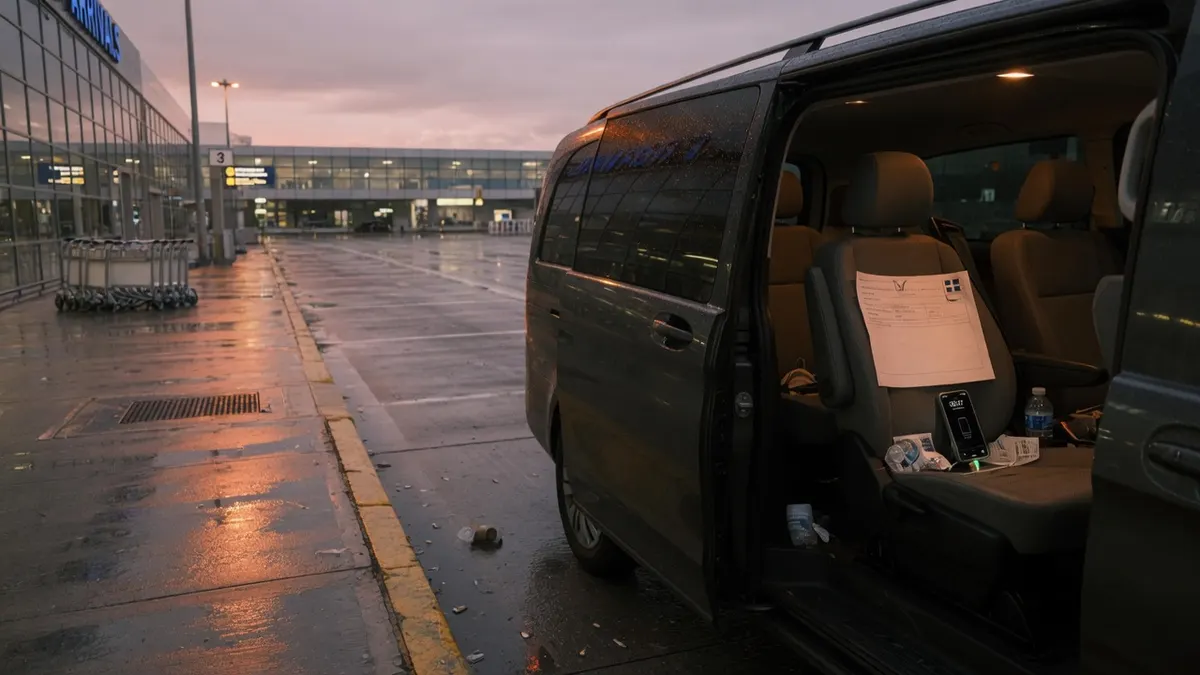
Book airport pickups from flight, hotel and bags
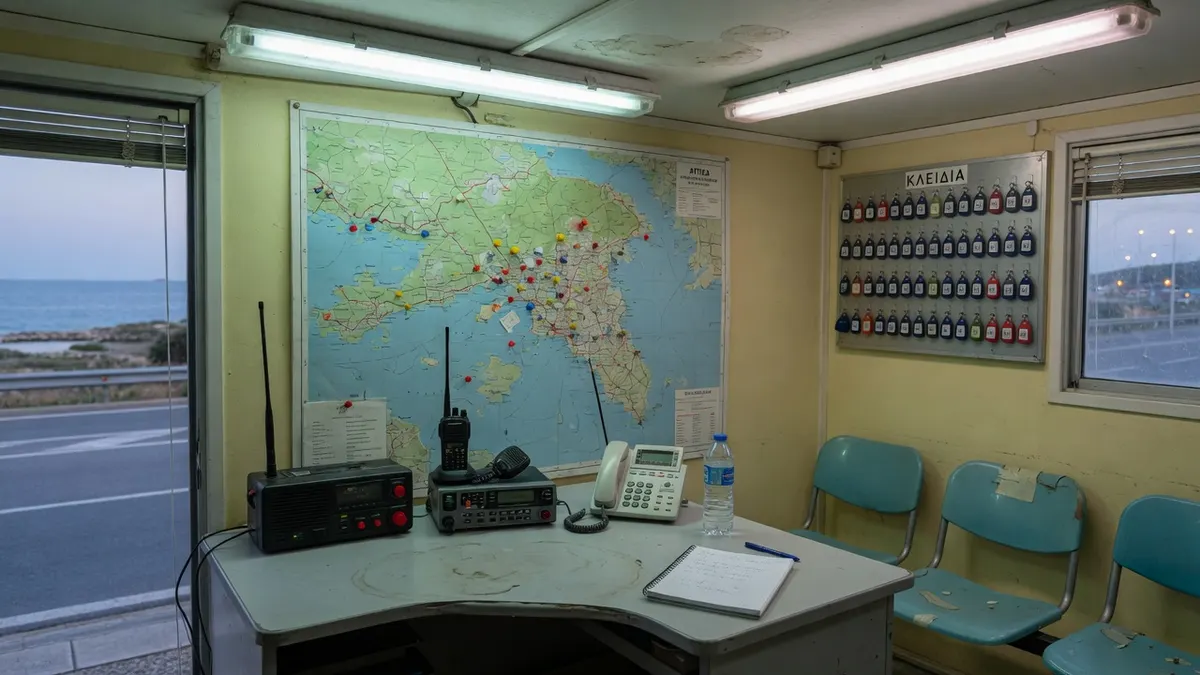
Quick summary
- The assistant reads the run sheet before it offers a slot, so a night pickup is never offered as a 05:40 return.
- A private pickup and a shared shuttle are different bookings. Get that wrong and two families meet at one van.
- New pickup, return or change first. Then the flight number, the hotel and the bags. Then the sheet.
- Anything that sounds like a fare, a child seat in stock, or a wait stays a callback unless you typed a published figure.
- If the assistant cannot read the run sheet, it takes a callback. It does not guess a free van.
- The assistant texts the flight, the hotel, the meeting point, and what to have ready at the curb.
TL;DR
You are on the radio. A caller who wants a slot will not wait for a callback just to learn whether 01:10 is free. An assistant can book those slots if it reads the run sheet first, treats a night pickup as different from a 05:40 return, and asks new pickup, return or change before it places anything. A pickup is a flight, a hotel and bags. A fare question is not a new slot type. If the sheet cannot be reached, the assistant does not guess. It takes the request and says so. The assistant texts the time, the flight and the meeting point.
Key takeaways
- Give the assistant the types and their real durations before you let it book — night pickup, daytime private, shared shuttle, return, extra stop.
- Mark last-run times and loaded vans in the same sheet it reads, including August nights.
- Test a move on an existing return and on a night pickup, separately, before you test a new villa.
- Turn on the SMS at the moment of booking, with the meeting point for that airport.
- If the run sheet cannot be reached, the only answer is a callback.
- Check the first fifty bookings by hand. That is when you find the 01:10 that was put on a van already loaded for a different hall.
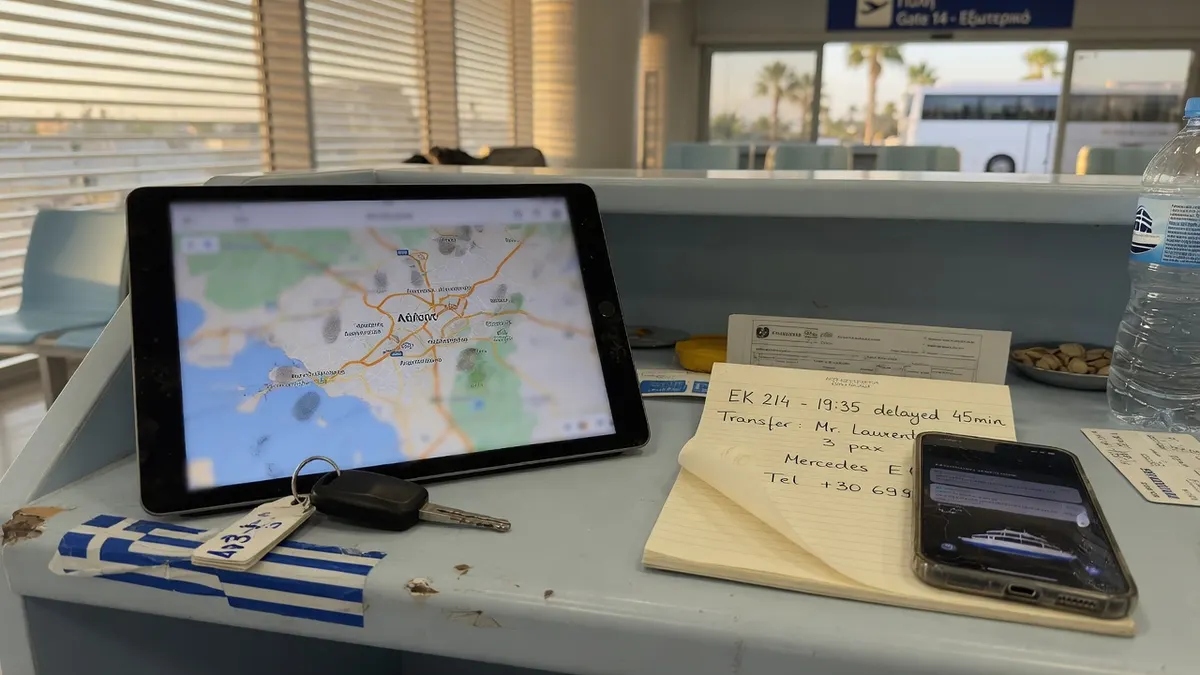
A pickup is not an empty hour
A hotel books a night. A transfer desk books a van against a flight. Those are not the same diary.
The caller says 01:10 as if that were a time you can write in a square. 01:10 is a landing they were told. The van has to be at the hall before that, with the right seats, for the right number of bags, and still get home before the 05:40 return that is already on the sheet. An assistant that treats “one ten” like a haircut slot will double-book the only 7-seater you have.
So the first job is not to be helpful with a time. The first job is to know what kind of run this is, then to read the sheet you already use.
New pickup, return, change — then the facts that belong to it
New pickup. Flight number, landing time they were told, hotel name or villa, people, bags. Without those five, there is nothing to check. A “hotel in Glyfada” is not a drop. Fenix is a drop. A villa with a pin is a drop. “Near the beach” is a callback.
Return. Name on the booking, hotel they are leaving from, flight they need to make, how many people in the morning. A 05:40 check-in is a different duration from a 14:00 run. If you mark them as the same type, the assistant will offer the noon van to a family that needed to leave at four.
Change. New flight number, new time they were told, what else moved — hotel, people, bags. A change is often not a new slot. It is a rewrite of a run that already exists. Opening a second pickup for the same family blocks a van you still need.
Only after that split does anyone look at a clock. An assistant that opens with “what time would you like?” will put a delayed landing into tomorrow morning and leave four people on tonight’s curb.
The run sheet, not a memory of who is out
Connect the sheet the desk already works from. If that sheet shows a free van of the type they need, the assistant may offer that slot. If the sheet is silent, stale, or unreachable, the assistant does not guess. It takes the request and says the desk will confirm.
Guessing is how you get two families at one sliding door. It is also how you promise a name board in a hall you do not staff after a certain hour.
Mark last-run times per airport, in the same place the assistant reads. Heraklion is not Eleftherios. An island after a wind delay is not the sheet you printed at six. If the last van is home, the honest answer is that the last van is home — said on the first call, not after a text that already went out.
Loaded vans need a mark too. A 7-seater that looks empty on a bad export is still on the road with a family. The assistant should see the same truth the radio sees.
Flight number, hotel name, bags — the three that must be on the note
People remember the flight. They remember the hotel they booked. They can count bags if you ask. They do not remember your run code.
Write those three on every new pickup, even when the sheet refuses the slot. A refused slot with a flight number is a callback you can make. A refused slot with “family, tonight” is a voicemail you will not return in time.
Bag count is not decoration. Four large bags and a buggy is not two cabin bags. The assistant does not downsize the vehicle to make the sheet look free. If they need a larger van than you have in that hour, that is a callback or a no — not a squeeze.
Hotel name in their words. If they say a Greek name and a Latin name for the same house, take both. Do not pick the one that is easier to type.
What must not be booked as if it were a slot
A fare is not a slot. If they ask how much, the assistant does not create a “price appointment”. It records the question. A published figure you marked as speakable may be repeated. A description of the ride may not.
A child seat is not a slot. It is stock. Note the request. Do not write “two seats confirmed” unless the desk has a rule that a seat is always in that van. Most desks do not.
A wait on a delay is not a slot. It is a rule you either wrote — wait up to a time you named — or a callback. The assistant does not invent “we always wait”.
An extra stop is not a second pickup and not a silent add-on fare. Note it. Keep the main run on the sheet. Price stays off this call unless you typed the add-on.
A name board in the hall is a staffing fact. Book the van if the sheet is free. Do not book a person at a door you do not cover.
Night pickups and 05:40 returns are different types
If you give the assistant one type called “transfer”, it will treat the 01:10 and the 05:40 as interchangeable hours. They are not.
A night pickup starts from the airport. The clock is the landing. The meeting point is a hall or a curb. The risk is a family with no board.
A return starts from a hotel. The clock is the flight they must make. The risk is a van that arrives after they should have left.
Put different durations on them. Put different buffers on them. Test a move on each type before you let the assistant touch a new villa. The first fifty bookings are where you find the night job that landed on the return van.
Shared versus private is a third type if you actually run both. Do not let a private request be “fitted” onto a shuttle to save a gap. Do not let a shuttle request be promised a private van because the greeting was friendly.
If the sheet cannot be reached
The only honest sentence is that the sheet cannot be reached. Take the flight, the hotel, the bags, a name and a number. Say the desk will confirm. Do not offer 01:10 from last night’s memory.
This is the failure that looks like success on a transcript. The assistant was polite. It wrote a time. The van was never free.
Give it a short outage line so it does not improvise. Outage is a callback, not a best guess.
The SMS is part of the booking
A slot that is not texted is a slot the family will ring again from the belt. Turn the SMS on at the moment the sheet is written, not an hour later.
The text follows the language of the call — 70+ languages. It should carry flight number, hotel, meeting point you actually use, and that a child seat is requested rather than confirmed, if that is the truth.
No sheet, no text. A confirmation of a guess is worse than silence.
Do not put a gate code for a villa into the first SMS unless that is a channel you already trust. A code on the wrong phone is a problem you cannot pull back.
What you configure first
- Types and durations. Night pickup, daytime private, shared if you run it, return, extra-stop as a flag not a type. Real minutes, including the wait you actually allow at the hall.
- Last-run times per airport, in the same sheet, with August and winter as different rows if they are different.
- The three fields required before a slot — flight number, hotel or villa, bags — plus people.
- Speakable fares only, if any. Everything else is a callback.
- Child-seat language. Request, not confirmation, unless stock is truly always there.
- SMS template with meeting point per airport, in the language of the call.
- Outage behaviour. Sheet unreachable means callback.
- Hand-check the first fifty. Night on a return van, villa written as hotel, seat treated as yes.
A booking assistant that still invents a fare is not a booking assistant. It is a second person on the recorded line saying a number you will take back at the curb.
Rates for CITT itself live on the pricing section of the home page. They are not repeated here.
AI receptionist, in-house staff, or a call centre
| CITT | In-house | Call centre | |
|---|---|---|---|
| Reads the run sheet before offering a slot | Yes, the sheet the desk works from | Yes | Usually not — takes a message |
| Books nights and 05:40 returns | Yes, if you marked them | If they are still awake | Sometimes |
| Treats a night pickup as different from a return | If you marked the two types | Yes | Rarely sees the sheet |
| Starts with new pickup, return or change | Yes — before it looks at the sheet | Yes | Often jumps to what time |
| Books a fare from a description | Never — the office looks at the zone | Quotes after the vehicle | Sometimes books "a price chat" |
| Sends the confirmation and the meeting point | Automatically, by SMS | If they remember | A generic text |
| Speaks the caller's language | 70+ languages | One or two | Whoever is on that shift |
What a mixed slot costs when a night pickup lands on a return van
Worked from these assumptions — change any of them and the answer changes:
- One 7-seater on the 05:40 return from a hotel, already loaded on the sheet for four people and bags.
- A new night pickup for a delayed 01:10 is offered the same van because the types were not marked.
- A private night pickup that you then cannot cover, and that books elsewhere, is worth about €70 — put your own figure in.
- This example assumes that mix happens twice in a busy week. Change the count if yours is lower.
- Two night pickups are written onto vans that cannot take them.
- Both families ring the next number when nobody is at the hall.
- 2 × €70 = €140 that week, plus two reviews about a board that never appeared.
- Busy weeks, over a 16-week summer — 16 × €140. Put your own weeks in.
About €2,240 a season from mixed slots alone — and only if you accept the conversion. Change it.
What it costs
CITT is pay as you go: no packages, no minimum, no contract. The current rates — the monthly fee per number and the per-minute rate — are on the pricing section of the home page, which is the only place they are published.
Frequently asked questions
Can it book a pickup if the run sheet is down?
No. If it cannot read the sheet you already use, it takes the flight number, the hotel and the bags, and leaves a callback. A slot spoken without the sheet is how two families meet at one van, or how a 01:10 is promised after the last run has gone home.
What does it need before it offers a time?
The type — new pickup, return, or change — then the flight number, the hotel or villa, how many people, how many bags. A time without those facts is a guess. Child seats and extra stops are requests on the same note, not a reason to skip the sheet.
Can it put two families on a shared shuttle?
Only if you actually run a shared service and the sheet shows space. It must not invent a shared van to make a private request fit. Mixing a villa drop with a hotel shuttle without a rule you wrote is how someone is left at the wrong door.
Will it text the flight and the meeting point?
Yes, if you turn the SMS on at booking. The text follows the language of the call — 70+ languages — and should carry the meeting point you actually use at that airport, not a door number the assistant invented.
What if they want a supermarket stop on the same slot?
That is an extra stop on a pickup, not a second booking and not a new fare said on this call. The assistant notes the stop and still checks the sheet for the main run. A price for the stop is a callback unless you typed a published add-on.
How do I know the first week's bookings are right?
Read the first fifty by hand against the sheet. Look for a night pickup on a return van, a villa written as a hotel, and a child-seat request that was treated as a yes. That is the week the types were wrong, not the week the greeting was wrong.