Multilingual receptionist for tutoring centres
Quick summary
- The English flyer is how a share of parents find you. They ring after school, often with another flyer in the bag.
- The first questions are still subject, class year, and Πανελλήνιες or regular lesson — in whatever language they opened with.
- Γ Λυκείου, year 12, and “last year of school” have to come back as the year on your roster, not as a polite paraphrase.
- A place invented in English is still a seventh chair. If the group is full, say so in their language.
- A direction or a sibling discount spoken fluently is still your answer. The assistant does not give either.
- The confirmation text goes out in the language of the call, to the parent, or they miss the first lesson.
TL;DR
The number on the English flyer rings after school. The teachers are already in a room. The parent started in English because that is the language on the paper. They want a place in a subject group — subject, class year, Πανελλήνιες or school — and they will not wait through a Greek greeting and a beep. The assistant stays in their language — 70+ languages — asks those three things first, and checks the roster you already keep. It will not invent a place. It will not choose a university direction. The text follows the language of the call, and it goes to the parent.
Key takeaways
- Treat English as a working language on the flyer number, not as a transfer if they sound foreign.
- Keep the same first questions in every language: subject, class year, exam or regular.
- Map the year they said — Γ Λυκείου, year 12, last year of lyceum — onto the year on your roster before you look at days.
- Repeat the two bans in every language you expect to hear: no invented seat, no invented direction or discount.
- Send the confirmation text in the language the parent used, to the parent's number.
- Route university direction, catch-up advice, and sibling prices to a person. The assistant takes the request.
They rang the number on the English flyer
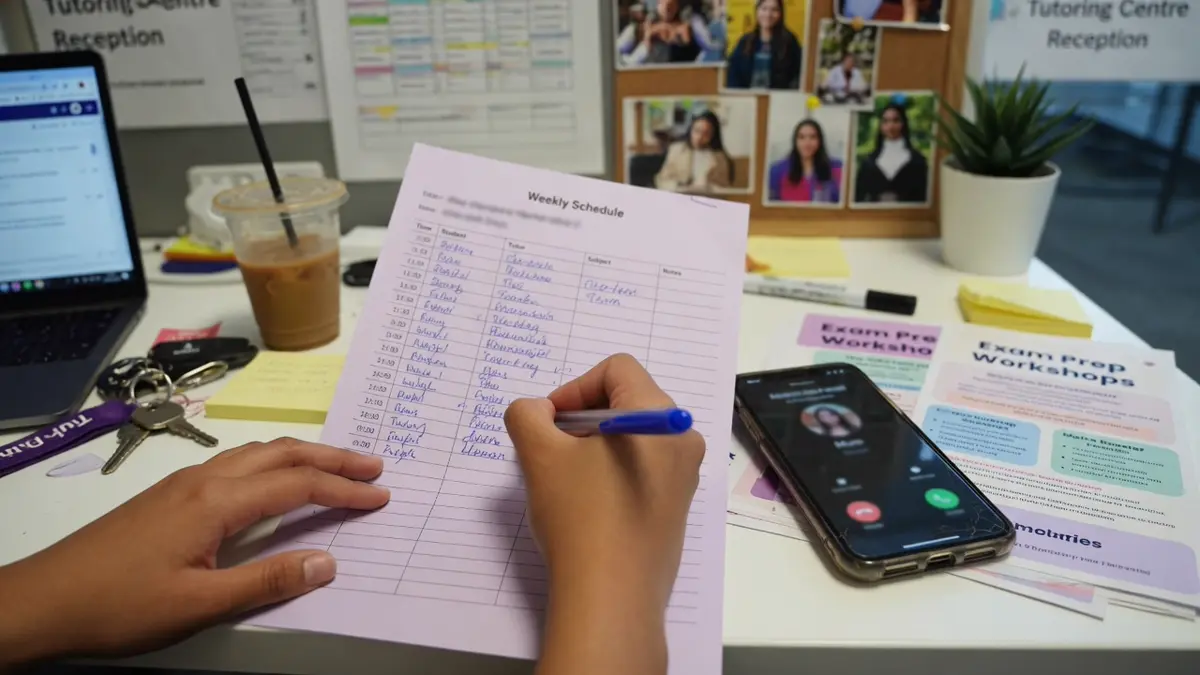
16:50 on a Tuesday. Behind the glass doors the B Lykeiou maths group is already at the board. Next room, chemistry. The owner is covering Γ Λυκείου. The phone on the desk rings.
The parent did not search for your name. They searched for maths for a child in the last year of school, in English, because that is the language the flyer at the international-school gate was printed in. Two papers came back. They rang yours. They will ring the next one if this goes to a Greek greeting and a beep.
The teacher cannot pick up. The owner cannot pick up. Nobody in the corridor is free.
That is a normal after-school hour in a Greek frontistirio that prints a flyer in English and keeps one number on the door. The parent who works in English in Athens, the family who moved from France last year, the grandmother who speaks Albanian and is placing a second child: they start in the language of the paper, or in the language they have. You do not need a plan per language. You need someone on that number who can continue the first sentence, and who will not invent a place in Γ Λυκείου maths because they can say it clearly.
Two ways this call goes wrong
They hang up. That is the first way. They heard Greek, or four rings and a tone, and they went back to the other flyer. You listen later and hear almost nothing, and you conclude that foreign parents write. Some of them do. The ones who rang wanted to talk today, with the flyer still in the bag.
They get an answer that is too helpful. That is the second way, and it costs a Tuesday rather than a lead. An assistant that speaks English well will want to close the loop: yes, there is a place, yes, that sounds like the exam group, yes, come at five. Said slowly, it sounds like competence. It is still an invented seat if the roster was not checked. The parent will keep the sentence. They will bring the child.
A third thing sits next to those. Parents who did not go through the Greek school themselves ask whether the child should take θετική or οικονομία, which university is realistic, how many extra hours will be enough for Γ Λυκείου in four months. The assistant writes those questions down in the parent’s words and stops. It does not become a counsellor because it can form the sentences.
The year they said is not always the year on the list
The opening is still subject, class year, exam or regular. English on the line does not mean they want a new enrolment. A parent who wants Thursday’s makeup, a change of day, or a waitlist update rings the number on the flyer because that is the number they have. If the assistant treats every foreign caller as a first enrolment, a parent who already has a child with you spends three minutes being offered a fresh group.
The year is where fluent English goes wrong.
A parent says “year 12”, or “the last year of school”, or “she’s 17”, or “third year of lyceum”. Your roster says Γ Λυκείου. A parent says “middle school”, or “she’s in the gymnasium”. Your roster says A, B, or Γ of Γυμνάσιο. The assistant has to map the words they used onto the year you actually run, and it has to read that year back, in their language, before it looks at days.
It does not guess from the child’s age. A seventeen-year-old can be Γ Λυκείου or a year behind. A child at an international school may not be in a Greek year at all. If the mapping is not clean, it takes a note. It does not drop them into B Lykeiou because that group had a chair.
Πανελλήνιες is the same kind of trap. A parent who says “university entrance”, “the national exams”, “A-levels”, or “she’s applying next year” may mean the exam programme, or they may mean extra hours around an international diploma. Write the phrases you actually hear. The assistant asks which of the two they mean, in their language. If they are not sure, it does not pick the exam group to sound serious, and it does not pick the shorter group to sound fast. It takes a note for you.
If they name a subject, write it down exactly. Maths is not physics. Ancient Greek is not modern Greek. “Science” is not a group on your list. Take the subject they can actually name, then the year, then the programme.
The rule the assistant must obey
Same facts, any language.
It may offer a place only when the roster shows a free seat in a group that matches subject, year, and exam or regular. It may repeat a published monthly fee only when that figure is on the sheet you connected. It may book a makeup only into a matching group that has a place. It may do those things in 70+ languages.
It may not say there is a place because the flyer still lists that group. It may not convert a euro fee into pounds to be helpful. It may not estimate. It may not choose θετική, θεωρητική, or οικονομία. It may not invent a sibling discount or a two-subject price. It may not promise a named teacher whose matching group is full. It may not send a Greek text after an English call. It may not send the text to the child.
When the list is silent, the English sentence is the same as the Greek one: I cannot confirm a place from here; I have the subject, the year, and the programme you named; someone will call you.
What you configure first
- English as a working language on the number already on the flyer. Not a second line. Not a note that says if they sound foreign, transfer.
- The same first questions in every language you expect to hear — subject, class year, exam or regular — written so they cannot be skipped.
- The year map. Γ Λυκείου, year 12, last year of lyceum, last year of school. A, B, Γ of Γυμνάσιο against the English words you actually hear. If these are not fields, the transcript is a story.
- The two bans, written in the languages you actually hear, so a fluent model does not improve them only in English: no invented seat, no invented direction or discount.
- The roster. A place is not a free hour. Exam groups are not regular groups.
- The confirmation text follows the language of the call, and it goes to the parent. Test this. It is the thing people forget.
- A named path for university direction, catch-up advice, and sibling prices. Request, in their words, flag. No answer.
- How a place is held — usually enrolment at the desk — written down, so fluency does not invent a hold.
Then listen to the first twenty calls that did not start in Greek. You are not grading the accent. You are checking that the three questions happened, that the year on the roster matches the year they meant, that no seat appeared that is not on the list, and that no direction was chosen. If a call fails those, it failed, however smooth it sounded.
The parent who does not know the Greek year
A lot of the English calls are from people who did not sit the Πανελλήνιες themselves. They know the child is in the last year. They do not know whether that is Γ Λυκείου on your wall. They know the child wants a university. They do not know whether they mean the exam programme or help with this week’s test.
Putting them down for Tuesday at 17:00 in B Lykeiou homework, because that group had a chair and the English was fluent, leaves a teacher with a name the year cannot take.
Read the year back. “I will write that as Γ Λυκείου — the third year of lyceum. Is that right?” If they hesitate, stop looking at days. Take a note. Offer a time with you.
If they ask for a trial in English, that is still a trial into a group that has a place, for the subject and year they named. Do not let fluency invent a private hour you do not offer.
A place is still held the way you already hold it. Say that in their language, before the SMS goes out. A parent who heard “you’re booked” and thought the chair was theirs will not take the news well at the desk.
A parent in English at 19:30 is on your desk at 19:30. These are not odd calls you staff with “the English-speaking teacher, when she is not in a room”. They are the same unanswered phone as Tuesday at ten to five, with a language on top.
When they already have a child with you
The published number does not become a new-enrolment line just because the greeting was in English.
“He missed Thursday. Is there a makeup this week?” is still a makeup. Same subject, same year, a matching group that has a place, in the window you already use. The assistant applies that rule in their language. It does not invent a Friday hour in French to sound sure.
A parent who wants to move Tuesday to Wednesday follows the matching roster, not a free hour on the clock. Set the notice you actually enforce. The assistant should say it at the end of a change, in the language of the call.
“How many extra hours will be enough for the exams in four months?” is not a reception answer in any language. The assistant does not say a number. It books a conversation with you, or it writes the question down.
If you run a waitlist, the assistant adds a name only when the matching group is actually full. Explaining the waitlist fluently in Albanian does not create a seventh chair.
A published monthly fee you gave it can be repeated. A sibling discount cannot. A two-subject price cannot.
A figure spoken on your number is yours
“What’s that in pounds.” “Give me a sense if two subjects are cheaper.” “Around a hundred and fifty?”
If the figure is not on the sheet, the assistant does not say it, convert it, or agree that the parent’s guess is close. A number spoken on your number is your number, in any language. The parent will keep it. They will turn up with that number already written down.
Do not store a “from” figure for the whole frontistirio. The assistant will read it out. If nobody should name a price until someone has seen the subjects and the year, do not give it that figure — not in Greek, and not in English.
A sibling discount asked from a description is the same trap. Two children, three subjects, “something on the price”. The assistant takes the names and the subjects and leaves the figure to you. It does not invent a family price.
A discount if they decide this week is a request. The assistant does not negotiate.
Direction, hours, and catch-up
What they need to bring to enrolment — identity, the child’s year, which subjects — the assistant can read back if you wrote the list. Whether the child should take θετική or οικονομία, which university is realistic, how many extra hours will be enough: those are requests. The assistant does not give academic advice.
They want to know if the child can start in January and still sit the exams in June. The assistant books a place if one exists, or a talk with you. It does not promise the year can be repaired from the phone, in any language.
A complaint about last month’s teacher, or a mark that did not move, is the same kind of call in any language: take the name, take what they said, put it in front of you. Do not offer a free month from the phone.
Two people, the phone handed across
Parents ring together. One speaks English, one speaks Greek, and they pass the phone. The assistant should follow the language of the sentence it just heard, and it should not lose the fields already collected when the language flips. “Γ Λυκείου maths, exam programme, Tuesday and Thursday” said in English is still the group when the next sentence is Greek. If the switch is messy, it reads the subject, the year, and the programme back once, in the language that is winning, and confirms.
If a third person comes on — a grandmother, a partner, someone who “handles the fees” — take their name and whether the callback should go to them. Do not restart the first questions. The subject, year, and exam-or-regular you already have are still the answer.
Send the SMS to the parent who will read it. If they named a second number, ask which one gets the text. A confirmation that goes to the child’s English-language mobile is a confirmation that sits unopened through the first lesson.
What you read when you get back to the corridor
You do not need to speak French to use the fields. You need the fields. Subject. The year on your roster, not only the words they used. Exam programme or regular lesson. Whether they asked for a new place, a makeup, a change of day, or a callback. The parent’s number. The language for the text.
Check the matching list before anyone offers a Tuesday hour. The parent who said “last year of school” is not B Lykeiou homework. The parent who is already on Thursday and wants a makeup is not a new enrolment. Mixing those notes is how you pull a teacher out of a room for a child who should not be in it.
It is tempting to give English callers a longer chat and a looser hand on the maximum, because they are comparing two flyers and you do not want to lose them. That is how the English enrolments become the sloppy ones. Same first questions. Same roster. Same two bans. Same text rule. The language is the only extra.
Put the assistant on the number already printed on the flyer, the door and the Instagram bio. One forwarding rule at the provider — everything, or only what has rung unanswered for the seconds you choose. Calls someone in the corridor still picks up never leave the building. You are not printing a second mobile “for international”. You are answering the number they already rang. Every line is answered at once. The bans do not change.
Rates live on the pricing section of the home page. They are not repeated here.
AI receptionist, in-house staff, or a call centre
| CITT | In-house | Call centre | |
|---|---|---|---|
| Parent opens in English at 16:50 | Continues in English | If that teacher has it | If that shift has it |
| First questions in their language | Subject, year, exam or regular | Varies by who picked up | Whatever the script was written in |
| Is there a place in Γ Λυκείου maths? | Only if the roster shows a seat | From memory, sometimes wrong | Risk, if the sheet is stale |
| Invents a place in their language | Never — waitlist or a note | Tempting, to be helpful | Risk, if they cannot see the list |
| English, French, Albanian, German | 70+ languages, same rules | Rarely more than one extra | Whatever was staffed |
| Text in the language of the call | Yes, to the parent | If they type it | Sometimes |
| Direction or a sibling price | Taken and handed over | Should be handed over | Not safe to answer |
What four unanswered English flyer calls can hide
Worked from these assumptions — change any of them and the answer changes:
- The published number receives a handful of English or French enrolment calls a week, mostly after 16:00.
- This example follows 4 such calls in a September week that currently reach a Greek greeting or the beep.
- 3 of the 4 do not leave a message. They dial the next frontistirio with an English flyer.
- A new enrolment is worth about €160 a month in this example — put your own average in before you trust the answer.
- A child who starts in September typically stays through June — eight months. Put your own stay in if it is shorter.
- Conversion is the assumption to attack. This example assumes 1 of those 3 silent parents would have finished enrolment. Change that if yours is lower.
- 4 English or French enrolment calls hit a Greek greeting.
- 3 vanish. The desk hears 1 message and concludes foreign parents write instead.
- If 1 of the 3 would have become an enrolment, that week hid €1,280 — €160 × 8 months.
- If this is one lost enrolment in a September-like month, keep €1,280. Do not multiply by eight months of the year unless each lost child would have stayed eight months. Put your own months in.
About €1,280 from one unanswered English week in this telling — only if you accept the conversion above. Change it.
What it costs
CITT is pay as you go: no packages, no minimum, no contract. The current rates — the monthly fee per number and the per-minute rate — are on the pricing section of the home page, which is the only place they are published.
Frequently asked questions
Do we have to print a second number for English?
No. The number on the door, the flyer and the Instagram bio stays yours. The assistant hears the first sentence and continues in that language, and it can switch mid-call if the parent does. You do not add a second mobile “for international”.
Will it tell them there is a place, in English?
Only if the roster shows a free seat in a group that matches subject, year, and exam or regular. Fluency does not change the rule. If the list is silent, stale, or unreachable, the assistant takes the three facts and leaves the confirmation to you. A parent who comes in for a seventh chair will not ring you a second time.
Will it convert the monthly fee into pounds or dollars?
Only if that converted figure is on the sheet you connected. It should not turn a euro fee into pounds to sound prepared, and it should not invent a euro figure either. A number spoken on your line is your number, in any language. If the sheet is silent, it takes the request and you call back.
Can it book a group in English and text them in Greek?
It should not. The text goes in the language of the conversation, to the parent. A parent who booked in English and receives a Greek message will miss the first lesson or reply to the wrong thing. The roster can stay in the language the desk uses; the message to the parent cannot.
We already have one teacher who speaks English. Why add this?
Because that teacher is at the board when the English call comes in at 16:50, and because the next call may be in French, or it may be a makeup in Albanian. Covering English with one bilingual colleague covers the calls that arrive while they are free. It does not cover the after-school burst, and it does not cover the languages they do not have.
What if they ask which direction the child should choose?
That is a request, not an answer. The assistant records the question in their words and puts it in front of you. It does not say θετική will suit the child, invent how many hours will be enough, or name a university. Fluency makes that kind of improvisation more tempting, not less.