Multilingual receptionist for restaurants
Quick summary
- Saturday night: both hands on plates, and the next call starts in German.
- The first question is still reservation, walk-in or takeaway — in the language they opened with.
- It checks the book before it offers a table. Their language does not let it invent one.
- A listed main it may repeat. A dinner-for-two it made up in English is still your number.
- The SMS follows the call: night, time, how many, the hold you actually use.
- A terrace in January, said clearly in French, is still a terrace you have stacked.
TL;DR
Saturday night. One person at the pass has plates in both hands. The phone rings in German. The caller wants a table for Saturday, to walk in tonight, or two gyros at the door — and they will not wait for a Greek beep. An assistant answers in the language they started in, asks which of the three it is, and checks the book you already use. It will not offer a table or name a dinner price unless you put that figure in. It texts the confirmation in that language, including the hold you already say out loud. 70+ languages. You do not set a language per table.
Key takeaways
- Treat the caller's language as the working language on the published number, not a transfer if they sound foreign.
- Keep the same first question in every language: reservation, walk-in, or takeaway.
- Repeat the bans in every language you hear: no invented table, no invented menu price, no allergy advice.
- Send the confirmation and the hold in the language of the call.
- Connect the book you already use. Fluency does not let it say a table is free.
- Write terrace months, winter hours and last seating the way you would text a guest. They will be read out in their language.
They started in German
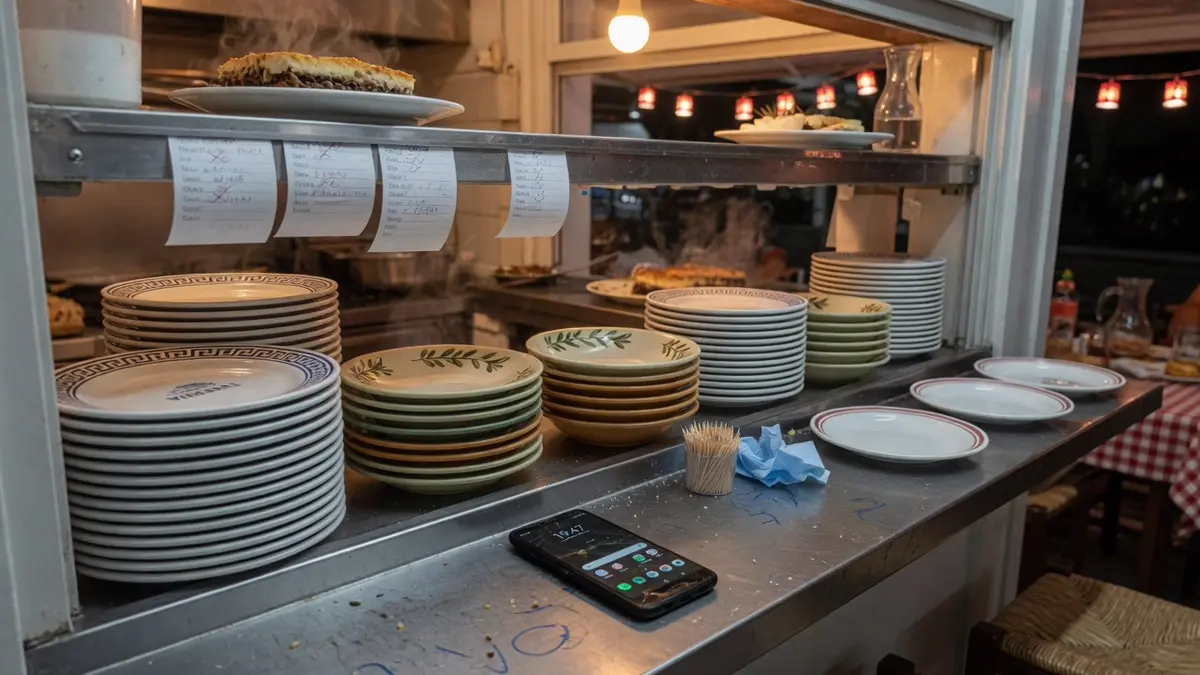
Saturday night. One person at the pass has plates in both hands. The phone rings. The caller starts in German, or English, or French — the language they found you in. You do not have that language while the four at that table are unfinished.
They will not leave a long Greek message. They hang up and sit down at the next place on the harbour. If a fluent voice then invents a table, a dinner-for-two price, or a wait it cannot see, they will keep that sentence.
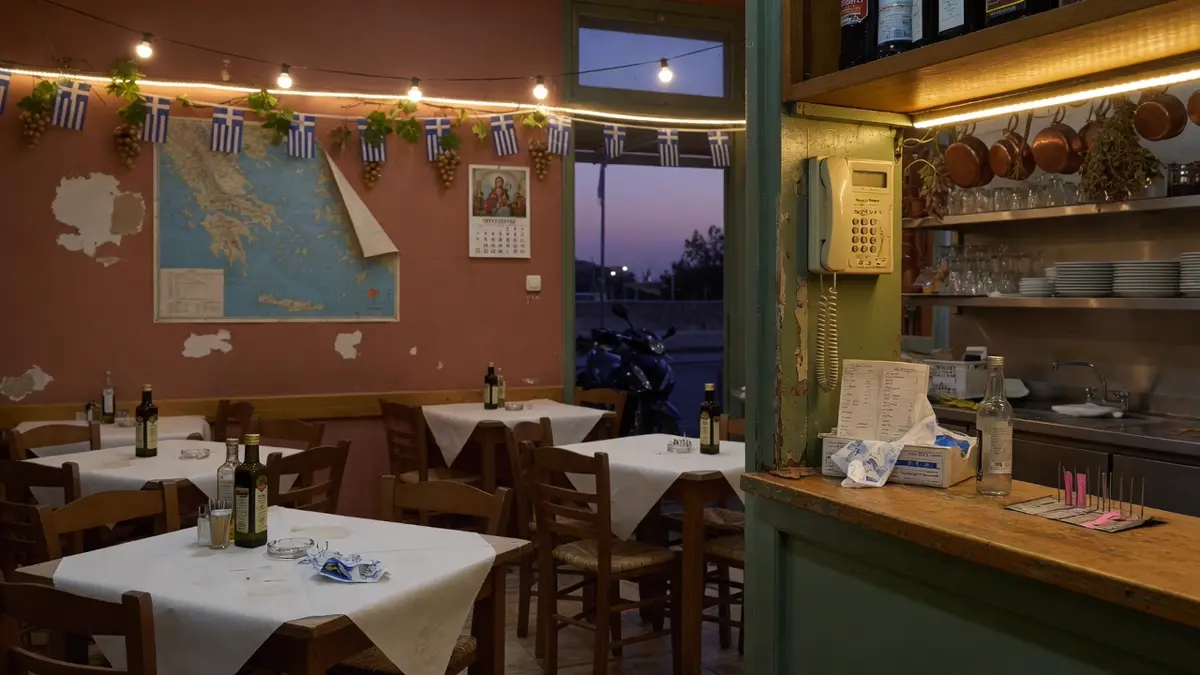
This is a normal Saturday in a Greek taverna. English from a couple off the harbour. German from a family with your name on a paper. French, Italian, in the same night. Greek from the cousin in Athens who is booking for someone else. You may have enough English to finish the guest at the door. You do not have enough of everything, and you do not have it with plates in both hands.
The number they rang is the one on the door, the Google listing, and the card on the table. They did not look for a bilingual host. They looked for a table. Three names came back on the same screen. They will tap the next one if this goes to a Greek greeting and a beep.
Sunday lunch is the same crush, only earlier, and the languages arrive with the families. If that is your busy service, it is the same problem on a different clock.
Two ways this call goes wrong
They hang up. That is the first way. They heard Greek, or four rings and a tone, and they went back to the list. You listen later and the box is almost empty, and you conclude that German guests write. Some of them do. The ones who rang wanted a table tonight, or a yes about Saturday, and they already had another doorway in the same glance.
They get an answer that is too helpful. That is the second way, and it costs the night rather than a lead. An assistant that speaks German well will want to close the loop: yes, a table at nine, yes, around that price for four, yes, the terrace, yes, come down, we will find something. Said clearly, it sounds like a room that is ready. It is still an invented table, an invented figure, and an invented wait. The caller will keep the sentence. The reserved four at the door will not care that the voice was not you.
A third thing sits next to those. People who are not in the country yet ask whether you take cards, whether there is parking, whether a child can have a high chair. The assistant repeats what you typed in. It does not guess a house rule because it can say the German sentence.
Reservation, walk-in or takeaway — still three jobs
The language changes. The jobs do not.
A reservation is how many people, which night, what time, inside or terrace. The assistant takes those facts and looks at the book. It does not skip to a yes because the English was friendly. It does not skip to a price because the German was clear. If the book cannot confirm a table that fits, it takes a name and a number and leaves the answer to you.
A walk-in is whether it is worth crossing the street tonight. That is not a time next Thursday. Hearing it in a language you only half have is how you tell people to come down when the book is already full. The assistant asks whether this is a walk-in. The honest answers stay short in their language: come now; come now and you will wait; no, the book is closed, here is the next night we can reserve. It does not invent a wait it cannot see.
A takeaway is two gyros, a time, and whether the kitchen still does pickup. That is not a table. An assistant that opens a reservation because the English word for “tonight” sounded like a booking makes a mess of Saturday and of the tickets. If you stop takeaway at nine, it says so in their language.
A single call can hold two of these, and it often does when the caller is not in Greek. “A table for Saturday, and can we pick up two gyros tonight?” is a reservation and a takeaway. “We’re two, just down the street” is a walk-in, not a reservation for Thursday. The assistant has to hear both, in their language, and confirm neither until the book and the kitchen say so.
Write the first question the way you would for a new person at the door, then keep it in every language you actually hear: reservation, walk-in, or takeaway. One sentence is enough. An assistant that skips it because the caller already sounded sure will put the wrong Saturday in the book.
A sentence they will keep
The last four at nine may already be in. The walk-in at the door may be about to take the only two left. If the assistant says Saturday is free because it could say so in French, two parties arrive for one table. They will both have the sentence. One of them will have nowhere to sit.
It checks the book you connected. If that book shows a table that fits — that night, that time, that party size, inside or terrace — it may say so and take the next step you allow. If the book is silent, slow, or down, it does not fill the gap with a yes in their language. Fluency is not a second book.
Do not put a hopeful sentence in the notes. “We usually have something on Saturday” will be read out, in German, as if it were a table. If a table is not free until you have looked, do not give the assistant a sentence that sounds like it is.
A table for four is not two tables for two pushed together, not unless you have said it may. Combining tables is a decision in the room. Saying it clearly in English does not make the four exist.
The same test covers the price. Catch of the day and lamb by the kilo are not a listed main. July is not November. A dinner-for-two quoted in English before anyone has seen the board is a number the door then has to take back, often with the guests already inside, in a language you do not speak well.
It can repeat a listed main or a set lunch you typed in. If you have no published figure for that question, it takes the request. Do not put an average spend in the notes. It will read the number out, and they will keep it.
A complaint about last night is the same kind of call in any language: take the name, take what they said, put it in front of you. Do not offer a free meal from the phone because the German was angry. You look at the night. You decide.
An allergy question is never advice, in any language. It can write “no nuts” on the booking you actually take. It cannot say the fish is safe.
The text they can read on the harbour
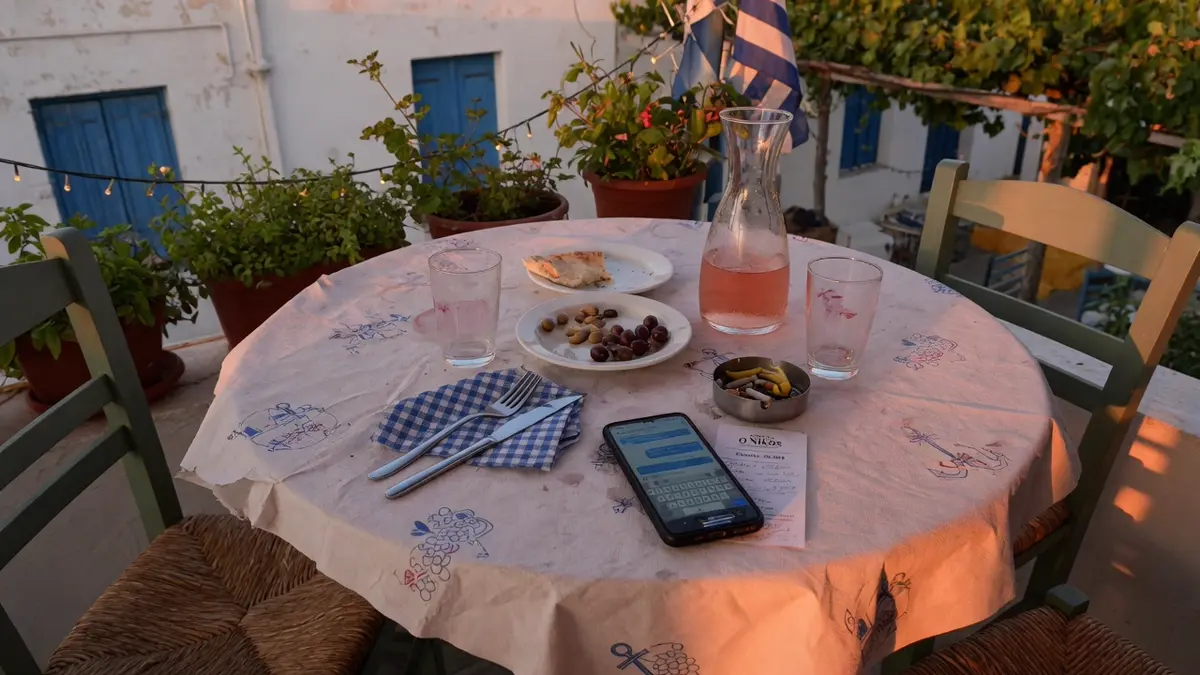
The confirmation is not a courtesy. On a small room it is how they know they have Saturday at nine, how many, inside or terrace, and the hold you already say out loud.
If they booked in German and the text arrives in Greek, they will ring again during service to ask whether they are in. That is not a translation problem on a website. That is a call you cannot take because both hands are on plates.
The SMS follows the language of the call. The book can stay in the language the door already uses. The message to the person arriving cannot. Test this once with a number you hold. It is the thing rooms forget, because the Greek text looks finished on your own phone.
Put the sentences they will need into what you type in: the hold, last seating, whether the terrace is open that month, where the door is if it is on the side street, whether you take cards. The assistant may repeat those. It may not invent a wait, a terrace in January, or a dinner-for-two price. If the entrance is around the corner from the name on the street, that sentence belongs in the first things it can say — in their language, not only in yours.
A call about last night’s table, a noise, or a dish they did not like is a note. It is not a promise of a free meal, in any language.
Terrace, winter hours, last seating — in their language
Plenty of tavernas in Greece do not run the same book in July and in November. The terrace is open when the weather allows. On an island, Tuesday lunch in winter may not exist. A guest who booked from Munich does not know that. They ask in German whether the terrace is open next Sunday. You are at the pass.
The honest answers have to be true in their language. If you have marked the terrace closed, the assistant says so and offers inside. It does not reserve the terrace in a month you have it stacked because the French was clear.
A caller who asks “are you open next Tuesday?” in November is asking whether you still run that day. If Monday and Tuesday are closed from October, mark them. An assistant that takes a Tuesday in November because the summer hours are still in the notes will have people arrive to a dark dining room — and they will have the sentence in English.
Last seating is the same kind of line. A caller at twenty-three who wants dinner is asking for a table, not a drink. If last seating is 22:30, the assistant says so in their language. It does not seat four people at 23:00 to be kind because it could form the English sentence.
Write those rules once, the way you would text a guest. They will be read out in 70+ languages. An empty rule becomes a terrace, a Tuesday, or a late table you cannot keep.
When they switch, and when someone else booked
Couples ring together. One starts in English. The husband takes the phone in German. The assistant follows the language of the sentence it just heard. Night, party size and the kind of call already taken stay taken. It does not restart the first question as if a new person had rung. If the switch is messy, it reads the facts back once, in the language that is winning, and confirms. A lost time at the handover is how you give away nine o’clock and keep eight.
If a third person comes on — a cousin in Athens, a colleague who “handles the money”, a parent who will pay — take their name and whether the confirmation should go to them. Do not lose the kind of call you already have.
The cousin who books in Greek for parents arriving from Munich is a house problem, not a polite extra. The people at the table speak German. If the hold text went to the cousin, or went to the parents in Greek, they ring again during service. Ask who is coming, and in which language the confirmation should go. The booking language and the arrival language are not always the same. The person who needs the text is the person who will sit down.
A walk-in who rings from the corner in English and a guest who already has a name in the book in German are not the same person. The first needs the book. The second needs the reservation that is already there. Ask which they are, in their language, before anyone talks about a free table.
The rule the assistant must obey
Same facts, any language.
It may repeat a listed main or a set lunch you typed in. It may say a table is free if the book you connected shows one that fits at that moment. It may tell the hold you wrote. It may promise a takeaway only if you still do pickup at that hour. It may do those things in 70+ languages.
It may not invent a table because the French was clear. It may not invent a menu price, convert a euro figure into pounds, or turn catch of the day into a number. It may not invent a wait. It may not open the terrace in a month you have it stacked. It may not send a Greek text after a German call. It may not decide if a dish is safe. It may not offer a free meal because the caller is unhappy.
When the book is silent, the English sentence is the same as the Greek one: I cannot confirm a table from here; I have your night and how many; someone will call you. That sentence, in their language, is what keeps them off the next doorway without giving away a table you do not have.
Several calls, one pair of hands
Saturday night is when the languages arrive together. A four at the pass. A tray in the room. The phone in German. A second ring in English before the first has finished. A second line with the same two hands still leaves the third caller on a busy tone.
The assistant answers several of these at once. The door still takes the ones a free pair of hands can take. A forwarding rule sends what you do not answer. Calls the door picks up never leave the restaurant.
Sunday lunch is no quieter. Families, name days, the terrace if the weather holds. You cannot leave the room to explain last seating in Italian. After last orders you are still running food, and the person who wanted a walk-in is still in the street, ringing in the language of the listing.
These are not odd calls you staff with “the one who has English, when she is at the door”. They are the ordinary Saturday. English, German, French, Italian. You do not set a language per table. You put someone on the number who can continue the first sentence, and who will not invent a table because they can say it clearly.
How CITT handles it
- Your number stays on the door. A forwarding rule sends what you do not answer. Calls the door picks up never leave the restaurant.
- Several calls are answered at once. A Saturday burst in three languages is a set of conversations, not a stack of busy tones.
- It picks up the language from the first sentence and stays in it, including when they switch. 70+ languages. You do not configure a language per table.
- It asks reservation, walk-in or takeaway first, in that language, then takes the facts that belong to that request.
- It checks the real book before it says a table is free, and writes only what you allow into the same book the door already uses.
- It confirms by SMS in the language of the call — night, time, how many, the hold.
- It escalates what cannot be finished on the call — an unpublished price, a table the book will not confirm, a twelve for a name day, an allergy question — as a tagged note.
- You get the transcript, the summary, and which of the three jobs the caller named, as fields the door can use without speaking that language.
What it will not do
It will not invent a free table. If the book does not show one, the caller gets a request taken, not a yes, in any language.
It will not invent a menu price, a wait, or a takeaway the kitchen cannot cook. It will not decide if a dish is safe.
It will not send the confirmation in a language they did not use. It will not open the terrace in a month you have it stacked. It will not take a Tuesday in November if you marked winter closed. It will not offer a free meal because the caller is unhappy. It takes the request. A human decides.
What these calls sound like
The order is the language they started in, then the kind of call, then the facts, then the book, then the hold said out loud in words they will still have on the harbour. There is no invented table and no invented price. There is no “come down, we will find something” over a book that is already full. There is no Greek text after a German call.
If the assistant is friendly and still says the last four is free, two parties meet at the pass. Put the person who rang about Saturday at nine on a request the door can finish, or on a table the book actually shows — in the language they used, with a text they can read.
What you set up first
Put the assistant on the number on the door with a forward-on-no-answer rule, so a free pair of hands at the entrance still takes the call. Then:
- The caller’s language as a working language on the published number. Not a second line. Not a note that says if they sound foreign, transfer.
- The same first question in every language you expect to hear — reservation, walk-in, takeaway — written so it cannot be skipped.
- The book you already use. If the book does not show a free table, the assistant takes a request. It does not invent one.
- Only the listed prices it may repeat. Do not give it a dinner-for-two number you would take back at the door.
- The hold, last seating, terrace months, winter hours — written the way you would text a guest. They will be read out in their language.
- One line that forbids allergy advice and a free meal from the phone.
- The confirmation text follows the language of the call. Test this with a number you hold. Include who the text should go to when a cousin booked for someone else.
Then listen to the first twenty calls that did not start in Greek. You are not grading the accent. You are checking that the first question happened, that reservation and takeaway were not mixed, that no table or price appeared that is not in the book, that the hold was the one you wrote, and that the text went out in the language of the call. If a call fails those, it failed, however smooth it sounded.
Rates for the service live on the pricing section of the home page. They are not repeated here.
AI receptionist, in-house staff, or a call centre
| CITT | In-house | Call centre | |
|---|---|---|---|
| Caller opens in German at 21:00 | Continues in German | If that person at the door has it | If that shift has it |
| First question in their language | Reservation, walk-in, or takeaway | Varies by who picked up | Often jumps to what time |
| Invents a free table in their language | Never — book or callback | Tempting, to be helpful | Risk, if the sheet is stale |
| Invents a dinner-for-two price | Repeats only a listed item you wrote | Can look at the board | Reads a list that may be last year's |
| English, German, French, Italian | 70+ languages, same rules | Greek, and English if they have it | Whoever is on that shift |
| SMS they can read on the harbour | Language of the call | If someone types it | Often Greek |
| Terrace closed in January, said in French | The months you marked, in their language | If they remember and have the words | Reads the summer board |
What four unanswered German and English calls hide in a week
Worked from these assumptions — change any of them and the answer changes:
- A small taverna, both hands on plates through Saturday service and Sunday lunch.
- In a normal week about 10 inbound calls start in English, German, French or Italian while your hands are on plates or tickets.
- You finish perhaps 4 of those, in the English you have. The other 6 hear Greek, or a beep, or English that runs out.
- Of those 6, 4 hang up without a message. They already have the next doorway in the same glance.
- A Saturday table for two is worth about €70 to the house — YOUR figure will differ, and this is the number to change first.
- Conversion is the assumption to attack. This example assumes 1 of those 4 silent callers would have been a table your book could take. Change that if yours is lower.
- 6 foreign-language calls in a week are not finished.
- 4 vanish. The door hears 2 messages and decides the German guests write.
- If 1 of the 4 would have sat down, that week hid €70.
- Saturdays and Sundays over the weeks you are actually open — 40 weeks at that rate, or fewer if you shut after October. Put your own weeks and your own conversion in.
About €2,800 a year in this telling — or much less if you put a lower conversion in. An empty message box is not evidence they never rang.
What it costs
CITT is pay as you go: no packages, no minimum, no contract. The current rates — the monthly fee per number and the per-minute rate — are on the pricing section of the home page, which is the only place they are published.
Frequently asked questions
Do we need a second number for English and German?
No. The number on the door, the Google listing and the cards on the table stays yours. The assistant hears the first sentence and continues in that language, including when they switch mid-call. You do not print a second mobile on the English menu. You add one forwarding rule — every call, or only the ones still ringing after the seconds you choose.
Will it quote dinner in pounds or dollars?
Only if you have put that figure in. It should not convert a listed euro price into another currency to sound ready, and it should not invent a euro figure either. A number spoken on your number is your number, in any language. Catch of the day and “how much for two” stay with someone who can see the board.
Can it confirm in Greek after they booked in German?
It should not. The text goes in the language of the conversation. A guest who booked in German and receives a Greek hold will ring again during service to ask whether they are in. The book can stay in the language the door uses. The message to the person arriving cannot.
We already have one person who speaks English. Why add this?
Because that person has plates in both hands at 21:00, or they are at the pass, or Sunday lunch has the whole room full. Covering English with one bilingual colleague covers the calls that arrive while they are free. It does not cover Saturday service, the terrace question, or the languages they do not have.
What if the husband takes the phone and switches to German?
The assistant follows the language of the sentence it just heard. Night, party size and the kind of call already taken stay taken. It does not restart as if a new person had rung. If the switch is messy, it reads the facts back once in the language that is winning. The SMS follows the language the booking finished in.
Can the door use a German transcript if nobody speaks German?
You get the words as they were spoken, plus a short summary you can read quickly. The fields that matter — reservation or walk-in or takeaway, night, time, how many, inside or terrace, name, number — should be captured as fields, so whoever is free at the door can still finish the book without speaking that language.