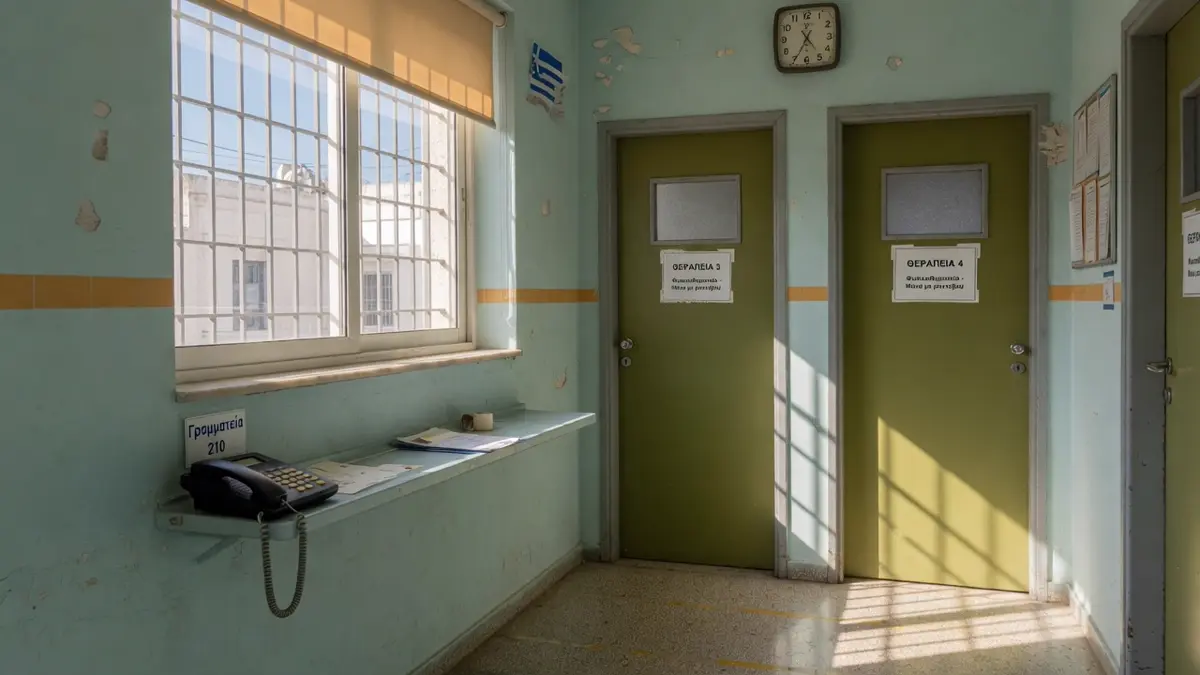
Multilingual phone for a physiotherapy clinic
Quick summary
- After training the phone rings in the language the caller has — Greek, English, German, Albanian — and your hands are on the table.
- First visit, follow-up or cancel still has to be the first question, in that language. A new patient still needs the longer time.
- Ice, exercises, how many sessions, and whether they should still come stay forbidden in every language you hear.
- A follow-up stays with Maria even when the caller cannot say her name in Greek. Do not offer whoever has a gap.
- A paper from the doctor and EOPYY are booking facts in the caller's language. They are not a plan the assistant may speak.
- Read-backs and the SMS go out in the language of the call, so a first visit is not confirmed in a Greek text they cannot read.
TL;DR
After work both hands are on the patient. The phone rings in English, German, Albanian, or Greek. The caller wants a first visit, a follow-up with the same therapist, or to cancel. An assistant that recognises the language from the first sentence asks which of those three it is, checks the calendar before it offers a time, and texts the confirmation in that language — 70+ languages. It still will not say ice, still will not give a session count, and still will not decide whether they should come. Treatment is not safer because it was asked in English.
Key takeaways
- Write the treatment refusal as a finished sentence in each language you hear — ice, exercises, session count, whether they should still come.
- Keep first visit, follow-up and cancel as the first question in that language. Do not skip to a time because the Greek was missing.
- Capture a follow-up therapist in the words they use. If they cannot say Maria, ask who they usually see, and do not swap.
- Give EOPYY, referral and parking as this clinic's own sentences, translated. Do not let the assistant invent entitlement.
- Confirm by SMS in the language of the conversation. A Greek text after an English call brings them back on the line.
- Call in yourself, in each language you care about, and ask whether you should ice the knee, before the first busy Thursday.

After training, in the language they have
Twenty past five. The patient is on the table. The phone starts.
The first caller wants a first visit and says their Greek is not good. The next asks, in English, whether they should ice a knee until they come. A father is on the line in Albanian about a child; the name on the book is the child’s. A coach rings in English for a player. Someone already on Maria’s Tuesdays calls in German to cancel five o’clock.
You speak Greek, and some English if you have it. You cannot leave the table. The person at the desk, if there is one, has the same two languages and a card payment in their hands. The others hear the ring, or hold music, or a machine.
Some hang up and dial the next clinic that answers in their language. Some hang up and the cancel never frees the table. A few stay on long enough to ask for ice, or a session count, in words the desk only half has.
What does not get done on that first call is a first visit that goes to the next clinic they already have saved, a follow-up that lands on the wrong therapist, and a treatment question that someone tries to answer because the English was clear enough to be tempting.
What fails when the desk has two languages
The volume is still first visit, follow-up, cancel. Whether the person at the desk can finish the call depends on the language.
A call in a language they only half have takes longer. The patient on the table waits, or the next caller hangs up. They guess that “next one” means any free thirty minutes. They book the father because they caught “knee” and missed that he was describing the child. They put the German cancel into a note that says “call back?”, and five o’clock stays empty.
A second person on the desk who also speaks English still leaves the Albanian caller waiting. Two people still take two calls. The third call is still a ring.
After two, or in the evening if you treat after work, the desk may already be empty. You are still at the table. The same mix rings. A machine that only speaks Greek does not take a first visit in English, and it does not hear a cancel in German.
The assistant answers several calls at once. It recognises the language from the first sentence and continues in it, including if the caller switches. It answers in 70+ languages. It takes the request. It still does not treat, still does not invent a session count, and still does not put a first visit into a follow-up gap.
First visit, follow-up, or cancel — in that language
The first question does not change because the Greek is missing. Ask which of the three it is, in the language of the call.
A first visit is still the longer time. A follow-up is still the shorter one, and still belongs to the therapist you named. A cancel is still a table that can be offered if the length matches.
If the assistant skips to a time because the caller is struggling, you get the same evening you get when a new hire is helpful: a new patient in Maria’s thirty minutes, or Dimitris on whoever is free.
Write those three words the way you already say them at the desk, in the languages you hear. First visit. Follow-up. Cancel. Do not invent softer labels. “A quick look” is how a first visit sneaks into a short gap. “Just a session” is how a follow-up loses the therapist.
If they cannot say which of the three it is, ask once more. Do not pick the short time to be kind. Kindness on this telephone is a callback, not a squeezed new patient.
Treatment is not safer in English
Patients will offer the assistant the sentence they want to hear, in the language they can manage at six in the evening.
Should I ice it. Which exercises over the weekend. Is this a disc. How many sessions. It hurts more — should I still come. Can I take something and come after training.
The answer stays forbidden in every language you hear. Ice, heat, rest, a cream, a movement, a session count, and whether they should still come are treatment. A polite sentence that starts with “usually we…” is still advice. It does not become safe because it was said in English, or because the caller’s Greek was thin, or because they asked nicely.
The assistant says it cannot advise — only the physiotherapist can — in their language. Then a time, or a note. A caller who wants to know if they should still come gets the time they already have read back, and a note on your list. They do not get a yes or a no.
If they describe the pain in detail, write it down in their words, in their language, and stop. Do not turn the description into a reason to book sooner, later, or not at all. Urgency is a decision you make. An assistant that says “that sounds like you should come in today” has already treated, in any language.
Do not put home-exercise lists in the notes in English and hope the assistant will only use them when it fits. It will read them out. If a sentence must not be said until someone has seen the patient, do not give the assistant that sentence, in any language.
Call in yourself. In English, or German, or Albanian, ask whether you should ice the knee. If the assistant answers, the refusal is not finished.
Same therapist, even when the name does not come out
Maria has been treating Dimitris’s shoulder for four weeks. The next session is still hers if the call arrives in German.
The assistant asks who they usually see, in their language. It matches that to the list you wrote. It offers that person’s next time. It does not treat a missing name as permission to book whoever is free.
People will say “the woman on Tuesdays”, “the one who did my shoulder”, a first name with the stress in the wrong place. Keep those words. Match them. If the match is unclear, take a callback. A swapped follow-up is a different appointment, and they will say so when they arrive.
A relative on the line is not the patient speaking. A son for a father. A coach for a player. A neighbour for an older woman. The assistant can take a booking from the relative if the clinic already accepts that. It should still take the patient’s name, not the speaker’s, and it should still ask first visit or follow-up. It should not take a treatment conversation through the relative at all. “Can you just tell me if my father should ice it” is treatment and a question about who may hear the answer. Record that they asked. You decide who is told what.
A parent calling about a child still needs the child’s name on the book. The assistant takes that name, and the words the father used.
The paper, EOPYY, and a rule that must be yours
New arrivals ring about a first visit with a paper from a doctor — or without one — in the language they can manage, not in Greek. They ask if you take EOPYY. They ask what to bring.
Give the assistant your own sentences, translated into the languages you hear. “Bring the paper from the doctor. We will look at it at the desk.” “We have EOPYY hours on the mornings you marked, and evenings are private first visits.” Those are clinic rules. “The fund will cover eight sessions” is entitlement. It does not belong in the assistant’s mouth, in any language.
It cannot read the referral aloud. It cannot say a foreign paper will be fine. It cannot book an EOPYY first visit you reserved for a completed paper if the paperwork is still a photo on a phone. A callback with a complete note is the honest end of that call.
Parking, shorts, arrive ten minutes early, the door is on the left — those lines may be repeated, in their language, because you already say them at the desk. Do not hide a treatment sentence inside a packing list. “Bring shorts, and ice it tonight” will be read as one instruction.
A coach who rings in English
A coach who rings for a player is still a first visit unless that player is already on your book. The call often arrives in English, after training, while your hands are on someone else.
Take the player’s name. Take the coach’s number if that is who should get the SMS. Book a first-visit time. Do not let the call become advice from the sideline. “Should they train tonight?” is treatment in English. The assistant does not answer it.
If the coach switches into Greek for a word and back again, follow. The first-visit length does not change. The refusal does not change.
The confirmation has to be in their language
When it books, it checks that the time is free before it offers it. If the calendar cannot be reached, it takes a callback. It confirms by SMS in the language of the call, so someone who cannot read a Greek text does not ring back to ask whether they actually got the 18:30.
The SMS names the type, the therapist, and the time. For a child, it names the child. For a player, it names the player. It can repeat the cancel notice you already use, in that language.
Do not let the SMS carry a plan. “See you at 18:30, ice it until then” is treatment in a text. “See you at 18:30 with Maria for a first visit” is a booking.
A first visit is still longer than a follow-up. Teach the assistant those types in every language you hear, or it will put the caller in the first empty time it sees because the Greek words were missing.
After the desk has gone, and in August
The phone still rings if you closed for August, or the desk left at two and you are still at the table. Configure the closed message in the languages you hear. The assistant can take a request for when you reopen. The treatment refusal still holds. Use a short forward while someone is at the desk, and an immediate forward once the desk is empty.
A machine that only greets in Greek after eight is how an English first-visit hangs up and dials the next clinic. The greeting can use the clinic name and still say it is an assistant, in the language of the call. The assistant will say so if asked.
The written record
What the caller actually said matters more when the person at the desk only half had the language. Keep the verbatim record. “Someone rang about a knee” is not enough. You need the words they used for the therapist, the type, and the treatment question you refused.
Decide the retention period, test the erasure route, and keep recordings inside the EU, encrypted.
What you set up first
The languages the clinic actually hears, with a test call in each.
The treatment refusal, written as a finished sentence in each language, including ice, exercises, how many sessions, and whether they should still come.
First visit, follow-up and cancel as the first question in those languages, with the two lengths you actually use, and who a follow-up stays with.
The policy sentences — EOPYY, the paper from the doctor, parking, shorts, the door — in this clinic’s wording, translated.
SMS in the language of the call.
A short forward while the desk is staffed, and an immediate forward when the door is locked.
Then call in yourself. Ask, in English, whether you should ice the knee. Ask, in German, how many sessions. If either question gets an answer, stop. Fix the line. Do not add a greeting.
Rates are published once, on the pricing section of the home page.
AI receptionist, in-house staff, or a call centre
| CITT | In-house | Call centre | |
|---|---|---|---|
| Language on the first sentence | Detected and continued | Whatever the person at the desk speaks | Whatever that shift staffed |
| First visit, follow-up or cancel first | Yes, in the language of the call | If they understood the start | Often jumps to what time |
| Ice or session count in English | Refused — time or a note | Can examine | Script, if they have one |
| Same therapist when they cannot say the name | Asks who they usually see, honours the list | If they recognised the description | Books whoever is free |
| EOPYY and the paper, in another language | Your sentences, translated | If that person has the words | Unreliable |
| SMS in the caller's language | Automatic | If someone types it | Rarely |
| Languages | 70+ | One or two | Whatever was staffed |
What an English first-visit the desk cannot finish does to the evening
Worked from these assumptions — change any of them and the answer changes:
- One treatment table. Evening window 17:00–20:00 — put your own hours in.
- About four inbound calls in that window arrive in a language the person at the desk, or you, does not finish well. Put your own count in.
- Of those four, three are first visits, follow-ups or cancels — booking work that should finish on the telephone.
- This example assumes two of those three hang up and dial another clinic, or do not get the request taken. Change the two.
- A first visit is worth about €40 to the clinic — YOUR figure, and this is the number to change first.
- This example assumes one of those two was a first visit you could have taken. Change that one.
- One first-visit caller who could not finish the call books somewhere else. That evening is €40 that never arrives.
- Five weekday evenings is not the right multiplier if your mix is thinner. Use your own week.
- If that one lost first visit happens twice a week, 46 weeks × €80.
About €3,680 a year from evening first-visits that failed on language — before counting the cancel that never freed five o'clock. Put your own figure in.
What it costs
CITT is pay as you go: no packages, no minimum, no contract. The current rates — the monthly fee per number and the per-minute rate — are on the pricing section of the home page, which is the only place they are published.
Frequently asked questions
Which languages will it actually use?
70+ languages, taken from the first sentence, including the ones a Greek clinic hears in a single week — Greek, English, Albanian, German, Russian — without asking the caller to pick from a menu. If the caller switches mid-sentence, it follows. Detection is not a treatment vocabulary. You still have to write the refusal sentences in the languages you care about.
Can it tell them to ice the knee if they asked in English?
No. Ice, heat, rest, a cream, a movement, a session count, and whether they should still come are treatment in every language. The assistant says it cannot advise, in their language, then offers a time or takes a note. A polite sentence that starts with “usually we…” is still advice. It does not become safe because the caller’s Greek is thin.
What if they cannot say the therapist’s name?
Ask who they usually see, in their language, and match that to the list you wrote — Maria, Tuesday evenings, the shoulder. Do not offer whoever has a gap because the name did not come out cleanly. If they still cannot say, take a callback. A swapped follow-up is a different appointment.
How do EOPYY and a doctor’s paper work in another language?
The assistant gives your rule, in the caller’s language — whether you run EOPYY hours, whether they should bring the paper, whether a first visit without a paper is private. It does not say how many sessions the fund will cover. It does not read the referral as a plan. Entitlement stays with the desk.
What language is the confirmation SMS?
The language of the conversation, including the type — first visit or follow-up — the therapist, and the time. A treatment question has no confirmation of a plan, only a confirmation of the time if one was booked. Do not let an SMS become a way of saying ice it, rest it, or come in six times.
Will it stay on the line to explain the exercises?
No. The assistant finishes the booking and captures requests. A conversation about exercises, how long this takes, or whether they should train tonight is yours. Speaking the language on the telephone is not consent to give treatment.