Missed calls at a physiotherapy clinic after work
Quick summary
- After work the physiotherapist has both hands on the patient. Nobody at the desk can leave the table.
- The callers who hang up first wanted a first visit tonight. They already have two other clinic numbers.
- A cancel at noon that nobody takes leaves the five o'clock table empty, and the next first visit goes elsewhere.
- The voicemail keeps the calm follow-ups. The people who wanted a new time leave nothing.
- The assistant answers, asks first visit, follow-up or cancel, and does not say ice, exercises, or whether they should still come.
- Pull unanswered calls by hour from the provider. Isolate the evening window before you judge the week.
TL;DR
After work both hands are on the patient. The phone rings in the next room. The caller who wanted a first visit tonight will not wait for a beep. They hang up and dial the next clinic. The person who wanted to cancel five o'clock may leave a message, or they may not, and the table stays empty. An assistant answers those rings, asks first visit, follow-up or cancel, and looks at the book you already use. It will not put a new patient into a thirty-minute gap. It will not say ice, rest, or how many sessions they need. It books time. You treat.
Key takeaways
- Ask the provider for unanswered and abandoned calls by hour, four weeks back. Look at 17:00–20:00 on its own.
- Do not judge the week by the voicemail. A first-visit caller who wanted tonight hangs up at the beep.
- Forward after a short ring so a free pair of hands at the desk still takes the call.
- Tag first visit, follow-up and cancel separately. An empty five o'clock is not the same miss as a new patient who booked elsewhere.
- Write one line that forbids treatment advice — ice, exercises, session count, whether they should still come.
- Pull the same evening window after four weeks. If it has not dropped, the forward is wrong, not the greeting.
Both hands on the table, and a phone in the next room
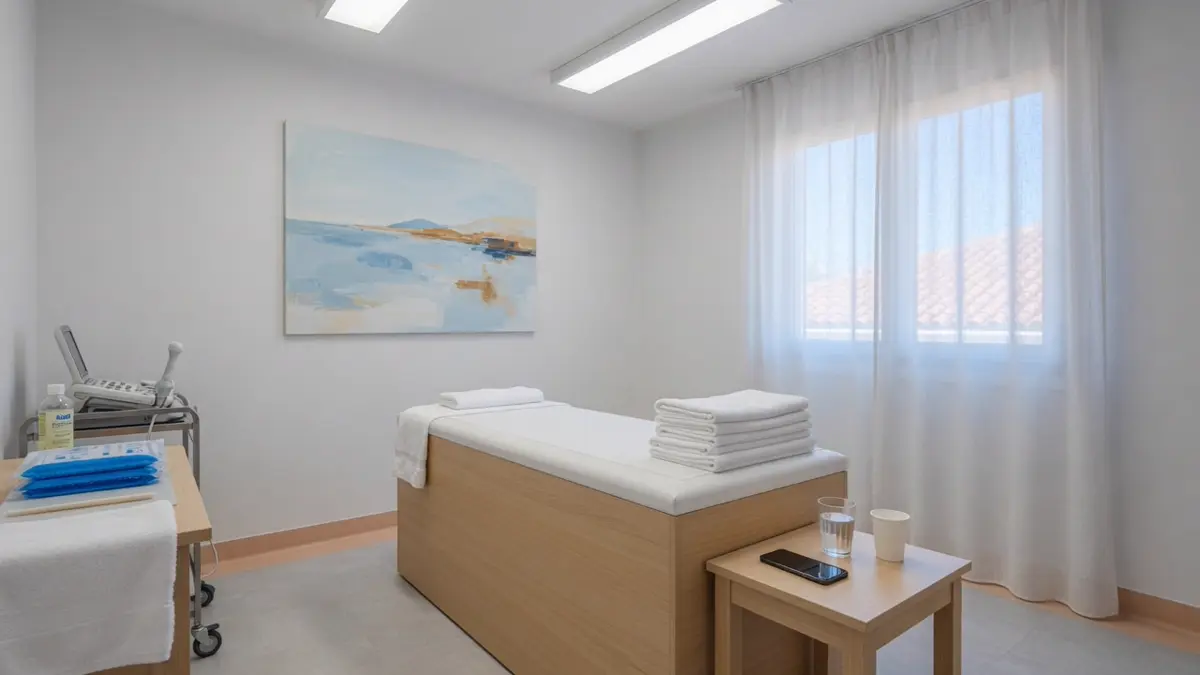
Twenty past five. The last patient of the afternoon is still on the table. One hand is under the knee. The other is on the shin, taking the last few degrees of the bend. The phone starts at the desk in the next room.
Pick it up and you let go of someone who cannot hold the stretch alone. Leave it and the caller is gone. In a lot of Greek clinics there is no one sitting at a desk all evening. You are the person who would have answered, and your hands are on the patient. If there is someone at the front, they are walking the last person out, taking a card, or handing out the next towel.
The same hour brings the first-visit callers after training, the follow-up who already sees Maria, the person who cannot make seven, and the coach who rings for a player. A second line with the same two hands still leaves the third caller listening to a busy tone.
That third caller often has your card and two others in the same glance. They will not wait for a beep. They hang up and dial the next clinic.
A Tuesday morning can be quiet. Five until you lock the door is not. Average the week and the evening disappears into a calm figure, and you hire as if the gap were a missing morning receptionist. Pull seventeen-to-twenty on its own. That is the hour the next clinic is already on the same list, and you cannot let go.
Who hangs up, and who leaves a message
Not every unanswered call is worth the same.
Someone rings to move Tuesday’s follow-up with Maria. They already know your name. They will record a message, or they will try again tomorrow. These are the calls you hear on voicemail, so these are the calls that shape how large the problem feels. They cost you a move, not a new patient. Dimitris is already on the book.
Someone rings about a first visit tonight. They twisted a knee at training. They have never been. They had your clinic and the next one in the same look. They hear the beep and treat it as nobody there. They hang up. This is the first visit that never reaches the book.
Someone rings at noon to cancel five o’clock. If nobody takes that call, the table stays empty and the next first-visit caller is told you are full. They may leave a message. They may not. Either way, an hour that could still have been offered is gone.
A coach rings for a player. First visit unless that player is already on your book. If nobody picks up they do not leave a name for the morning. They try the next clinic that answers, and the player is already on someone else’s table.
Voicemail is the wrong count
The people who record a message already have a time, or want something next month, or know which therapist they had last year. The people who will not record one are standing after training with a first visit to place and three numbers in the same glance.
So you hear Dimitris asking to move Tuesday, and you do not hear the person who rang about a first visit and booked the next clinic. If you judge the problem by the messages, you conclude you miss a couple of follow-up moves. The log says otherwise, once you isolate the evening.
A caller who speaks no Greek will not leave a long message in Greek. English from someone who trained after work. German from a person staying two months. They hang up at the beep and ring the next clinic that answers in their language.
If you have never asked the provider for unanswered calls by hour, do that before you change a script or a hire. Four weeks is enough to see the shape. Look at five to eight. Look at the hour after you lock the door. Leave the rest of the week as one figure until you have those two.
Stop using the box as a dashboard. Use the log. Split the evening from the rest of the day. Other hours matter — lunch, a Saturday morning if you open — but the after-work window is when both hands are on the patient and first-visit callers do not wait.
Three calls while you cannot let go
The calls do not arrive one, then a gap, then one. They arrive as a first visit after training, a follow-up who wants Maria, a cancel for seven, and a coach for a player, in the window it takes to finish a movement.
Hire someone for the evening and they take the first call. Callers three and four still hear ringing, or a busy tone, or the beep. One extra pair of hands still leaves people dialling the next number. The assistant can hold more than one conversation while the patient stays on the table.
A second mistake is quieter. Forward every ring at once, including the ones a free pair of hands would have taken, and the person who only wanted to cancel seven never hears a familiar voice. Then you decide the assistant does not sound like you. Leave the forward on. Set it for fifteen or twenty seconds. The desk keeps what it can reach. The assistant takes the rest. Calls you answer cost nothing.
A second line with the same two hands does not change this. The third caller is still waiting. What changes it is that the third call is answered while you are still holding the knee.
The cancel nobody took
Someone rings at noon to cancel the five o’clock. That table can still be offered — to the person who called at 11:40 and was told this evening was full, or to the next caller who wants a follow-up of the same length.
If nobody takes the cancel, two things happen. The table stays empty at five. The first-visit caller who rang at four is already somewhere else, because they were told you were full.
Set the notice you already say out loud. The assistant should treat a cancel inside that window as a time that is free again, not as a note for the morning. A cancel after the window is still a cancel. You would rather hear it than find an empty table. It is not a refill you can count on.
Do not offer a cancelled thirty-minute follow-up as a first visit. Length first, then the name on the book. If the cancel rule is written for the next day, a cancelled seven o’clock stays empty, and the first-visit caller who rang at four has already booked the next clinic.
A coach, a player, and a first visit that never landed
A coach who rings for a player is still a first visit unless that player is already on your book. Take the player’s name, take the coach’s number if that is who should get the SMS, and book a first-visit time. Do not let the call become advice from the sideline.
If nobody picks up, the coach does not leave a long message about a knee. They try the next clinic. You never see the player. Existing patients come back as follow-ups. A new patient often does not come back at all.
The same is true of a parent who rings after school. The name on the book is the child’s. If that call is missed and they walk in, the desk has to start again. If they do not walk in, they are on someone else’s table by seven.
Questions that must not wait on a machine
The caller will ask for treatment, and they will ask it on a line nobody is taking.
“Should I ice it until I come?” “Which exercises can I do over the weekend?” “It hurts more today — should I still come?” “How many sessions will I need?”
Those sentences must not be answered by voicemail, and they must not be answered by an assistant that is trying to be helpful. Ice, heat, rest, a cream, a movement, a session count, and whether they should still come are all treatment. The assistant books time.
“I can’t advise on treatment — only the physiotherapist can.” Then a time, or a note. A caller who wants to know if they should still come gets the time they already have read back, and a note on your list. They do not get a yes or a no.
If they describe the pain in detail on a missed line that the assistant then catches, write it down in their words and stop. Do not turn the description into a reason to book sooner, later, or not at all. Urgency is a decision you make. An assistant that says “that sounds like you should come in today” has already treated.
Do not put home-exercise lists in the notes and hope the assistant will only use them when it fits. It will read them out.
First visit, follow-up, or cancel — even on a call you just caught
Picking up is not enough if the first question is “what time”. A new patient, a follow-up with Maria, and a cancel for five then land in the same note.
First visit. A new patient, or someone you treat as new. Longer time. Intake. Often a paper from a doctor. Often a question about EOPYY or a private time. The assistant takes the name, asks whether they have been before, and only then looks at a gap that is long enough. Body area is a booking fact — who they were sent to, whether you have a person who takes that kind of first visit — not a diagnosis.
Follow-up. Someone already on the book. Shorter time. Same therapist if that is how you work. The assistant asks who they usually see and offers that person’s next time. It does not treat a follow-up as any free thirty minutes.
Cancel. A time that is about to go empty. The assistant takes which appointment, releases it if they are inside the notice you set, and can offer that table to the next caller — but only when the length matches.
If the caller cannot say which of the three it is, the assistant asks once more. It does not pick the short time to be helpful. Catching the missed call and then putting a first visit into Maria’s thirty-minute gap is how the whole evening runs late.
A referral is a paper to bring, not a plan. It can ask whether they have a paper from the doctor, and private or EOPYY if you marked those as different books. It cannot read the referral aloud, or say the fund will cover eight sessions. Someone at the desk checks the paper.
After you lock the door
Plenty of small clinics lock at eight. The phone still rings. A first-visit caller who trained late. A cancel for tomorrow morning. A parent who only got to the phone after the child’s training.
If they reach a machine after you have locked, you hear them in the morning — or you never hear them. Immediate forward once the door is locked, with the same three questions, is the minimum. The assistant can still take a first-visit request at 20:20 and park it for the morning. It can still take a cancel so tomorrow’s table is free to offer. It still does not say ice. It still does not say they should come first thing because it sounded urgent.
If you are closed, the spoken line about what the clinic does next has to be early in the call. Capture still happens. Treatment still does not.
If you close in August the first-visit callers still ring. The assistant can take a request for when you reopen. It does not invent a time in a week you are not there.
How CITT handles a missed physiotherapy call
- The number on the door stays yours. A forward sends what you do not answer. A call a person at the desk picks up never leaves the clinic.
- Several calls are answered at once. The evening rush is a set of conversations, not a stack of busy tones.
- It asks first visit, follow-up or cancel first, then takes the facts that belong to that request.
- It looks at the book you already use before it offers a time, and only if the gap fits the length.
- It honours the therapist you named on a follow-up, and does not invent a swap to sound helpful.
- It confirms by SMS, in the language of the call — 70+ languages — and can say the cancel notice you already use.
- What cannot be finished on the call — a treatment question, a referral the desk has to see, a complaint about last week’s session — goes to you as a tagged note.
- You get the transcript, the summary, and which of the three the caller was, tagged so the evening is not one pile called “missed”.
What it will not do
You keep your hands on the patient. The assistant picks up.
It will not treat. Ice, rest, heat, a cream, a movement, a session count, and whether they should still come are all out.
It will not put a first visit into a follow-up gap, or a follow-up onto whoever is free when you named a person. If the caller does not know whether they have been before, it asks. If they still cannot say, it does not pick the short time.
It will not read a referral as a plan, or say what EOPYY will cover. It will not invent a time the book does not show. If the calendar cannot be reached, it takes a callback.
A description of pain is written down. You decide whether it is urgent.
What you set up first
- The evening slice of the call log. Unanswered calls, by hour, four weeks back. If you skip this you will never know whether anything moved, and you will argue from the feeling of the table.
- Forward on no-answer, not always. Fifteen to twenty seconds while someone might still be free at the desk. Immediate once the door is locked.
- Three tags: first visit, follow-up, cancel. The weekly summary is useless if the evening is one pile.
- The two lengths you actually use, and who a follow-up stays with.
- The cancel notice you already say out loud, so a freed table can be offered the same hour.
- One line that forbids treatment advice. Ice, exercises, how many sessions, whether they should still come.
- Re-pull the evening log after four weeks. Compare unanswered calls, not assistant volume.
Then the lines it may repeat — bring the paper, arrive early, park in the side street, the door is on the left — and opening hours, who is in on Thursday evening, how to find the door. Do not give it a sentence about ice.
Rates for the service live on the pricing section of the home page. They are not repeated here.
Put your own first-visit figure in
The worked example above is arithmetic on stated assumptions. A private first visit on a Thursday evening and an EOPYY time on a Tuesday morning are not the same call. Put your own figure in. If the evening still justifies the change with your number, the argument is real.
Count unanswered calls between five and eight. Then count them again.
AI receptionist, in-house staff, or a call centre
| CITT | In-house | Call centre | |
|---|---|---|---|
| Hands on the table after work | Answers while you finish the movement | After they can let go, if at all | Depends who was rostered |
| Several evening calls in the same few minutes | Several conversations at once | One, then a busy tone | Depends on the evening roster |
| First question | First visit, follow-up, or cancel | Yes — they can hear it | Often jumps to what time |
| Puts a first visit in a follow-up gap | Never — length first | No, they know the book | Risk, if the menu is flat |
| Ice, exercises, should I still come | Refused — time or a note | Can examine | Reads a script |
| Cancel that can still fill five o'clock | Taken, table offered if the length matches | If someone is free to rebook | A message for the morning |
| Caller's language | 70+ languages | One or two | Whoever is on that shift |
What the evening voicemail does not show in a one-table clinic
Worked from these assumptions — change any of them and the answer changes:
- One treatment table. A typical weekday evening, 17:00–20:00 — put your own hours in.
- In that window both hands are on a patient, so nobody picks up.
- This example uses six inbound calls on that typical evening. Change the six.
- The desk, or you, reach two of them between patients. Four go unanswered.
- Of those four, one leaves a message and three leave nothing.
- Of the silent three, two wanted a first visit tonight. Change the two.
- A first visit is worth about €40 to the clinic — YOUR figure, and this is the number to change first.
- This example assumes one of those two first-visit callers books somewhere else the same evening. Change that one.
- The voicemail after you lock the door shows one person. That is the number the clinic believes.
- The provider's log shows four unanswered. The other three are the ones nobody counted.
- One of the silent first-visit callers books the next clinic. That evening is €40 that never arrives.
- Five weekday evenings × €40. Put your own evenings in.
- 46 working weeks × €200.
About €9,200 a year, from one recurring three-hour window that voicemail will never report — and only if you accept the conversion above. Change it.
What it costs
CITT is pay as you go: no packages, no minimum, no contract. The current rates — the monthly fee per number and the per-minute rate — are on the pricing section of the home page, which is the only place they are published.
Frequently asked questions
How do I find out how many evening calls we actually miss?
Ask your telephony provider for unanswered and abandoned calls by hour, and isolate the after-work window — usually 17:00 to 20:00 in a Greek clinic. If you have never done this, start there. The voicemail is the wrong count: a caller who wanted a first visit tonight hangs up at the beep and dials the next number. The log is the number to work from.
Would hiring someone just for the evening not fix this?
It helps the first call. It does not help the third. Evening traffic arrives together — a first visit after training, a follow-up who wants Maria, a cancel for seven, a coach for a player — in the same few minutes you cannot let go of a knee. One extra person changes how many hands can leave the table. It does not change how many people ring at once.
What happens to the calls the desk does answer?
Nothing, and nothing is charged. The forward only sends a call onward when it has rung for the seconds you choose. A call a person at the desk picks up never leaves the clinic.
Can it tell a caller to ice the knee until they come?
No. That is treatment. The assistant books time. It can repeat a line you wrote — bring shorts, arrive ten minutes early, park in the side street — and it can say that only the physiotherapist answers questions about the pain. A caller who asks “should I still come if it hurts more” gets a note for you, or the time they already have confirmed, never a yes or a no from the phone.
What about a cancel that would have freed five o'clock?
If nobody takes that call, the table stays empty and the next first-visit caller is told you are full. The assistant takes which appointment, releases it if they are inside the notice you set, and can offer that table to the next caller — but only when the length matches. A cancelled follow-up is not a hole you drop a first visit into.
How soon can we tell it worked?
Four weeks of evening hours, against the same unanswered-call figure you pulled at the start. Do not use “calls the assistant handled” as the measure — that number cannot tell you whether anyone is still ringing out while your hands are under a knee.