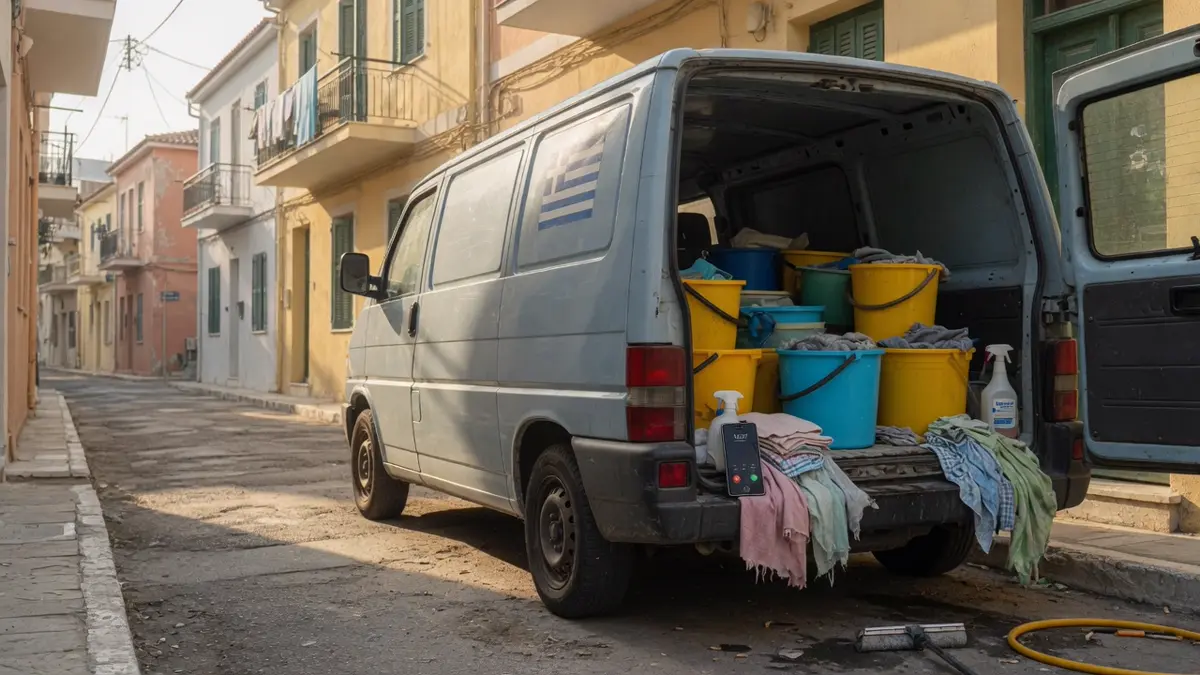
Hosts ring in English. The crew speaks Greek
Quick summary
- The second language on this phone is the host who does not have Greek, ringing about checkout.
- They still ask regular, one-off or turnaround — and an 11-to-3 window is still a window in English.
- The assistant continues in the language they started — English, German or French on the same number as Greek.
- A price invented in English is still your price. If it is not in the file, it is a callback in any language.
- The confirmation and the access note go out in the language of the call, or they miss the lockbox.
- Fluency does not let it invent a hiding place, a stretch, or a product.
TL;DR
You run a cleaning crew in Greece. Hosts start in English, German or French about an 11-to-3 turnaround. Tenants and regulars start in Greek about a Friday move-out or a Tuesday skip. The people who would answer have gloves on, or both hands on the wheel, and a little English does not help in someone else's kitchen. An assistant answers the number on the cards in 70+ languages, asks regular house, one-off or Airbnb first, and says only the hours, listed figures and access rules you wrote down. It texts the confirmation in the language of the call. Fluency is not permission to guess a price or a plant pot.
Key takeaways
- Put every language on the same number on the cards and the listings. Do not print a second mobile “for English hosts”.
- Keep the same first question in every language: regular house, one-off, or short-let turnaround.
- Repeat the bans in every language you hear: no invented price, no invented stretch, no invented lockbox.
- Send the confirmation and the access note in the language of the call — 70+ languages.
- Connect the calendar you already use. Fluency does not let it say a morning is free.
- Write the access question the way you would text a host at the airport. It will be read out in their language.

They started in English and you already had gloves on
You are in someone else’s kitchen. Both hands are in gloves. The phone rings in a pocket and stays there. If you picked up you would hear that the first word is not Greek. You do not pick up. The host hears the Greek greeting you recorded last year, then a beep. They hang up.
That is the language problem on a cleaning number. A host saw the checkout photos. A tenant is moving out on Friday and their Greek is not enough for voicemail. An agency has always spoken English to you. A regular came in last year with a cousin translating and is now alone with a telephone. They want today before three, a move-out, a skipped Tuesday, or they want to complain about last week’s glass.
You are the person who would have answered in English. You are also the person with both hands wet, or on the wheel. A little English does not help while a caddy is on the stairs. German or French you may not have at all.
An assistant can greet them in 70+ languages. That is the easy part. What still has to be right is the job, the window, the price sentence, and the access. If you have not written the answer down, the assistant takes a name. Fluency is not a reason to guess.
Who is actually ringing
A host who does not live in the building. They want to know if you can do today, what the window is, and where the keys are. They will not leave a Greek message. They will try the next crew on the same search.
A tenant moving out, ringing in English. The landlord is Greek. The flat is in Greek on your list. The person on the phone is not. They want Friday before the walk-through. Name, rooms, area — in the language they started.
An agency that books under a Greek company name. They have always spoken English to you. If the assistant treats them like a tourist looking for a weekly wipe, they get a speech they did not need and you get no flag.
A regular who shops in Greek at the door and will not use Greek on the phone. They manage with pointing when you are in the house. On the telephone they start in English or Albanian. The Tuesday they are asking to skip was written in Greek, under a Greek name, by someone who is not on this call.
What goes wrong when the language is the miss
You will not tag it as language. The log shows a short unanswered call. You may decide foreign hosts book on the listing, they do not ring. Some of them did ring. They heard Greek they could not follow, and they tried the next name.
The other miss is a person at a lockbox that does not exist. Someone — you, in a hurry between houses, or an assistant that wanted to be liked — understood “how much, can you do today, the keys are under the mat”, and answered so you would not sound difficult. You now own a price or a hiding place in a language you may not read until the next guest is in a wet bathroom. A figure spoken on your number is your figure.
The third caller is already angry. Last week’s visit missed the glass. They will tell the whole story in a language you do not speak. If the only option is you, live, with gloves on, they give up or they come to the next visit shouting. A transcript and a flag the same day is how you handle a conversation you cannot have in someone else’s kitchen.
The rule the assistant must obey
Same facts, any language. If it is not in the file, we call back.
It may say the job split you wrote, a published figure you wrote, or an access rule you wrote, including “we do not invent a hiding place”. It may speak 70+ languages to do those things. It checks a stretch before it offers it, and it sends the confirmation itself, in the language just spoken.
It may not translate a guess. It may not convert currency because the host asked in English. It may not tell a host the morning is free because the book is silent. It may not invent a plant pot so the English sounds finished. It may not settle a complaint with a free redo it invented because the caller was upset and clear. It may not switch back to Greek because the name on the house looks Greek.
When the file is silent, the English sentence is the Greek one: I cannot answer that from here; I have written down what you asked; a person will call you.
The first question is still the job
Stay in their language. Do not skip the split because English feels urgent.
Regular house, one-off, or short-let turnaround. Then the facts that belong to that job. A host who starts with “can you do today” still has to say which of the three it is. A tenant who starts with “Friday, three bedrooms” is a one-off until they say otherwise. An agency that says “the usual flat in Koukaki” is a regular or a turnaround only if that flat is on your list.
Dates and times are not the opening question. Fluency does not make “what time would you like?” safer. An 11-to-3 window said in German is still a window. A Tuesday regular said in English is still occupied time.
If you do not take short-lets, say so in the languages you actually hear. A clear English no is better than a hopeful Tuesday that was meant for a weekly house.
Hours and areas they will send a guest into
Whether you take same-day turnarounds. Whether Saturday exists. Whether August is paused. Which areas you actually cover. A host who heard “yes, Koukaki” when you only do the northern suburbs will send a guest to an empty hallway.
Write the week as it actually runs. If Saturday is wrong in English, a host texts a code and you are not coming. When you change Saturday, change the file the same morning. Parking, which bell, lockbox on the rail: those sentences save a drive. If you only turn English on for July, you will still drop the German agency call in February. Leave it on.
A price invented in English is still your price
A quote on this phone is a list, not a figure. Which job, how many rooms, extras, the area, whether anyone has seen the house. “They left it filthy” is not a list. “After the builders” is not a price. It does not get better when it is said fluently in English.
Do not let the assistant invent a figure to be hospitable. Do not let it convert into dollars or pounds because the host asked in English. A number on your line is your number, in euro, unless you have listed something else.
It may repeat a listed weekly on a known house, or a listed turnaround on a flat you already do. Unseen one-off work cannot, not honestly, in any language.
If they want to send photos, the assistant takes the request and, if you have written where, tells them where to send them. It does not pretend to have seen the hallway.
Those fields are why a recording in a language you do not speak is still usable. A long polite conversation with no fields is only a slightly better voicemail.
Access in the language they will use at the door
A host at the airport needs the access sentence in the language they started. A Greek SMS to that number is how they miss the lockbox and call you from the taxi.
The assistant repeats the access rule you wrote. It can ask where the keys are. It must not invent a mat, a plant pot, or a neighbour, and fluency does not make that safer. A wrong hiding place in clear English is still a locked door.
New houses with no access note are a callback. Alarm codes belong in what you entered. If the guest is still inside, the assistant books from checkout, in whatever language the host used — not from “this morning”.
If a partner or an agency placed the original job, ask whether the text should go to this number or another. The number on the call may not be the person who needs the code.
They booked with an agency and they are ringing alone
Someone books through an agency. The house goes on your list under a Greek company name. Later the host rings alone, in English or German, about that turnaround. The assistant should not need the agency. Address, checkout, next guest, what they are asking. If you have put the house where the assistant can see it, it may offer a stretch that is free. If you have not, it flags you. “We usually do that building” is not a booking.
Send the confirmation, and any access text, in the language of this call, not in the Greek the agency used last time.
Keep the language of the last successful conversation on the record if you can. If you cannot, let the current call decide. Do not switch back to Greek because the company name is Greek. The book is for you. The sentence is for them.
The text they will actually read
If you send a confirmation at all — a visit, a look, a “we will call you back” — it goes out in the language of the call. A Greek text to a number that just spent four minutes in English is a text that is not read. They miss the hour, the next guest arrives, and they bring the agency in tow.
If you keep a calendar, the assistant checks the stretch before it offers it. It does not invent a window because the host asked in English and sounded in a hurry. Then it sends the SMS itself.
A look that is still a request does not belong in that text as if Friday is sold. “We have noted a deep clean” is honest in German too. “See you Friday at nine” is not.
What you do with a transcript you cannot read
You do not need to speak German to act on a flag that says turnaround, complaint, or locked door. You need the fields and a same-day call. Do not leave the row because the words look difficult. The assistant does not argue, offer a free redo, or decide that the story is small.
It is tempting to say yes faster when the caller is not Greek, so you do not sound difficult. That is how English becomes the language you invent prices in. Same file. Same callback. Listen to the first fifteen non-Greek calls for the job split, a figure that is not in the file, a plant pot, and a complaint that produced a speech instead of a flag.
What you configure first
- The same number. The one on the cards and the listings. No English line.
- The first split in a form that can be spoken — regular, one-off, turnaround — including in the languages you actually hear.
- The callback sentence in those languages, not in a list of seventy you do not.
- Fields — job type, window or rooms, area, access, a number — so a recording you cannot speak is still a usable list.
- Listed figures it may repeat, and one line that forbids a price from a description, in any language.
- The access question, and one line that forbids an invented hiding place.
- SMS language follows the call. Check this with one English turnaround before you trust it.
- Complaints flagged the same day, on a phone, regardless of language.
Then leave it on in February. The host who rings about tomorrow’s checkout in German is not a seasonal extra. They are the same book, on a quieter week, asking the same question the file already knows how to refuse.
Rates for the service live on the pricing section of the home page. They are not repeated here.
AI receptionist, in-house staff, or a call centre
| CITT | In-house | Call centre | |
|---|---|---|---|
| Host opens in English at 11:10 | Continues in English | If they can pull over and have the words | If that shift has it |
| First question in their language | Regular, one-off, or Airbnb | Varies by who picked up | Often jumps to what time |
| Invents a price in English | Never — listed figure or callback | Tempting, to be helpful | Risk, if the sheet is stale |
| Invents a lockbox or a mat | Repeats only the access you wrote | Can ask you | Risk, if the sheet is silent |
| English, German, French, Greek | 70+ languages, same rules | Greek, and English if they have it | Whoever is on that shift |
| SMS they can read at the airport | Language of the call | If someone types it between houses | Often Greek |
| Agency booked under a Greek company | Speaks the language of this call | If they notice who is ringing | Follows the name on the sheet |
What unanswered English host calls hide in a week
Worked from these assumptions — change any of them and the answer changes:
- In season, a handful of non-Greek calls a week ask first whether you can do today, and what the window is.
- This example follows 4 such calls in a week that currently hit a Greek voicemail or a ring-out.
- 3 of the 4 do not leave a message. They ring the next crew on the same search.
- A two-bedroom turnaround is worth about €65 to you. Replace this with your own figure.
- This example assumes 2 of those 3 silent hosts would have been work you could take. Lower it if that feels rich.
- 4 non-Greek turnaround calls hit silence or a Greek beep.
- 3 vanish. You conclude foreign hosts book on the listing, they do not ring.
- If 2 of the 3 would have been a €65 visit, the week hid €130.
- Put the weeks you actually take short-lets — 20 × €130 is only the sum if both numbers are yours.
About €2,600 a season on a small ticket — enough to matter, not enough to invent a bigger story. Put your own figure in.
What it costs
CITT is pay as you go: no packages, no minimum, no contract. The current rates — the monthly fee per number and the per-minute rate — are on the pricing section of the home page, which is the only place they are published.
Frequently asked questions
Do I need a separate number for English hosts?
No. The number on the cards and the listings is enough. The assistant hears the first sentence and continues in that language, and it can switch if they switch. A second mobile “for English” is another number you will forget to forward, and the hosts who already have the listing number will never look it up.
What if I do not speak the language the complaint arrived in?
That is what the transcript is for. You get their words, a short summary, the job they named, and a flag the same day. You can answer in Greek, or in English, or you can ask someone. What you should not do is leave a complaint sitting because you were embarrassed by the language.
Can it tell a host what a deep clean will cost in English?
Only if you have put that figure in the file for a house you already do. A number made up in clear English is still your number. “They left it filthy” is not a price in any language. It takes rooms, the window, and a callback.
Will it start quoting in another currency?
Not unless you wrote that figure down. It should not convert to be helpful. A number on your line is your number, in euro, unless you have listed something else. If the file is silent, it takes what they want and you call back.
Most of my week is Greek regulars. Is this worth turning on?
You do not switch on a separate service. You turn on the same receptionist. On the days the call is a host in English it does not go to a beep. The cost of leaving it off is the 11-to-3 window that went to the next crew while they listened to Greek they could not follow.
Does the booking stay usable if they spoke German?
If you have configured the fields — job type, window or rooms, area, access, a number — yes. Those fields are the point. A long polite recording you cannot use is only a slightly better voicemail.