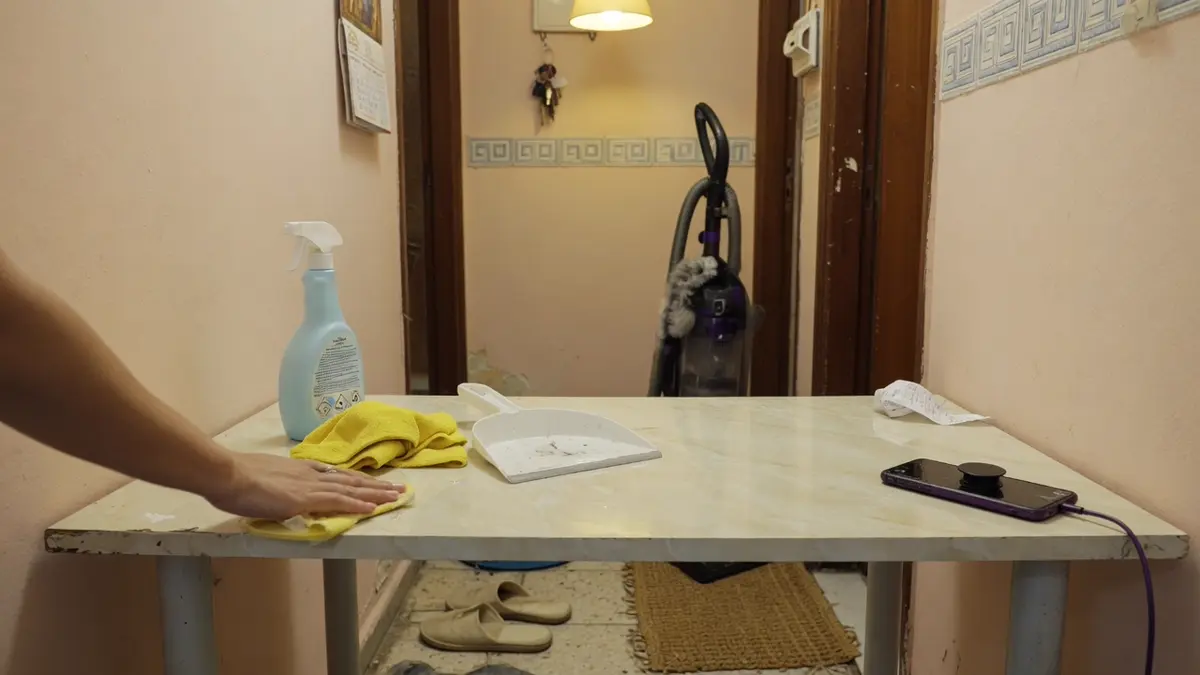
Missed calls while the crew is already in a house

Quick summary
- The person who would pick up has gloves on in someone else's kitchen, or both hands on the wheel.
- A host who needed an 11-to-3 turnaround hangs up and rings the next crew. They leave no message.
- A regular who has to skip Tuesday, and a tenant naming a Friday move-out, hang up the same way.
- Voicemail is the wrong count. The people who already know you may wait. The people who needed today do not.
- The assistant answers, asks regular house, one-off or Airbnb first, and does not invent a price or a time.
- Ask the provider for unanswered calls by hour before you change the forward. Isolate late morning.
TL;DR
You run a cleaning crew in Greece. Late morning, the people who would answer are already inside a house, or they are driving to the next one. The phone is face-down on a worktop or in the cup holder. The caller wants a regular Tuesday, a one-off deep clean, or an Airbnb turnaround before the next guest. They will not wait on a beep. An assistant answers every line at once, asks which of those three it is, and either books a stretch that is actually free or writes a request. It will not quote a deep clean from a description. It will not put a same-day turnaround on a morning a regular already occupies.
Key takeaways
- Ask the provider for unanswered calls by hour, four weeks back. Look at late morning on its own.
- Do not judge the week by the messages. Hosts who needed today, and new one-offs, leave nothing.
- Forward after a short delay so a pull-over between houses still belongs to you.
- Tag regular, one-off and Airbnb separately. A skipped Tuesday and a same-day turnaround are not one pile.
- Never quote unseen one-off work, and never invent a lockbox or a key hiding place.
- Pull the same late-morning window after four weeks. If it has not dropped, the delay is wrong.

Gloves on, the van moving, and a phone nobody can take
Half past ten. The people who would answer are already inside a house. Both hands are in gloves, on a worktop or carrying a caddy up a stairwell. The phone is face-down at the far edge of the kitchen, or it is in a pocket and stays there, because you do not take a booking call in someone else’s house.
Or they are on the road to the next one. The phone is in the cup holder. You do not take a booking while you are reversing into a street you do not know.
The caller hears the ring, then nothing, and hangs up.
They were not ringing to chat. They wanted a regular Tuesday kept or skipped, a one-off deep clean, or an Airbnb turnaround before the next guest. For a job that has to happen today they will not wait for a beep. They have your number and two others from the same search. They hang up and ring the next crew.
You will not see any of that on the list you write at lunch. That list only shows the houses you already entered. The phone company’s log shows the rings. Most crews have never asked for that log by hour.
Who was ringing
A host who just saw the checkout photos. Eleven o’clock. Suitcase by the door. They need the flat done before three. If nobody answers they do not leave a message. They try the next name on the same search. Tomorrow is not the job.
A regular who will not be home tomorrow. Same day as always, or they need to skip this week. If nobody picks up they assume you are coming anyway, or they assume you are not, and you find out at the door. A year of Tuesdays does not mean they will wait on voicemail for one change.
A tenant naming a move-out. Friday, three bedrooms, they want it done before the landlord walks through. They will give that Friday to whoever answered. A message you hear at six does not get you into that flat at nine.
After-builders, a deep clean, a house nobody on your list has seen. They describe the dust. They want a number and a day. If nobody picks up they take both to the next crew. If someone picks up in a hurry and quotes from the description, you then have to take the number back.
There are others. Add the oven this week. The guest is staying another night — move tomorrow’s turnaround. Where do they collect the keys. Do you do ironing. They all meet the same rule: if you wrote the answer down, the assistant may say it. If you did not, it takes a name.
Why another pair of hands usually does not fix the phone
The person who knows whether Tuesday is already a regular, whether you do after-builders, whether Koukaki and a house across the city can share a morning, is the person who is already in a kitchen. Every time they stay with the house — which they should — the person on the phone hears nothing.
People will tell you to put someone on the phone. For most crews the wage is not there between houses. Hosts still ring together when the checkout photos land. Two, then a third, in the same few minutes. One extra person changes how many hands can leave a worktop. It does not change how many people ring at once.
The other local mistake is treating the messages as proof. “We do not miss that many — look, three this week.” Those three are the people who already know you. The host who needed today is not in the pile.
A second line in the same van still leaves the third caller listening to a busy tone.
What the assistant may say, and what it must not
If the assistant invents a same-day yes, a host texts a code and you are already in a regular’s kitchen across the city. If it invents a price from “they left it filthy”, you own a figure you then have to take back.
The rule is the one you already keep when you have pulled over: if it is not written down, do not say it. A listed weekly on a known house, a listed turnaround on a flat you already do — those figures it may repeat. An unseen one-off is rooms, access, and a callback. A lockbox code you did not write is not a sentence it should invent so the call can finish.
The late-morning temptation is to put a helpful yes on every “can you do today” so the host stays. That is how a turnaround lands on a Tuesday a regular already occupies. Write the callback sentence yourself, so the assistant does not turn it into a yes you did not mean.
What you set up first
- The unanswered-by-hour log. Late morning, the hour after the last house, Saturday if you take Saturday. Four weeks. Write the number down.
- Forward on no-answer. Ten to twenty seconds. A pull-over between houses still belongs to you.
- The three job families, named the way you name them. Regular house. One-off. Airbnb turnaround. Real lengths, including the drive.
- Tags. Regular, one-off, turnaround, access, complaint. Otherwise the week is a blur of “messages”.
- Same-day turnarounds and locked-door problems to your mobile, not to the evening email.
- The callback sentence, in your words, so the assistant does not improve it into a yes.
Then pull the same log a month later. The figure that matters is still unanswered calls between nine and twelve. If that figure has not moved, you are looking at a delay that is too long, or at a second number on an old card or an old listing that you forgot you still print.
The regular who needed to skip Tuesday
A house that has been Tuesday at nine for a year is not a gap when they ring to cancel. It is work you can give to a host who is asking for today, if you hear the cancel in time.
If nobody picks up, two things happen and both are bad. You drive to a door that does not open, because they went to the island and assumed you had heard. Or you leave the morning blocked, and the host who rang at ten goes to someone else.
The assistant writes the skip the same hour, against the house that is already on the list. It does not treat “we won’t need you tomorrow” as a new one-off. It finds the regular. It frees the stretch. Then the next inbound turnaround can be offered that morning if the area fits.
A house that pauses for August should be marked as paused. If the file still has every Tuesday in August, the assistant will defend those mornings against hosts who actually needed them.
The host who needed today
Checkout photos land, and three hosts ring in the same twenty minutes. Each one has a window, not an afternoon. Eleven to three. Twelve to four. A guest who is already late leaving.
They will not leave a message. They will not fill in a form. They have two other numbers on the same screen.
The assistant has to ask which job it is — because a host sometimes actually wants a deep clean, and a tenant sometimes sounds like a host — then both ends of the window, then the area. Only then does it look at the book. A gap between two houses is not today if those houses are not in the same part of the city.
If that stretch is not free, it says so and takes a callback, or it offers the next window that actually fits. It does not say “we’ll squeeze it in” over a regular. It does not offer Thursday at 16:00 to a person whose next guest is at three today.
Mark the regulars the way you already mark them on paper. A same-day turnaround cannot land on a morning that already has a house.
The card, the listing, and the WhatsApp they actually use
Cleaning work reprints cards slowly. The number on last year’s card, or on a short-let listing you forgot, or on a WhatsApp profile a host still has, may not be the number you forwarded. The unanswered log on the line you care about will look healthy. Hosts will still say they could not get through.
Once, at the start, ring yourself from a private phone using every number you can still find in public — the cards, the listings, the WhatsApp, the number on the van. The ones that do not reach the assistant are the miss you are not measuring. Fix those before you blame the voice.
If you also give out a mobile — “the quick number” for hosts you already do — decide which one people actually use and forward that one. Forward only the printed line and the mobile still rings in a pocket while gloves are on a worktop. Forward both with no delay and you never take a call yourself, even when you have pulled over. The unanswered log on each number will tell you which one is real. Start there.
After the last house, and what you do with the list
You are locking a door or you are already in the van. “Can you do tomorrow” rings while you are finding the keys. That caller is a host looking at tomorrow’s checkout, or a regular who just found out they will not be home. Forward it. Do not wait until you have sat down.
The evening caller is often the same three questions from a sofa: a turnaround tomorrow, a move-out on Friday, a regular who wants to add the oven. A recording that says “leave a message after the tone” asks them to do work they will not do for a job that small. The assistant asking which job it is, or taking the rooms and a number, is what those calls need after the last house.
Once the calls are answered, you have a list instead of a quiet phone. Return the same-day windows that still fit today first. If the notes do not say regular, one-off or turnaround, plus the area and the checkout if it was a short-let, fix the questions it asks. A complaint about last week’s glass is a name and what they said, flagged the same day — not a free redo from the phone.
A quiet Tuesday is not proof the phone was fine
A slow week gets explained as August, or the street being quiet, or hosts booking later. Sometimes that is true. Sometimes four turnaround calls went unanswered between nine and twelve and two regulars who needed to skip assumed you were coming. You cannot see the difference on the list of houses you already do. You can see it in unanswered calls tagged as turnaround or regular. If you do not tag, you will keep telling yourself the season story. The log is how a crew that lives in other people’s kitchens stops guessing why Tuesday was empty.
Rates for the service live on the pricing section of the home page. They are not repeated here.
AI receptionist, in-house staff, or a call centre
| CITT | In-house | Call centre | |
|---|---|---|---|
| Gloves on in someone else's kitchen | Every line answered at once | After the house, if at all | Depends who was rostered |
| Host needs today, 11 to 3 | Asks the window, then the book | If they can pull over | Often a message for tomorrow |
| Regular calling to skip Tuesday | Writes it the same hour | If they hear the ring | A note, sometimes late |
| Several hosts after the same checkout hour | Several conversations at once | One, then a busy tone | Depends on the morning roster |
| Quotes a deep clean from “it’s filthy” | Never — rooms and a callback | Can go and look | Reads a list price aloud |
| Invents a plant pot or a mat | Never — repeats the access you wrote | Can ask you | Risk, if the sheet is silent |
| What voicemail shows after lunch | They were answered | The people who already know you | Their log, not yours |
The late-morning window voicemail under-counted
Worked from these assumptions — change any of them and the answer changes:
- A weekday morning in Greece. The people who would pick up are already inside a house or on the road to the next one.
- About 16 inbound calls that morning — put your own number in.
- About 7 of them arrive between nine and twelve, when nobody can stop.
- Of the calls nobody reaches, 2 leave a message and 5 leave nothing.
- Of the silent five, 3 are new same-day turnarounds or new regulars.
- A two-bedroom turnaround is worth about €65 to you — YOUR figure will differ, and this is the number to change first.
- This example assumes 2 of those 3 would have been work you could take. Drop it if yours is lower.
- Voicemail after lunch shows 2 people. That is the number the week believes.
- The provider's log shows 7 unanswered in that window. The other 5 are the ones nobody counted.
- 3 of the 5 silent calls were new same-day or new-regular work. If 2 of those 3 would have been yours, that morning hid €130.
- A morning like that once a week — put the weeks you actually take this work. 40 × €130 is only the sum if both numbers are yours.
About €5,200 a year from one recurring morning window voicemail will never report — only if your weeks and your figure match. Change both.
What it costs
CITT is pay as you go: no packages, no minimum, no contract. The current rates — the monthly fee per number and the per-minute rate — are on the pricing section of the home page, which is the only place they are published.
Frequently asked questions
How do I find out how many morning calls we actually miss?
Ask your telephony provider for unanswered calls by hour, and isolate late morning — usually nine to twelve, when the people who would pick up are already in a house or on the road. The messages are the wrong count. A host who needed today hangs up at the beep and rings the next crew. The log is the number to work from.
Would hiring someone just to sit on the phone not fix this?
It helps the first call. It does not help the third. Hosts ring together when they see the checkout photos. A regular who has to skip Tuesday, a tenant naming Friday, and two short-lets for the same afternoon can arrive in the same ten minutes. One extra person changes how many hands can leave a kitchen. It does not change how many people ring at once, and the quiet hour between houses does not pay a wage on its own.
Is voicemail not enough for a crew this size?
It catches the people who already know you and are willing to wait — a regular who can skip next week instead of this one. It does not catch the host who needed the flat done before three, and it does not catch the tenant who will give the move-out to whoever answered. Those two do most of the damage, and they leave nothing.
What happens to the calls we do take between houses?
Nothing, and nothing is charged. The forward only sends a call onward when it has rung for the seconds you choose. A call you pick up after you have pulled over never leaves your phone.
Can it tell a caller what a deep clean will cost?
It can repeat a published item you gave it — a listed weekly for a known house, a listed turnaround for a flat you already do. It must not invent a one-off price from “it’s dirty” or “after the builders”. Rooms, pets, oven and whether anyone has seen the house all change the work. It takes the request and books a look or a callback.
How soon will I know if it worked?
Four weeks of late mornings, against the same unanswered-by-hour figure you pulled at the start. Do not use “calls the assistant handled” as the measure. That number cannot tell you whether anyone is still ringing out while gloves are on a worktop.