Multilingual receptionist for auto repair shops
Quick summary
- English on the garage number is a working language, not a transfer if they sound foreign.
- The first question is still service, KTEO or breakdown, in whatever language they opened with.
- MOT, TÜV or “the test before the ferry” means the KTEO sticker. Write the phrases you actually hear.
- A ready time invented in German is still your time. A pads price invented in English is still your price.
- The plate, the job and whether the car will move have to come back as facts, not as a polite paraphrase.
- The confirmation text goes out in the language of the call, or they miss the drop-off and find the shutter down.
TL;DR
The number on the sign rings in English on a Tuesday morning. The lift is up. Both hands are greasy. The caller started in English because that is the language they have — a resident, a rental, someone driving to a ferry on Saturday. They want a service, a KTEO, or the car has already stopped. They will not wait through a Greek greeting and a beep. The assistant stays in their language — 70+ languages — asks which job it is, takes the plate, and books only a bay that is free. It will not invent a ready time. It will not invent a parts price. The text follows the language of the call.
Key takeaways
- Treat English as a working language on the number on the sign, not as a transfer if they sound foreign.
- Keep the same first question in every language: service, KTEO or breakdown.
- Write MOT, TÜV and “the test” as KTEO, then follow what you actually do — official test, prep, or neither.
- Repeat the two bans in every language you expect to hear: no invented ready time, no invented parts price.
- Send the drop-off text in the language the caller used, or they miss the shutter.
- Route “can I drive it to the ferry” and any tax or invoice question to a person. The assistant takes the request.
They rang in English. The lift is up.
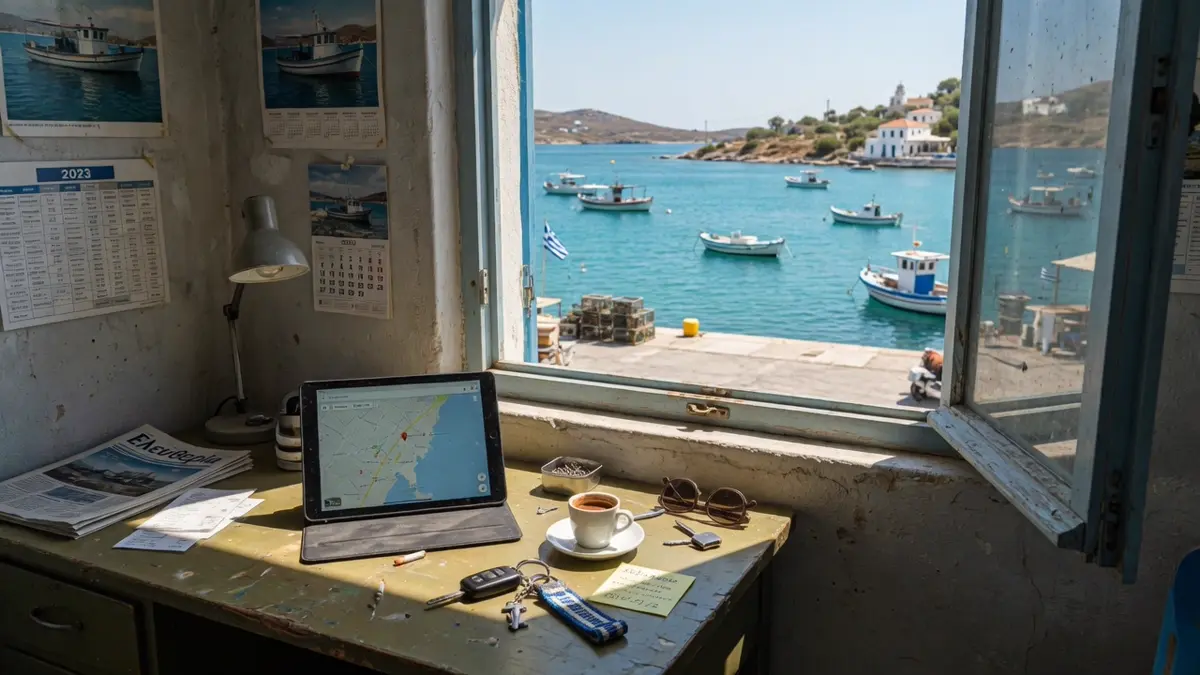
Tuesday, half past eight. One car is on the lift. The other bay has a service already open. Both hands have grease on them. The phone is in the small office, or on the tool chest.
The caller did not search for your firm. They searched for a garage that could take a car this week, in English, because that is the language they have. A resident. A rental. Someone driving to a ferry on Saturday. Three pins came back on the map. They tapped yours. They will tap the next one if this goes to a Greek greeting and a beep.
Nobody can pick up. The car is in the air. You cannot leave it on the locks to walk to the desk and guess a pads price in English.
That is a normal weekday morning in an independent garage in Greece that keeps the same number on the sign and on Google. The person in a rental, the couple who work in English in Athens, the driver whose sticker runs out before the boat: they start in the language they have. German, French, Italian and Albanian show up the same week, for the same reason. You do not need a plan per language. You need someone on that number who can continue the first sentence, and who will not invent five o’clock because they can say it clearly.
Two ways this call goes wrong
They hang up. That is the first way. They heard Greek, or four rings and a tone, and they went back to the map. You listen later and hear almost nothing, and you conclude that foreign drivers write. Some of them do. The ones who rang wanted to talk today, with the car still in front of them, or with a ferry on Saturday.
They get an answer that is too helpful. That is the second way, and it costs Thursday rather than a lead. An assistant that speaks English well will want to close the loop: yes, we can do the MOT, yes, ready at five, yes, pads are about this in pounds. Said slowly, it sounds like competence. It is still a test you may not issue, a time nobody can give from the phone, and a parts figure from a plate. The caller will keep the sentence. They will plan the boat on it.
A third thing sits next to those. People who are not sure of the Greek words ask whether they can keep driving to the ferry, what a warning light means, whether you can put the invoice on a foreign company. The assistant writes those questions down in the caller’s words and stops. It does not become a mechanic or an accountant because it can form the sentences.
Service, KTEO or breakdown first, in whatever they opened with
The opening is still the three jobs. English on the line does not mean they want a used car, and it does not mean they want a long chat. A German resident with a service light on, a tourist whose rental has stopped, a driver who wants the sticker before the end of the month — they ring the number on the sign because that is the number they have. If the assistant treats every foreign caller as a mystery, a person who wanted an oil change spends three minutes being asked where they are from.
Service. What they want done, the plate if they have it — including a foreign plate or a rental sticker — and when they can leave the car. Kilometres matter if they know them. A rental driver often does not. Make, model and year will do, and the plate is taken when they arrive.
KTEO. They may not know the word. They will say MOT, TÜV, contrôle, the sticker, the test before the ferry, the test before the end of the month. Write the phrases you actually hear, so the assistant does not book an official test when they wanted a prep, or a prep when you do not do that work. A lot of independent garages in Greece do the check — lights, brakes, wipers, emissions — and send the car on. The assistant follows the line you wrote.
Breakdown. Where is the car. Will it roll. A rental in a hotel car park is still a location, not Thursday at half past eight. If you do not run a truck, say so in their language in the first sentence. If you keep a tow number, give that number. Then a note or a callback, not a diary time that assumes the car will arrive under its own power.
A caller who left a car yesterday, wants to know if it is ready, or wants to move Thursday, should not be asked whether the car has already stopped, in any language. Listen for the job card, the plate, the word “ready”. Those calls belong to a card you already have.
A caller who asks if you have a used Golf is told this is a garage, in their language. You do not sell cars. Fluency does not turn that question into a lead.
The rule the assistant must obey
Same facts, any language.
It may book a bay only after it has checked the calendar you already use, and only for a job that belongs in the book. It may repeat a figure only when that figure is a published menu item you gave it. It may say a car is ready only when the job card says so. It may do those things in 70+ languages.
It may not invent a ready time because Saturday is a ferry. It may not convert a euro price into pounds to be helpful. It may not estimate pads from a plate. It may not diagnose a noise. It may not say they can keep driving. It may not book official KTEO if you only do the prep. It may not send a Greek text after an English call. It may not take a used-car enquiry as a viewing.
When the card is silent, the English sentence is the same as the Greek one: I cannot give you a ready time from here; I have the job you named; someone will look at the car.
What you configure first
- English as a working language on the number already on the sign. Not a second line. Not a note that says if they sound foreign, transfer.
- The same first question in every language you expect to hear — service, KTEO or breakdown — written so it cannot be skipped.
- The phrases that mean the sticker. MOT, TÜV, the test, the ferry. Then what you actually do: official test, prep, or neither.
- The fields a desk can act on. Plate or foreign plate, make, model, year, what they want done, whether the car will move, when they can come. If these are not fields, the transcript is a story.
- The two bans, written in the languages you actually hear, so a fluent model does not improve them only in English: no invented ready time, no invented parts price.
- The confirmation text follows the language of the call. Test this. It is the thing people forget, and it is how they miss the shutter.
- A named path for “can I drive it”, warning lights, and invoices in a foreign company name. Request, in their words, flag. No answer.
- How a car that will not move is handled, said in a sentence you would actually say, so fluency does not invent a truck you do not run.
Then listen to the first twenty calls that did not start in Greek. You are not grading the accent. You are checking that the three-way split happened, that the plate or the car is in the summary, that no finish time appeared, that no pads figure appeared that is not on the menu, and that no official KTEO was booked if you only do the prep. If a call fails those, it failed, however smooth it sounded.
The ferry on Saturday
A lot of the English calls are from people who need the car for a date they already have. A boat. A flight. A drive north. They want to know whether you can take it Thursday, and whether it will be ready Friday.
Putting “ready Friday” on the line, in clear English, is how you own a missed boat. The assistant books Thursday if a bay is free. It takes the Saturday date and puts it on the note. It does not promise the bay will meet that date. A need date is not a collection appointment.
If they ask for a same-day turnaround because of the ferry, that is a request for you, not a length the assistant may invent. Last month’s real lengths stay last month’s real lengths. Fluency does not shorten a clutch.
A test they call MOT is still the sticker. If you only do the prep, say so before you offer Thursday, not at the shutter on Thursday morning with a boat on Friday.
A rental company that wants the car back tomorrow is the same shape. Take the date. Do not invent the finish.
When they want to know if it is ready
The shared number does not become a tourist line just because the greeting was in English.
“Is my car ready?” is still a job-card question. The assistant reads the card. Ready, not ready, waiting for a part. If the card says ready, it can say so and tell them the collection hours, in their language. If the card does not say, it takes a name and a number. It does not invent half past five in German to sound sure.
A caller who wants to move a booking follows the book, not a special foreign diary. Set the notice you actually enforce. The assistant should say it at the end of a booking, in the language of the call.
“The car is making a noise, can I drive it to the ferry?” is not a reception answer in any language. The assistant does not say yes, and it does not say what the noise is. It offers a diagnostic if a bay is free and you take those, or it puts the description in front of you. A human looks at the car.
A published oil-service price you gave it can be repeated. A pads figure from a plate cannot, in pounds or in euros.
If they want the invoice in a company name, or a VAT number from abroad, that is a note for the office. The assistant does not give tax advice.
A figure spoken on your number is yours
“What’s that in pounds.” “Give me a sense of the pads.” “Around two hundred?”
If the figure is not a published menu item you gave it, the assistant does not say it, convert it, or agree that the caller’s guess is close. A number spoken on your number is your number, in any language. The caller will keep it. They will turn up with that number already written down.
Do not store a “from” figure for unseen parts. The assistant will read it out. If nobody should name a pads price until someone has opened the car, do not give it that figure — not in Greek, and not in English.
A ready time is the same trap wearing a clock. “This afternoon” said helpfully in French is still a time the office then has to take back.
A discount if they decide this week is a request. The assistant does not negotiate. A complaint about last week’s invoice is the same kind of call in any language: take the name, take what they said, put it in front of you. Do not offer a free redo from the phone.
Two people, the phone handed across
Couples ring together. One speaks English, one speaks Greek, and they pass the phone. The assistant should follow the language of the sentence it just heard, and it should not lose the fields already collected when the language flips. “2014 Yaris, service and pre-KTEO, Thursday 08:30” said in English is still the job when the next sentence is Greek. If the switch is messy, it reads the job back once, in the language that is winning, and confirms.
If a third person comes on — a rental desk, a partner, someone who “handles the invoice” — take their name and whether the callback should go to them. Do not restart the first question. The service-KTEO-breakdown answer you already have is still the answer.
A rental desk that takes the phone mid-call will ask for a finish time and a parts figure. The bans do not loosen because the voice got more official.
What you read when you get off the lift
You do not need to speak German to use the fields. You need the fields. Service, KTEO or breakdown. The plate, or the foreign plate, or the make and year. Whether the car will move. Whether they asked for a bay, a tow number, or a callback. The Saturday date they care about, as a note, not as a promise. The language for the text.
Check the book before anyone offers a Thursday hour. The caller who said the ferry is Saturday is not a reason to invent a Friday finish. The couple who can leave the car all week might be a Thursday service. Mixing those notes is how you pull a car down for people who needed a promise you cannot keep.
It is tempting to give English callers a longer chat and a looser hand on ready times, because they have a boat. That is how the English jobs become the sloppy ones. Same first question. Same three jobs. Same two bans. Same text rule. The language is the only extra.
Put the assistant on the number already printed on the sign, the listing and the job card. One forwarding rule at the provider — everything, or only what has rung unanswered for the seconds you choose. Calls someone in the office still picks up never leave the garage. You are not printing a second mobile “for international”. You are answering the number they already tapped. Every line is answered at once. The bans do not change.
The rental that has already stopped
A hotel car park. A foreign plate. A driver who does not know the Greek for breakdown, and who will not wait on voicemail in a language they do not speak.
This is still a location and whether the car will move. It is not a Thursday service spoken slowly in English. If you do not collect, say so. If you keep a tow number, give it. If they can drive it in, look at a bay the same day if you have one. Do not diagnose from the noise they make in English. Do not invent a truck.
Write down the rental company if they name it, and the plate if they have it. A lot of them have the agreement and not the plate in their head. Make, model and colour will do until they arrive.
If the rental desk then rings and asks for a finish time, the assistant reads the card. If the card is silent, it takes a callback. It does not say this afternoon to sound as if the garage is on top of it.
Before the first live English Tuesday
Write the sentence for a ready time you cannot give, in English, and do not improve it later. Write the sentence for a parts price that is not on the menu. Write MOT, TÜV and “the test” as KTEO, then the line you actually run. Write how a car that will not move is handled. Mark the lunch shutter and Saturday noon, because a Greek text after an English call is how they arrive when you are closed.
Then listen to the first twenty. If a finish time, a pads figure, or an official test you cannot issue appears, stop and tighten the bans before you count how many English bookings the assistant placed.
Rates live on the pricing section of the home page. They are not repeated here.
AI receptionist, in-house staff, or a call centre
| CITT | In-house | Call centre | |
|---|---|---|---|
| Caller opens in English on a Tuesday morning | Continues in English | If that mechanic has it | If that shift has it |
| First question in their language | Service, KTEO or breakdown | Varies by who picked up | Whatever the script was written in |
| MOT, TÜV, “the test before the ferry” | Treated as KTEO, then your rule | If they heard the word | May book a test you cannot issue |
| Invents a ready time in their language | Never — card or callback | Tempting, to be helpful | Often says this afternoon |
| Invents a pads price in pounds | Never — menu item or callback | Looks at the car | Risk, if the sheet is thin |
| German, French, Italian, Albanian | 70+ languages, same rules | Rarely more than one extra | Whatever was staffed |
| Text in the language of the call | Yes | If they type it | Sometimes |
What four unanswered English garage calls can hide
Worked from these assumptions — change any of them and the answer changes:
- The number on the sign receives a handful of English or German calls a week — a service, a KTEO, a rental that has stopped — mostly weekday mornings and after the shutter closes.
- This example follows 4 such calls in a week that currently reach a Greek greeting or the beep.
- 3 of the 4 do not leave a message. They ring the next garage on the map.
- A booked service visit is worth about €150 to the garage — YOUR figure will differ, and this is the number to change first.
- Conversion is the assumption to attack. This example assumes 1 of those 3 silent callers would have booked a bay. Change that if yours is lower.
- 4 English or German calls hit a Greek greeting.
- 3 vanish. The office hears 1 message and concludes foreign drivers write instead.
- If 1 of the 3 would have become a booked service, that week hid €150.
- If this is one lost bay a week, 48 × €150. Put your own weeks in if you close in August.
About €7,200 a year in this telling — only if you accept the conversion above. Change it.
What it costs
CITT is pay as you go: no packages, no minimum, no contract. The current rates — the monthly fee per number and the per-minute rate — are on the pricing section of the home page, which is the only place they are published.
Frequently asked questions
Do we have to print a second number for English?
No. The number on the sign, the Google listing and the job card stays yours. The assistant hears the first sentence and continues in that language, and it can switch mid-call if the caller does. You do not add a second mobile “for international”.
Will it promise the car will be ready at five, in English?
No. Fluency does not change the rule. A ready time said before anyone has opened the car is a guess, in any language. The assistant does not give one. It can repeat a collection window you already use once you have marked the job card ready. If they need the car for a Saturday ferry, it takes the date and puts it on the note.
Will it convert a pads price into pounds or dollars?
Only if that converted figure is a published menu item you gave it. It should not turn a euro price into pounds to sound prepared, and it should not invent a euro figure from a plate either. A number spoken on your line is your number, in any language. If the menu is silent, it takes the request and you look at the car.
Can it book in English and text them in Greek?
It should not. The text goes in the language of the conversation. A caller who booked in English and receives a Greek message will miss the hour, or arrive at the shutter at lunch. The job card can stay in the language the office uses; the message to the caller cannot.
We already have one mechanic who speaks English. Why add this?
Because that mechanic is under a Golf when the English call comes in at half past eight, and because the next call may be in German, or it may be a breakdown in French. Covering English with one bilingual colleague covers the calls that arrive while they can wipe their hands. It does not cover the morning burst, and it does not cover the languages they do not have.
What if they ask if they can drive it to the ferry?
That is a request, not an answer. The assistant records the question in their words and puts it in front of you. It does not say the noise is safe, invent a ready time so they catch the boat, or explain a warning light. Fluency makes that kind of improvisation more tempting, not less.