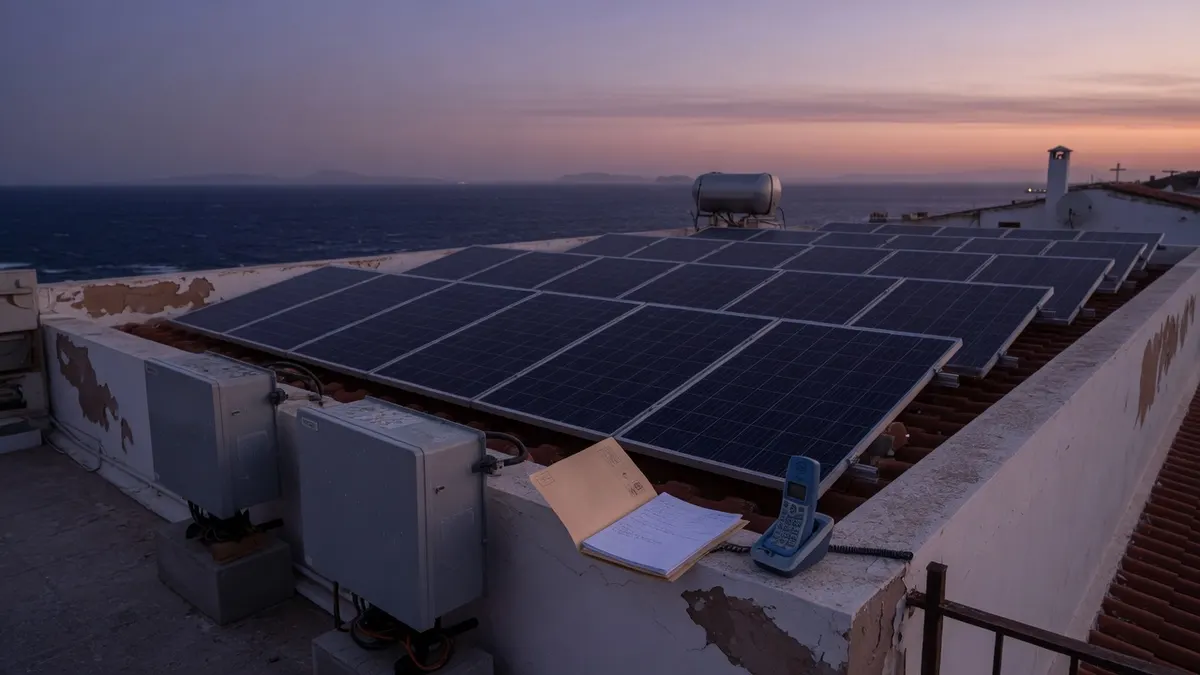
Multilingual phone reception for solar and PV
Quick summary
- A published Greek number already takes English, German, Albanian and Russian in the same March week.
- The assistant hears the language on the first sentence and continues in it. It covers 70+ languages, and it can switch if they mix.
- New array, stopped system or papers is still the first question. A name in English does not tell you the roof type.
- A kilowatt-hour question in German is still a production question. Fluency does not let it invent a figure from a photo.
- The spoken rule does not change: the figure comes after the survey. A photo is not a yield.
- The confirmation SMS goes out in the language of the call, with the roof type and which papers to have ready.
TL;DR
You are on a terrace when an owner rings in English with a photo, or in German from a holiday house. They want a production figure, or a morning for a survey. They will not wait for the colleague who is comfortable in English to come off a parapet. An assistant answers in the language it hears — 70+ languages, and it can switch if they mix Greek and English on the same call. It asks new array, stopped system or papers first, takes the roof and three-phase or not, writes the note or books a morning that is free, and refuses anything that sounds like kilowatt-hours from a photo, a payback, or a connection month. It will not read a Greek grid letter aloud and tell them what it means.
Key takeaways
- Leave language detection on. Pinning the line to Greek is how the 09:40 English photo never reaches you.
- Put the split in every language you actually hear, not only the two you staff.
- Write the callback sentence once and never vary it: the figure comes after the survey. No kilowatt-hours from a photo.
- Do not let it explain a Greek grid letter, name a payback, or quote production because they asked in English.
- Send the SMS in the language of the conversation, with the roof type and the paper list.
- Read the first multilingual transcripts with an installer. That is where a soft production sentence creeps in.
The first word is not Greek
An owner says “do you speak English?” You are on a parapet. The person who would have taken the English call is in a folder. You cannot pick up. They will not wait.
The number they dialled is the one on the van, the window, and the listing a neighbour forwarded. Those pages are in Greek. The caller is not. In a Greek solar shop that is English, German, Albanian and Russian in the same March week, and often more than one of those before lunch.
Thirty seconds of hold, or a promise that someone who speaks English will ring back, is enough. They hang up and dial the next installer. An owner who wants a figure from a photo this afternoon will not wait. A holiday-house buyer will not wait either.
The assistant hears the first sentence and stays in that language. It covers 70+ languages. If they start in English and drop into Greek for the street name, it can switch. The split does not change. The no-figure sentence does not change.
A roof does not have a nationality
New array, stopped system, papers. Terrace or tiles. Three-phase or not. Those words arrive in whatever language they speak. A German owner will say Dach or send a picture of tiles. An English buyer will say “the flat roof over the living room”. An Albanian manager will name the block and not the supply. The assistant still asks.
A name in English is not a roof type. A coastal postcode is not three-phase. If the assistant skips the question because the call is hard, you send a terrace morning to a tiled roof, and the owner decides you do not know the house.
Write the split in the languages you actually hear. Not as a brochure. As the sentence an installer would say on that phone.
A figure in English is still a figure
Fluency is how the bad sentence arrives. They have a photo. They ask, slowly, how many kilowatt-hours. The kind answer is a range. That answer is a number the shop now owns.
The assistant refuses in their language. Not with a lecture. With the same short line: the figure comes after the survey. A photo does not show the roof.
If they send a Greek grid letter, that is still not a connection date. The assistant does not read the stamp into English approval. It takes the letter as a note for you.
Burning or smoke stay a transfer in every language. Do not let a mixed call drop those onto an evening list because the Greek words did not arrive cleanly.
Holiday houses, coastal roofs, March arrivals
A lot of the English and German on this line is not a tenant in Athens. It is an owner who arrived on Friday to a house that has been shut since October, or a buyer who wants panels before the season. The inverter may be red. The papers may be in a drawer. They want a number, a connection month, and someone this week.
The assistant takes the split, the address, whether anyone is at the house now, and whether they sent a photo. It does not promise a coastal survey from a van that is on an Athens terrace. Come-now is yours, and rare. This is still a lead.
Holiday houses in August are the other language burst. Mark August. Do not let the assistant book a March-style survey into a week when the shop is on the other coast.
What the SMS has to do
The text goes out in the language of the call. Split. Roof. Window. Which papers. The line that nobody will quote kilowatt-hours from the photo before you arrive.
A Greek SMS to a German owner is how they miss the window and leave the stairwell key with a neighbour who is not there. A correct SMS still does not promise that the installer on the roof will speak German unless you marked that person.
What you set first
Leave detection on. Write the split and the no-figure sentence so they exist in every language the shop hears. Mark who can take an English or German survey. Route burning and smoke to a phone regardless of language.
Then sit with the first twenty transcripts that were not in Greek. That is where a kind production range creeps in, because the caller asked slowly and the photo was in the way.
Rates live on the pricing section of the home page. They are not repeated here.
Addresses mix, roofs do not
A caller will give the village in English and the street in Greek, or the other way around. The assistant writes both down. It does not tidy the street into a language the book prefers and lose the number of the house.
Do not let it invent a Greek roof type from an English description of “the flat one over the pool”. The look of the photo is a note. Terrace or tiles is a question they still have to answer. Three-phase is a question they still have to answer.
What a good multilingual call sounds like
They open in their language. The assistant stays there. Split. Roof. Three-phase or not. Address. Then a morning that exists, or a ring to you. Then the refusal of the figure, in the same language, without a table.
There is no English walkthrough of a Greek grid letter. There is no German payback for an array nobody has measured. There is no “twenty minutes” offered because the owner drove from Munich and sounds urgent.
If the assistant is fluent and still quotes kilowatt-hours from the photo, you own that number in their language. Put the person who rang about the terrace at 09:40 on a survey, not on the next shop’s pad, and send the SMS in the words they used.
AI receptionist, in-house staff, or a call centre
| CITT | In-house | Call centre | |
|---|---|---|---|
| Answers in the caller's language | 70+ languages, heard on the line | One or two | Whatever was staffed |
| Switches mid-call | Yes | Rarely | Transfer, if someone exists |
| Asks new array, stopped system or papers first | Same question in every language | If they remember | Often jumps to what morning |
| Quotes kWh because they asked in English | Never — the figure comes after the survey | Tempted to | Tempted to |
| SMS in the language of the call | Yes | If they type it | Sometimes |
| Transcript the installer can use | Caller's words, language noted | A paraphrase | A short note, often in Greek |
What a month of unanswered English photos costs a small shop
Worked from these assumptions — change any of them and the answer changes:
- About 80 inbound calls a month in the survey season, two people.
- This example treats 12 of those as callers who open in a language nobody in the shop speaks in that hour.
- Of those 12, 6 hang up, or ask to be called back by someone who speaks English and then do not answer.
- 3 of the 6 were new-array leads — a foreign owner, or a resident who sent a terrace photo.
- A survey that becomes a signed array is worth about €2,400 of margin — put your own figure in, not ours.
- This example treats 1 of those 3 as a lost signed array.
- 1 signed array never reaches an installer, because the first half-minute had no shared language.
- 1 × €2,400 = €2,400 of margin in one month.
- Over the six busier months — 6 × €2,400.
About €14,400 a season, from the first sentence of the call, on that conversion. Change it.
What it costs
CITT is pay as you go: no packages, no minimum, no contract. The current rates — the monthly fee per number and the per-minute rate — are on the pricing section of the home page, which is the only place they are published.
Frequently asked questions
Do we have to set up each language ourselves?
No. The assistant recognises the language from the first sentence and continues in it, including switching mid-call if the caller changes. What you set are the facts of the shop — new array, stopped system or papers, the no-figure sentence, the callback, which papers to bring — so those facts are there whatever language arrived.
Can it explain a Greek grid letter to someone who does not read Greek?
No, and you should refuse any system that will try. Explaining what a stamp, a missing plan, or a connection date means is a decision, even when the motive is kindness. It records that the caller has a letter, books a drop or flags a callback, and tells them to bring or send it. The installer reads it.
What if the caller mixes Greek and another language?
That is common on this line, especially with addresses and three-phase. The assistant can switch mid-call. The split and the no-figure sentence stay in force in both languages. A mixed call is not a reason to drop the rule.
Will the SMS go out in Greek to someone who spoke English?
It should go out in the language of the conversation. That is a setting, not a hope. A survey confirmation in the wrong language is how a first lead misses the window and decides the shop cannot handle them.
Does an answer in English mean the survey will be in English?
No. Reception in 70+ languages is not a roof conversation in 70+ languages, and it is not a promise that the installer on the terrace will work in English unless you have marked a person who can do that. It gets the caller to a morning they can book. The survey is still yours. If only one person can take it in English, the assistant offers mornings from that person's book.
Is the transcript usable if the call was not in Greek?
You get the caller's words, a summary, and a note of the language. That is more usable than a Greek paraphrase written from memory between two other roofs. An installer who needs a full written translation of a long call still commissions one. They are not starting from nothing.