Missed calls in a real estate agency

Quick summary
- Both of you are in someone else's hallway with the keys. The number on the listing is ringing on an empty desk.
- The person who just opened the two-bed hangs up at the beep and taps the next agency on the same screen.
- After six and Saturday morning are when a buyer can actually talk, and when neither of you is at the desk.
- Vendors leave a message. Portal callers do not. If you judge the week by the tape, you staff for the wrong people.
- The assistant answers, asks buy, rent or sell, writes down area, budget and size, and does not invent a price or that a listing is still available.
- Pull unanswered calls by hour from the provider before you change the forwarding rule. Most two-agent offices have never asked for that log.
TL;DR
Saturday morning both of you have the keys. The number on the listing is ringing on an empty desk or in a bag. The person who just opened the two-bed will not leave a message; they will tap the next agency on the same screen. After six it is the same story: a buyer who can actually talk, and nobody at the desk. The assistant answers, asks buy, rent or sell, writes down area, budget and size, and either books a viewing when the calendar is free or takes a request. It will not invent an asking price or say a property is still available unless your own listing file says so.
Key takeaways
- Ask the provider for unanswered calls by hour. Look at the evening block and Saturday morning on their own.
- Do not judge the week by the tape. The people who ask if the flat is still available leave nothing.
- Forward after a short delay so an agent who is actually at the desk still takes the call.
- Tag new buyer, new tenant and vendor separately. They are not the same unanswered call.
- Send vendor and offer calls to a named mobile the same evening. Do not park them in Monday's digest.
- Pull the same log after four weeks. If Saturday morning and the evening block have not dropped, the forwarding rule is wrong.
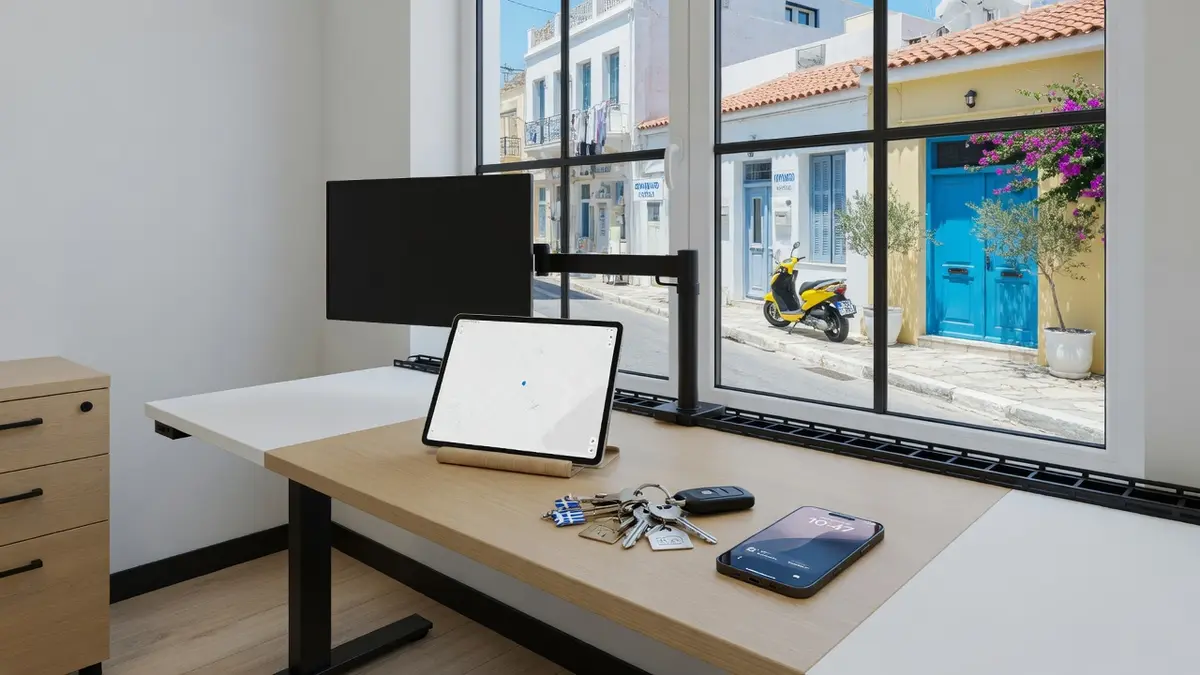
Nobody can pick up. Both of you have the keys.
Saturday, 10:40. One of you is still in the first hallway of the day, a third-floor walk-up in Ampelokipi, with a couple who asked to see the storage and have not finished. The other is already in the car, keys for a Glyfada maisonette on the passenger seat, noon viewing after that. The number printed on the listing, the window card and the Google profile starts ringing. Nobody can pick up.
The caller opened the two-bed twenty minutes ago. Saturday late morning is free. Three cards came back for the same postcode. They did not search for your firm. They searched for a two-bedroom. The agent who answers keeps the viewing. The one who does not is closed, as far as they are concerned.
That is a normal Saturday in a two-agent office in Greece. After work and on Sunday the same thing happens: both of you are in someone else’s hallway, or driving with the mobile in a bag. A vendor who has decided to sell rings on a Sunday evening. A couple relocating from Munich rings at 20:30 Greek time. By the time you play the tape, another agency has booked Saturday on a comparable flat.
You already measure viewings, offers and signed mandates. The thing you usually cannot see is the person who tapped the telephone icon at 20:37, listened to four rings, and went back to the search. That caller is in the telephony log, which nobody in the office has ever asked to see.
The person who hangs up at the beep
Not every unanswered call costs the same.
The caller who leaves a message is often a vendor, or a tenant already in a property of yours, or someone who has dealt with the firm before. These are the ones you hear on Monday. These are the ones that shape the story of “we don’t miss much”.
The caller who asks if the flat is still available, and hangs up at the beep, is the portal tap. They have your card and two others. They wanted a yes and a Saturday time. A beep is, to them, a no. They are gone before you are back in the car.
Then a new listing goes live, or a portal pushes a price drop, and five people tap the number in twelve minutes. One of you is already in a hallway. Callers two to five hear engaged, or they hear ringing that nobody will take. A second mobile does not answer the third call.
Then the caller who has already tried twice. They are not in this week’s log as a new miss. They have decided you are the agency that does not answer, and they will not try a third time when the next flat comes up. Inbound volume can drift down for a season without anyone naming a cause.
After six, and Saturday morning
Look at the log by hour before you look at it by day. You will find the unanswered calls in two windows: the first evening block after people leave work, and Saturday morning once both sets of keys have left the office.
Monday at 10:30 often looks fine. Someone is at the desk. The people who can actually buy or rent are not free at 10:30 on a Monday. They are free after six, and they are free on Saturday. Those hours are also when you are standing in someone else’s hallway.
“We answer during office hours” answers the people who already know you — a key collection, a contract question, a tenant who needs the plumber. The person who just saw the listing rings when they themselves can talk.
You lose a person and a Saturday on that street
If you miss “is the Patission third-floor still available”, you have not only lost a caller. You have lost the Saturday viewing on that address, or on the comparable one the next agency will show. The next card on the same screen gets the person who can come this weekend. Your vendor, if they hear that people cannot get through, starts taking viewings themselves, or they give the keys to the office in the same building. None of that shows up as a cancelled appointment. It shows up, months later, as a thinner instruction book and a story about the market.
If you hold an exclusive mandate, the vendor’s cousin rings Saturday and nobody picks up. The vendor hears that their only agency does not answer on the number printed under their own flat. A shared listing at least has another office that might pick up.
The portal form is the other trap. You tell yourselves the form is the real channel and the phone is for existing clients. Then you look at which viewings actually completed and find that a large share of them started with a tap on the number. The people willing to type a name into a form will wait. The people who tap the number will not.
Count unanswered calls on the number that is actually printed on the listing. If the portal shows one number and the Google profile shows another, you will count the wrong line.
The phone is in the bag
A delay of fifteen seconds assumes someone can hear the ring and choose. At a viewing the phone is often in a bag, on silent, or on a kitchen counter the vendor asked you not to touch. Fifteen seconds pass. Thirty. The call is already gone, or it has already bounced, before you even know it happened.
If the published number is a mobile that travels to viewings, a long delay just sends the caller to the beep. A short delay — or an immediate forward when the calendar says that agent is out — is how the assistant actually sees the call. The agent who is genuinely at the desk, on a day they are not showing, can still pick up if you keep a desk number in the chain. Most two-agent offices do not have that. They print one number on every card. Set the delay for a phone that is in a bag at a viewing.
Someone standing on the pavement rings the number on the window card. They can see the lights are off. They still want to know if the two-bed on the card is free Saturday. That call is the same call as the portal tap. Do not send them to the beep because the office looks closed.
Five at once, then one at 20:05
You talk about missed calls as if they were spread through the day. They are not. A new listing goes live and five people tap the number in the same quarter of an hour. One of you is already pointing at a kitchen. Callers two to five hear engaged. The assistant takes every call: buy, rent or sell, area, budget and size, and a viewing request. Confirming the listing five times from memory is how you book five Saturdays on a flat that had one set of keys.
Then 19:10, 20:05, 21:40. One caller at a time, each with time to talk, each looking at two other agencies. The person who would answer is eating, or showing a last flat, or has put the work phone in a drawer. The assistant stays on the number and asks the same questions. It does not say someone will call in the morning if a Saturday time is actually free and the file is live.
If you only staff for the evening callers, the five who tap the new listing still go unanswered. If you only think about those five, the evening callers still tap the next card. Pull the log as two pictures, not one weekly total.
A vendor leaves a message. A buyer does not.
Vendors leave messages. Buyers who just saw a listing do not. If you judge the week by the tape, you will conclude that the missed call is a landlord wanting an update, and you will staff for that. You will then miss the five people who wanted her flat.
Keep vendor messages. Return them. Do not let them be the measure. The measure is unanswered calls in the evening block and on Saturday morning, tagged as new buyer or new tenant. If that number is high and the tape is mostly existing landlords, you are not seeing where the money went.
A vendor calling about their own flat does not want to be asked their budget. They want a named agent, or a valuation visit, or a straight answer about an offer that was supposedly coming Friday. If that call sits in Monday’s digest, they have already waited the weekend.
Answer. Do not invent.
Answering is not enough if the answer is a guess. The missed-call problem tempts people to put something — anything — on the line so the caller stays. That is how an agency ends up confirming a let flat, or quoting last week’s asking price, at 21:00, with nobody in the building.
Answer so the caller does not tap the next card. Ask buy, rent or sell on the first exchange. Write down area, budget and size, plus the listing they named if they named one. Do not tell them it is available. Do not give a figure that is not in the file. Offer a viewing only if the calendar has a time that is actually free, and treat that time as a request against an unconfirmed listing unless the file is live in front of the assistant.
A caller who heard “I cannot confirm that flat from here, but I have your budget and a Saturday request, and an agent will close it” is still on your books. A caller who heard “yes, eleven-thirty, it is available, it is nine hundred” and then met a locked door is a Saturday you spend apologising.
Someone rings at 21:00 and says they will take the Patission flat at the asking price, or at ten thousand under. If that goes to the beep, they ring the other agency that listed the same street. The assistant writes the words down, reads them back, and sends it to the agent who holds the mandate. It does not accept. It does not counter. The vendor hears the offer from you.
What the transcript is for
It is how an agent who was in a hallway at 11:00 walks into a 14:30 callback already knowing buy or rent, the area, the budget and the size. That is the difference between “sorry I missed you, what were you after” — which is a second cold call — and “you wanted Ampelokipi, rent, around nine hundred, seventy metres, Saturday”. The second sentence is why the caller does not tap the next agency while you are asking them to start again.
If the transcript does not contain those four things, the setup is wrong, even if every call was answered. An answered call that produces “enquired about a flat” is a message with a longer recording.
What you configure first
- The unanswered-by-hour log. Four weeks, evenings and weekends included. Without it you are guessing.
- Forward on no-answer, not always. Fifteen to twenty seconds, shorter if the published number travels to viewings. The agent who can pick up, picks up. The rest hit the assistant.
- Buy, rent or sell, written as a required first question.
- Tags. New buyer, new tenant, vendor, existing tenancy. The weekly summary is useless if those are one pile.
- Vendor and offer calls to a named mobile the same evening. Those do not wait for Monday.
- The two forbidden sentences, in the same words every agent already uses when they are being careful: we do not confirm availability unless the file says so; we do not quote a price that is not written down.
The number on the listing stays yours. One forwarding rule at the provider. Calls an agent takes at the desk never leave the agency. Every line is answered at once. The assistant checks the calendar before it offers a viewing, and confirms by SMS only when the viewing is real.
Then leave it a month and pull the same log. If unanswered calls in the evening block and on Saturday morning have not dropped, you are looking at the forwarding delay, or at a number that is not the one on the portal.
They ring after six, often in English
In a Greek agency, English is how a large share of the people who can actually complete a purchase start. They ring after six, often from another time zone, often looking at two other English-language cards on the same portal. German, French, Russian and Albanian turn up in the same week. If nobody picks up, they do not leave a message in a language they are not sure you speak. They tap the next card.
The assistant picks up the language from the first sentence and stays in it, including if the caller switches mid-call. Seventy-plus languages. Write down furnished or not, a metro stop, a date they land. Do not invent a flat that matches.
Before the first live day
Write down which mobile gets a vendor call and an offer after six. Write down the sentence for a listing you cannot confirm, and the sentence for a price that is not on the file. After four Saturdays, pull the same log. If the evening block and Saturday morning have not dropped, fix the forwarding rule, or check that the assistant is on the number printed on the listing.
AI receptionist, in-house staff, or a call centre
| CITT | In-house | Call centre | |
|---|---|---|---|
| Answers while both of you are at a viewing | Yes | Only whoever stayed behind | Yes |
| Five people tap a new listing at once | All of them | One | Depends who is on |
| Writes area, budget and size | On every new enquiry | If they have a pad | A short message, sometimes |
| Says a flat is still available | Only if the file says so | From memory, often | From a sheet that may be yesterday's |
| Saturday morning, both sets of keys are out | Same as a Tuesday | Nobody — both of you are out | At a surcharge |
| After six, a buyer just opened the portal | Same as any other hour | No | At a surcharge |
| Quotes an asking price that is not in the file | Never — callback | Sometimes from memory | Risk, if the sheet is stale |
What the Saturday tape does not show
Worked from these assumptions — change any of them and the answer changes:
- Two agents, both out on viewings from 10:00 to 13:00 on a typical Saturday.
- 17 inbound calls in that window. Four are reached on a mobile between addresses.
- Of the 13 unanswered, 3 leave a message and 10 leave nothing.
- 6 of those 10 silent calls were "is this still available" or a first viewing request.
- A completed rental instruction is worth about €800 in this example — put your own average in before you trust the total.
- This example assumes 1 of those 6 silent enquiries would have become an instruction. Lower it if your conversion is weaker.
- The tape on Saturday afternoon shows 3 people. That is the number the office believes.
- The provider's log shows 13 unanswered. The other 10 are the ones nobody counted.
- 6 of the 10 were listing enquiries. If 1 would have completed as a rental, the morning is €800 that never entered the books.
- Saturday mornings × 46 weeks — 46 × €800. Put your own weeks in if you close in August.
About €36,800 a year that the tape will never report — and only on the conversion you just chose to believe. Change it.
What it costs
CITT is pay as you go: no packages, no minimum, no contract. The current rates — the monthly fee per number and the per-minute rate — are on the pricing section of the home page, which is the only place they are published.
Frequently asked questions
How do we find out how many calls we actually miss?
Ask the telephony provider for unanswered calls by hour, including evenings and weekends, for the last four weeks. Most two-agent offices have never requested it. The figure is usually much larger than the pile of messages, because a caller who just tapped a listing hangs up at the beep and taps the next card.
Would a better mobile for every agent not fix this?
It fixes the call that arrives while they are walking back to the car. It does not fix the call that arrives in a vendor's sitting room, or the three that arrive together when a new listing goes up. One person still has one pair of hands.
Does the portal form not catch them?
Some of them. The people willing to type a name into a form are not the same people who tap the number because they want to know, right now, whether they can see the flat on Saturday. Those two groups overlap less than agencies hope. The form also does not ask buy, rent or sell in a way you can trust.
What happens to the calls we do pick up?
Nothing, and nothing is charged. The forwarding rule only sends a call on when it has rung unanswered for the seconds you set. An agent who answers at the desk, or who steps out of a hallway and picks up, keeps that conversation.
Will a buyer know they are not speaking to an agent?
They will know they got an answer. The assistant introduces itself the way you configure — most agencies put the firm name in the greeting and do not pretend the voice is a named negotiator. If asked directly, it says it is an assistant. What buyers punish is the ring-out, not the honesty.
How soon can we tell whether anything changed?
Four weeks, against the same unanswered-by-hour log you pulled at the start. Measure unanswered calls, not calls the assistant handled. A dashboard full of handled calls can hide a forwarding rule that is still dropping Saturday morning.