Multilingual receptionist for a Greek pharmacy
Quick summary
- August, and an ordinary Saturday: the line starts in English, German, or Albanian while you are sealing a bag.
- They still want three things: a named box, the hours including the midday close, and whether you are on duty tonight.
- A foreign brand name stays in their words. The assistant does not turn it into another tin.
- A cough in English is still not a box. The ban on advice, a dose, and a substitute holds in every language.
- Hours and today's duty are repeated as you entered them, then texted in the language of the call.
- Fluency does not let it invent stock, invent the next green cross, or say an e-prescription is ready.
TL;DR
The queue is at the glass. You are matching a script to a box. The phone starts in English. They want a named tin they bought at home, the hours — they do not know you close at midday — or whether your green cross is the one still lit. The person at the till has Greek and some English, and cannot leave the counter. An assistant that recognises the language from the first sentence repeats the hours you entered, says today's duty, and confirms a box only if that box is on the list. It works in 70+ languages. It still will not give a dose, name a substitute, or pick a tin from a symptom. The SMS follows the language of the call.
Key takeaways
- Treat the caller's language as the working language on the number on the door, not a transfer if they sound foreign.
- Keep the same first split in every language: stock, hours, duty, pickup, or a question it must not answer.
- Repeat the bans in every language you hear: no advice, no dose, no substitute, no invented stock, no invented next shop.
- Write the midday close and today's duty as finished sentences, then let the SMS go out in the language of the call.
- Keep a foreign brand name in their words. A person matches it to the shelf. A guessed Greek tin is a wrong yes.
- Call in yourself, in each language you care about, and ask for a substitute before the first August Saturday.
The counter in August, and a call that starts in English
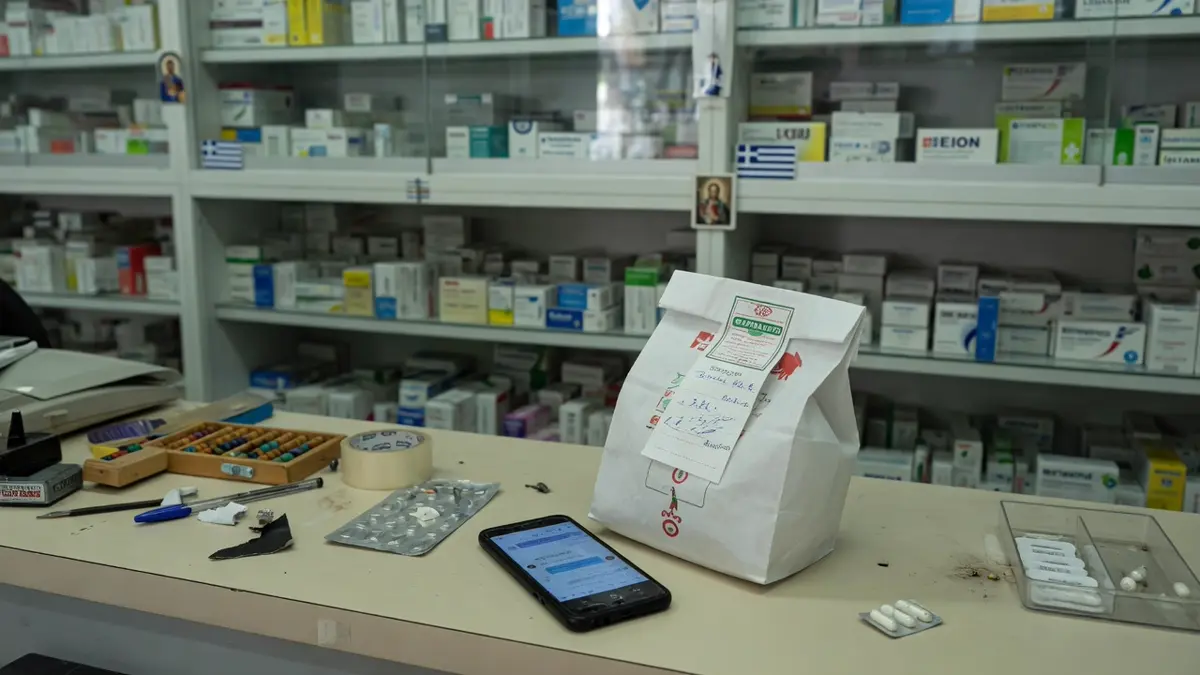
Ten past seven in August, or an ordinary Saturday morning. The queue is at the glass. You are matching an e-prescription to a box. The phone starts in English.
They want the tin they bought at home. They want to know if you are open — they do not know you close at midday. They want to know if the green cross is the one still lit tonight. A few describe a cough, or a temperature, and ask what they should take.
The person at the till has Greek and some English. They can finish one of those conversations if they have the language. They cannot leave the people at the glass. The others hear the ring, or a busy tone, or a beep in Greek.
Some hang up and walk to the next pharmacy. Some hang up and walk to your door at 15:10, find it locked, and do not come back at 17:30. A few stay on long enough to ask for a substitute in a language the till only half has, and someone guesses a tin.
What does not get done on that first call is a named item that leaves someone else’s drawer, a tourist at a locked door, and a symptom that became a guessed box.
What fails when the till has two languages
The volume is still stock, hours, duty, pickup, a question the assistant must not answer. Whether the person at the counter can finish the call depends on the language.
A call in a language they only half have takes longer. The queue piles up. They guess the local name from a foreign brand. They say “yes, we are open” at 15:10 because they did not want to explain the midday close in German. They miss that the caller asked about tonight’s duty, not Saturday morning. They hear “cough” and reach for a tin.
A second person at the till who also speaks English still leaves the Albanian caller waiting. Two people still take two calls. The third call is still a ring.
After two, or in the evening if the second person has gone, the same mix rings. A machine that only speaks Greek does not take a stock note in English, and it does not say the two times in German.
The assistant answers every line at once. It recognises the language from the first sentence and continues in it, including if the caller switches. It answers in 70+ languages. It takes the request. It still does not give a dose, still does not name a substitute, and still does not pick a box from a symptom.
Hours and the midday close, in the language they have
A tourist who asks “are you open now?” is on a pavement deciding whether to turn. They do not know the Greek pharmacy week.
You open in the morning. You close in the middle of the day. You open again in the evening. Wednesday afternoon is often dark. Saturday is often morning only. Sunday is duty or nothing. August adds a person who rang in English and has never seen that pattern.
If the till cannot say the two times in their language, they hear “yes” or they hear ringing. “Yes” at 15:10 walks them to a locked door. Ringing walks them to the next shop. Either way they do not come back at 17:30.
The assistant repeats the hours you entered for this day, in the language of the call. It does not smooth them into “we close at eight.” If you close at 14:30 and open again at 17:30, those are the two times it must be able to say. Monday at 09:00 does not tell them whether to turn the car around on Saturday.
The SMS follows the call. A caller who asked in German gets the two times in German. Do not let a Greek text go out to someone who could not read the card on the door.
After you lock the door the same hours still have to be true, in the same languages. A night caller is asking whether to come now.
Tonight’s duty, asked in a language the rota is not written in
A caller at 21:40 in English does not want a time. They want to know if your green cross is the one still lit. On a Sunday in August that is the whole call, and they will not wait for a Greek beep.
If you are on the list tonight, say so, in their language, and say until when. If you are not, say so. Do not send them to the door on a Sunday you are dark. Do not invent the next pharmacy on duty because they asked in English and sounded lost. You do not have that list in your head for every street. Fluency does not create it.
Yesterday’s “we are on duty” left in place is how someone walks across the neighbourhood at midnight for a dark shop. Change today’s line when the rota changes. The spoken sentence has to exist in the languages you actually hear, not only in Greek.
A caller who asks “which pharmacy is on duty in this area?” is asking for a public list you may not have in front of you. The assistant can say whether you are on duty. It cannot name the next door, in any language.
The named tin they bought at home
They name a brand from another country, a size in grams they read off a photo, letters they can see on a box they cannot pronounce. Sometimes they hold the phone to a label in German or French.
The assistant’s job is to keep those words.
If the exact name is on the list you marked, it may confirm that item, in their language, and say the hours. If it is not on the list, it takes the name as they said it, a size if they gave one, and a number. You look at the shelf. A person matches the words to a tin. A guessed local name is a wrong yes. They walk in, stand in your queue, and leave without a bag.
Do not let fluency become a translation into another brand. “We also have…” is a substitute. It is not availability. It is not safer because it was said in English.
Baby formula, a specific cream, a blood-pressure cuff — these are the August calls where a guessed yes wastes their walk. Write the list the way you would for someone who has never opened the back cupboard, including the foreign names you actually keep. If that list is empty, every stock call is a note. That is safer than a fluent guess.
A cough in English is still not a box
“I need something for a cough.” “What is the strongest.” “The baby has a temperature, what do I give.” “I can’t take the white one, what else is there.” Patients will offer those sentences in the language they can manage at seven in the evening.
The answer stays forbidden in every language you hear. A dose is still a dose. A substitute is still a substitute. “Usually people take…” is still advice. Fluency does not turn those into a tin the assistant may name.
The assistant writes the words down, in their words, and puts the note in front of you. It can say you are open. It can say someone will call back. It cannot pick a box from a description.
If they ask “just tell me what is closest”, that is still a substitute. Take the note. Invite them to the counter.
If they describe something that sounds urgent — the phrases you put on a short list — it follows the escalation you wrote. Detection of English does not mean detection of the informal phrase. You have to supply the phrases, in the languages the street actually hears.
Call in yourself. In English, or German, or Albanian, ask for a substitute. If the assistant names a second tin, the list is not finished.
Write that ban as one line in the setup, in each language you care about. Do not type a dose into the notes and expect it to stay quiet in English. If the assistant has the number, it will say the number.
Pickup, AMKA, and a barcode read in another language
Someone wants to know if they can pick up. They have an AMKA, or a barcode, or a name they spell slowly. They are in a car. They do not want to queue if the box is not there.
The assistant takes the name as they said it, the AMKA or the barcode as they read it, and a number. It reads those back, in their language. It does not say the medicine is ready. It does not say the e-prescription has been issued. It does not say there is a bag waiting. That check is yours.
A pickup note is a request. It is not a dispense. Fluency does not let it become one.
“When will my cream be ready?” is a note with a name, not a time the assistant invents in German to sound helpful. You know when the prepared cream is done. The assistant does not.
If a relative is on the line for an older person, take the patient’s name, not only the speaker’s. Do not discuss what they should take through the relative. That is advice, and it is also a question about who may hear the answer. Record that they asked. You decide who is told what.
It does not sit in on the conversation at the glass
A colleague will ask whether the assistant can stay on the line and explain the cream, or tell the parent why this tin and not the other, or interpret while you speak at the counter.
It cannot. That conversation is the pharmacist’s. The assistant takes clerical requests and the facts you entered — hours, duty, stock on the list. You speak to the person, at the glass or on a callback.
Tell callers it is an assistant. The greeting can use the shop name and still say so, in the language of the call. The assistant will say so if asked.
After you lock the door, and in the languages you hear
The phone still rings if you closed for the midday, or you locked at half past eight, or Sunday you are not on the rota. Configure the closed message in the languages you hear. The assistant can take a stock note for the morning. The hours and the duty still have to be early in the call. The advice ban still holds.
Use a short forward while someone is at the counter, and an immediate forward once the door is locked.
When it books a jab or a measurement — if you book those at all — it checks that the time is free before it offers it. If the calendar cannot be reached, it takes a callback. It confirms by SMS in the language of the call, so someone who cannot read a Greek text does not ring back to ask whether they actually got the 10:20.
A flu jab is still not a stock question. Teach the assistant those types, or it will put the English caller in the first empty time it sees.
The written record
What the caller actually said matters more when the person at the till only half had the language. Keep the verbatim record. “Someone rang about a tin” is not enough. The foreign brand name, in their letters, is what you need when you call back.
A German hours question that was answered as “we are open” will show in the transcript. So will a cough that became a guessed box. Read the first week of August calls in the languages you claimed to cover. You are listening for a second brand, a smoothed midday close, and a duty yes left over from yesterday.
Decide the retention period, test the erasure route, and keep recordings inside the EU, encrypted.
What you set up first
The languages the street actually hears, with a test call in each.
The advice ban in those languages, including “what should I take”, “what is the strongest”, and “what else is there”. Call in and say the phrase.
The midday close and today’s duty as finished sentences, ready to be spoken and texted.
Repeat capture with read-back in the caller’s words, and a clear rule that a foreign name is not turned into a local tin unless that exact name is on the list.
Pickup as a name and an AMKA, never as “ready”, in every language you hear.
A short forward while the counter is staffed, and an immediate forward when the door is locked.
Then listen for a guessed local name, a spoken substitute, and a German hours answer that smoothed the midday close into “we are open.”
Rates live on the pricing section of the home page. They are not repeated here.
AI receptionist, in-house staff, or a call centre
| CITT | In-house | Call centre | |
|---|---|---|---|
| Caller opens in English at 19:10 | Continues in English | Whatever the till speaks | Whatever that shift staffed |
| Named tin in a foreign brand | Kept in their words, list or a note | If they understood the box | Often a guessed local name |
| Midday close, asked in German | The two times you entered | If they have the language | A generic weekday card |
| Cough, in any language | Note for the pharmacist — no box | The pharmacist decides | Not permitted, or they improvise |
| Next duty pharmacy, asked in English | Only whether you are on duty | If they know tonight's rota | Often guesses from a printed list |
| SMS after the call | Hours, duty, or a pickup note, same language | If someone types it | Rarely |
| Languages | 70+ | One or two | Whatever was staffed |
What an English stock call the till cannot finish costs August
Worked from these assumptions — change any of them and the answer changes:
- In August about 8 inbound calls a day arrive in a language the person at the till cannot finish. Put your own count in.
- Of those 8, 5 are hours, a named tin, or tonight's duty — short facts that should finish on the telephone.
- This example assumes 2 of the 5 hang up and buy the tin on the next street, or walk to a locked door at midday.
- A typical named-item sale is about €18 — YOUR figure will differ, and this is the number to change first.
- 2 lost tins a day × €18 = €36 of that day's counter.
- Six selling days a week in August — 6 × €36.
- Six weeks of August — 6 × 6 × €36.
About €1,296 from one August, from calls the till could not finish in the language they started in. Change the count and the price.
What it costs
CITT is pay as you go: no packages, no minimum, no contract. The current rates — the monthly fee per number and the per-minute rate — are on the pricing section of the home page, which is the only place they are published.
Frequently asked questions
Which languages will it actually use?
70+ languages, taken from the first sentence, including the ones a street pharmacy hears in a single week — Greek, English, German, Albanian, French, Italian — without asking the caller to pick from a menu. If the caller switches mid-sentence, it follows. Detection is not a medicine vocabulary. You still have to write the advice ban in the languages you care about.
Can it look up the Greek box from a foreign brand name?
It must not invent a local name. It records the phrase, any size they gave, and a number, reads that back in their language, and puts it in front of whoever can see the shelf. A guessed tin is worse than an unfinished call. If the exact name is on your list, it may confirm that item. Nothing else.
What if they ask what to take for a cough, in English?
That is still medicine advice. The assistant writes the words down for the pharmacist. It can say you are open and that someone will call back. It cannot pick a box from a description, in any language. “What is the strongest” and “the baby has a temperature” are the same refusal.
Will it tell a tourist which pharmacy is on duty nearby?
It can say whether you are on duty tonight, and until when, in their language. It cannot name the next green cross. You do not have that list in your head for every street, and a fluent sentence does not create it.
What language is the hours SMS?
The language of the conversation. A caller who asked in German whether you close at midday gets the two times in German. Do not let a Greek text go out to someone who could not read the door. A pickup note follows the same rule. A dose does not go in the text, in any language.
Can it stay on the line and interpret at the counter?
No. The assistant finishes the telephone call. A conversation at the glass about what to take is the pharmacist's. Speaking the language on the phone is not consent to stand in on that conversation.