Multilingual phone reception for diagnostic labs
Quick summary
- A published Greek number already takes English, German, Albanian and Russian in the same week.
- The assistant hears the language on the first sentence and continues in it. It covers 70+ languages, and it can switch if they mix.
- Draw, results or named test is still the first question. A name in English does not tell you which job it is.
- A results question in German is still a results question. Fluency does not let it say a value is normal.
- The spoken rule does not change: someone from the lab will call. The doctor interprets.
- The confirmation SMS goes out in the language of the call, with only the preparation you marked.
TL;DR
You are labelling a tube when a patient rings in English for a 07:40 chair, or in German about yesterday's TSH. They want a draw booked, or they want a number. They will not wait for the colleague who is comfortable in English to come off a chair. An assistant answers in the language it hears — 70+ languages, and it can switch if they mix Greek and English on the same call. It asks draw, results or named test first, takes the name, books a slot that is free, takes the doctor's name if offered, and refuses anything that sounds like interpretation, a diagnosis, or an invented fasting rule. It will not read a Greek printout aloud and tell them what it means.
Key takeaways
- Leave language detection on. Pinning the line to Greek is how the 07:20 English draw never reaches you.
- Put the three-way question in every language you actually hear, not only the two you staff.
- Write the results sentence once and never vary it: someone from the lab will call. It does not read a number.
- Do not let it explain a Greek report, name a fasting rule, or say “normal” because they asked in English.
- Send the SMS in the language of the conversation, with only the listed preparation.
- Read the first multilingual transcripts with the hatch. That is where a soft “it's fine” creeps in.
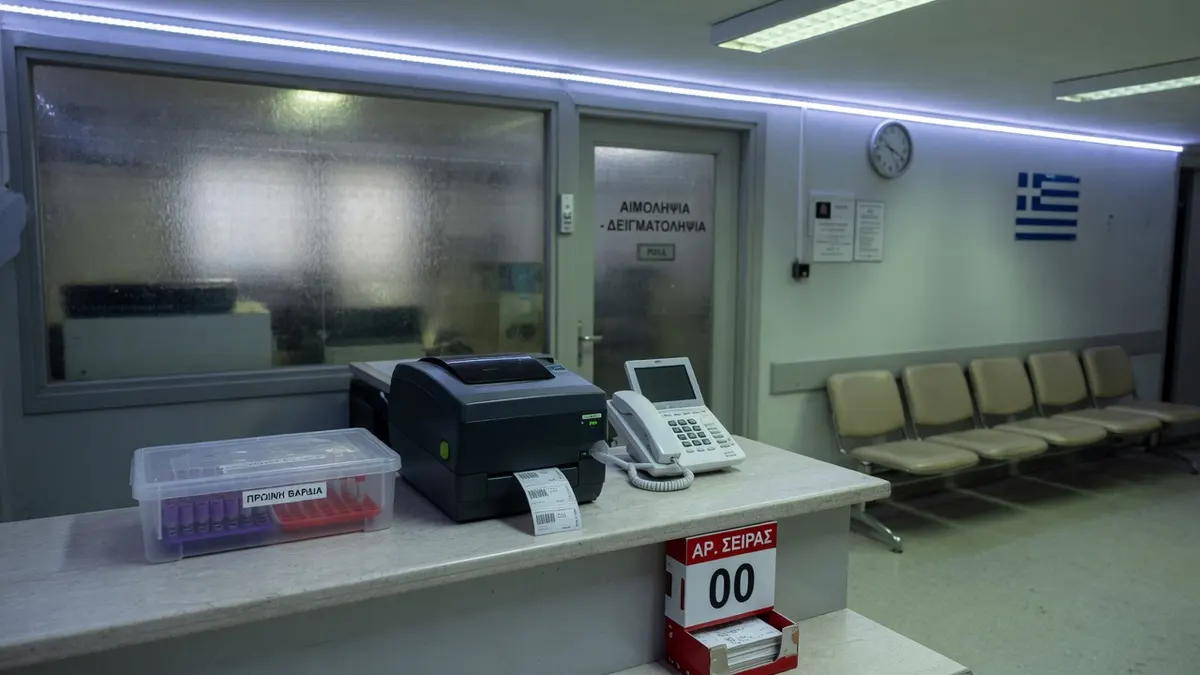
The door is Greek. The patient is not.
The slip is in Greek. The listing is in Greek. The patient who found you on a map starts in English, or the tourist only has German, or the carer on the line has Albanian. That is a normal week in a city lab, not a special event.
You are in a vein. The person who could continue in English is already on a chair. The call does not wait for a colleague. It waits for a busy tone, then it walks to the next door that sounded international.
An assistant that hears the first sentence and stays in that language is how those calls become a chair instead of a short ring. 70+ languages. It can switch if they mix.
Staying in English does not change what the call is allowed to do.
The three-way split in every language you actually hear
Draw. Results. Named test. Then the name. Then the doctor’s name if they offer it.
Write those questions in the languages that already appear on your pad: Greek, English, German, Albanian, Russian, at least. If you only write them in Greek, the English call will be asked “τι ώρα θέλετε;” and you will get a time without a job.
A name in English does not tell you whether this is a chair or a number. “Anna” is not a category.
If they mix — Greek for the AMKA, English for the question — the assistant follows. The SMS follows the language they settled in.
Fluency is not a licence to say “normal”
This is the sentence that goes wrong in a second language.
A patient asks, in English, if the TSH is fine. The hatch who wants to be helpful in a language they do not staff will say “it’s normal.” That sentence is a clinical answer in any language.
The rule is the same as in Greek. Someone from the lab will call. The doctor interprets. A results request is a name and a date of birth, not a value.
Do not let a translated kindness become a diagnosis.
Do not translate the printout
Reading a Greek report in English is still reading a result. Summarising it is still interpretation. “The liver bits are okay” is still a clinical sentence.
The assistant does not do that path. Not as a favour to a tourist. Not because they have a plane.
Preparation lines you wrote in that language are different. Those are logistics: water, empty stomach, time. Write them yourself. Do not auto-translate a kit insert on the line.
If you have not written the English fasting line for that named test, the assistant books the chair and flags preparation as unknown. It does not guess coffee.
What the SMS must carry
The time. The type. Only the preparation you marked. In the language of the call.
A patient who booked a glucose in English and receives a Greek blanket “νηστεία” will either eat or not eat for the wrong reason.
Do not put a result on the text. Do not put a range. Do not put the word normal in any language.
If you do not have a preparation line in that language, send the time and say the lab will confirm. Do not machine-translate the kit.
Transcripts you can actually use
You need the name as they said it, the doctor’s name as they said it, the test in their words, and the language noted. A paraphrase into Greek that respells “Keller” without the Latin is how the file misses the referring doctor.
Read the first dozen multilingual transcripts with the hatch. That is where a soft “don’t worry” appears, because the model wanted to comfort in English.
If a cover-the-silence sentence appears, take it out of the notes the assistant is allowed to use. Comfort is not a result.
Monday 07:20, in other languages
English draw calls hang up faster than Greek ones, because those patients already have two doors and a shift, or a flight.
German results calls after a holiday week are often “is it normal?” If the line is pinned to Greek, they hear a busy tone or a language they cannot answer, and then they are at the hatch anyway, asking for a number in public.
Leave detection on. Shorten the ring-time in the fasting window. Do not staff this problem with a hope that “most of them speak Greek.”
What you set first
The languages you actually hear, with the three-way question in each. The results sentence, identical in meaning, written by you in those languages. Speakable preparation, written by you, not invented on the line. SMS in the call’s language. A flag for chest pain that does not depend on Greek.
Then listen to the first week. If an English call was offered a hatch time in a fasting chair, that is a diary problem, not a language problem. If an English call was told the TSH was fine, that is a sentence you did not forbid hard enough.
Rates live on the pricing section of the home page.
AI receptionist, in-house staff, or a call centre
| CITT | In-house | Call centre | |
|---|---|---|---|
| Answers in the caller's language | 70+ languages, heard on the line | One or two | Whatever was staffed |
| Switches mid-call | Yes | Rarely | Transfer, if someone exists |
| Asks draw, results or named test first | Same question in every language | If they remember | Often jumps to what time |
| Says a value is normal because they asked in English | Never — someone from the lab will call | Tempted to | Tempted to |
| SMS in the language of the call | Yes | If they type it | Sometimes |
| Transcript the hatch can use | Caller's words, language noted | A paraphrase | A short note, often in Greek |
What a month of unanswered English draw calls costs
Worked from these assumptions — change any of them and the answer changes:
- About 220 inbound calls a month, two people at a city lab.
- This example treats 18 of those as callers who open in a language nobody at the hatch speaks in that hour.
- Of those 18, 8 hang up, or ask to be called back by someone who speaks English and then do not answer.
- Of those 8, 3 were asking for a private draw. "A draw that goes ahead is worth about €35 — put your own figure in."
- 8 multilingual calls reach nobody in that month.
- 3 of them were new draws. 3 × €35 = €105 of that month's private work.
- The other 5 still matter: a results question in German is not a fee, it is a number you must not say.
About €105 from three silent draws in languages the hatch did not speak that hour — change the figure.
What it costs
CITT is pay as you go: no packages, no minimum, no contract. The current rates — the monthly fee per number and the per-minute rate — are on the pricing section of the home page, which is the only place they are published.
Frequently asked questions
We only speak Greek at the hatch. Isn't that enough?
It is enough for the patients who already have a ticket. It is not enough for the person who rang in English from a listing, or the tourist who only has German and needs a chair before a flight. Pinning the line to Greek is how those calls become a short ring in the provider's log.
Can it translate the printout into English?
No. A printout is a result. Translating it is still reading it. The assistant does not read a number in any language. It can repeat a speakable preparation line you wrote in that language. If you have not written it, it takes a note.
They mix Greek and English. What then?
It can switch. The split stays the same in both languages: draw, results or named test, then the name. The SMS follows the language they settled in, not the language of the door.
Can it tell an English-speaking patient the TSH is normal?
No. Fluency does not create a clinical licence. “Is it normal?” is still a results request. The assistant takes the name. Someone from the lab calls back.
What about a fasting question in a language we do not staff?
Only a line you wrote in that language for a named test is speakable. An improvised coffee rule in English is still an invented rule. If the test is not on the list, book the chair or flag you.
Will the transcript be in Greek for the file?
You get the caller's words, with the language noted. Do not ask the assistant to “make it Greek” if that means rewriting a doctor's name. The spelling they said is what the file needs. See [pricing](/en/#pricing) for how calls you pick up are treated.